オオカミと白い騎士 Wolves and White Knights

Major Update: This post was written in the winter of 2020. I have just passed through the winter of 2021/2022 almost entirely unscathed. Kept my stride the whole time. I wrote in this post that I would have to live with SAD my whole life. But I have this time around made an incredible discovery, and that is light therapy. By blasting 10000 lux of light into my eyes every morning this winter I was able to get the light that my body needs so desperately in the winter, artificially, and it made a huge difference. I used a product called Luminettes, and would highly recommend them to anyone struggling with SAD, or who just feels that they could use a boost to their energy levels, or struggles with waking up. They have been truly life-changing for me. If you are SAD, do not hesitate to bring light therapy into your life in some form!

For the one seeking redemption for their cursed soul, there is the church. For the one seeking water to cure their parched lips in the waterless desert, there is oasis. And for the one searching for life in the middle of a bleak and desolate winter, there is onsen.

I’ve been in a strange, tense state.
I blame it on the winter.

I’ve been unable to relax, unable to unwind, spending every minute striving, enduring, or otherwise holding myself hostage to a certain strictness, and for what purpose, simply because I can’t find it in myself to have any “wasted time”, since I’m not doing what I want to do, even though I haven’t the slightest idea what I want to do really is. I only have a vague, ceaseless, unyielding dissatisfaction, and my answer to it seems to be spending every ounce of my dissatisfied energy on anything that I could consider to be concretely productive, that I can feel justified about doing, and I’m starting to wonder if perhaps I’m getting some kind of masochistic satisfaction out of denying myself any pleasure, or perhaps I’m just angry that nothing seems to be bringing me pleasure, or satisfaction, or if it would, it’s for the wrong reasons. At any rate, although I haven’t had much fun this winter, I can say that my Japanese, as a consequence of this self-imposed period of monasticism, has improved tremendously.


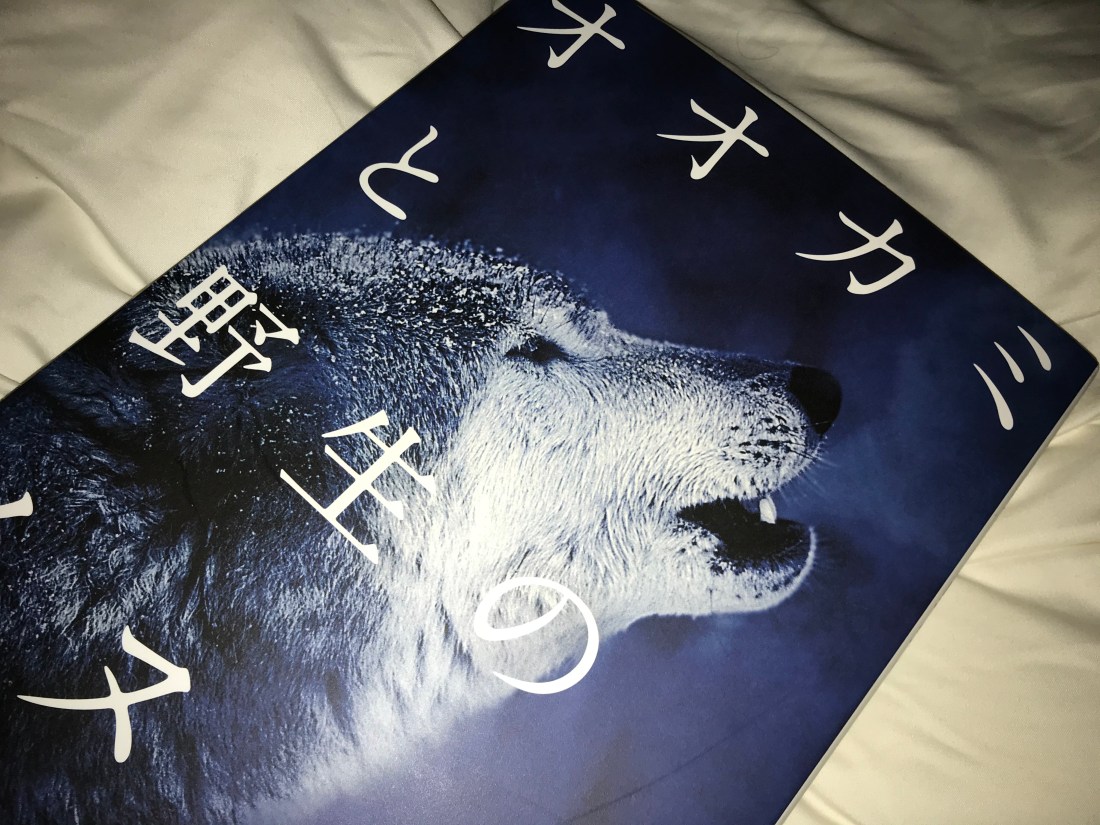
Yesterday, I bought a book, titled “Wolves and Wild Dogs”, replete with full-page graphics of lean, menacing, sharp-toothed hunters, pulling down boars and bulls alike, and I think that what may have drawn me to this book was that there was something in those images, of the shocking, wet white fur of the Arctic wolf, artfully bounding an ice floe, of the matted white and grey, brown-tinged Eurasian wolves, with their piercing gazes, posing boldly out in the frigid tundras and snowscapes, something in them stirred up something in me, and maybe I felt that I too, was like these wolves; gaunt, hungry, hunting.

The alternative to this mindset, for me, may be depression, and that I won’t do.


Again, I blame this on the winter. I have no doubt that I am a fortunate benefactor of that aptly named illness, SAD, seasonal affective disorder. It’s something I’ll never escape, only something that I will learn to live with, considering most places bar the equator have seasons, and one of those seasons will be Winter, that cruel, grey mistress.

If it were possible to do so, I would wholeheartedly like to step into the ring with Winter, and take it down, dominate it, physically express my pent-up disgust and dislike of it, as relief for me, and punishment for it. But Winter I cannot dominate. And Winter I cannot escape. And so, I can only defy.


While Winter is crushing in its oppression, there is yet a place where she holds no power, and that place is the onsen. What everything Winter is, the onsen is her antithesis. It is the only place where one can go to escape the iron chains of chill, the smothering blanket of unyielding and endless grey, the savage spell of flesh-cracking aridity. It is sacred ground, the onsen, and from the minute you step into its domain, you are freed like a citizen of East Germany taking their first step across that dividing line. Winter, be damned! you’re free to declare, as you brazenly strip off your armor, and stride forth, naked, utterly exposed, something that is completely unthinkable, could not be tolerated by the cruel Mistress, but again, this is not her domain, and it must spite her to no end, knowing that all her hard work is being in an instant undone; for the moment one steps into that steaming, sacred bathhouse, one is restored, and the icy grip of Winter’s clawed hand, shattered and melted, dissolved and replaced with a vigorous, shrouded aura of vitality, of life.


It was not in the summer that I understood onsen’s power. For in the summer, one has an altogether different, much inferior enemy, the eternal and omnipotent humidity, and a steaming hot bathhouse doesn’t do much in that battle. But against Winter, onsen is an impregnable fortress, one that the enemy, try with all her might, cannot take, one that undoubtedly frustrates and infuriates her, as her foes, her oppressed subjects, return to it again and again, to be protected and restored, re-equipped and reinvigorated, given new life to continue the fight.

If only I had an onsen closer to me, that I could seek its splendid shelter every night! Were I a wolf, then the feeling that takes hold of me when I walk into that onsen must be akin the feeling a wolf has of securing a hard-won kill. For they are both a matter of freedom from oppressors. Freedom from that sharp, aching, gnawing oppressor, hunger, for the wolf, and freedom from that silent, looming desolation, Winter, for me.


There was one other place, one other time, when I have felt in full defiance, stood in absolute insolence of Winter. On top of a mountain, fully equipped for battle, with a slicing whirlwind whipping about me, blasting my eyes and howling my ears, with the monochrome palette of white earth, black rock, and grey void before me, I could then shout, Winter, you are nothing to me. And in that moment, it was absolute truth. I could look her right in the face and lay down a direct challenge, and take a resolute stand; I could fight, on my own terms, a direct fight. I could step into the ring with her, for once, or so I felt. But this was me, trying to dictate the terms of our engagement, and Winter smartly declined them. No, we fight on her terms, and it is not a fight that she will have decided by a single, all-forces-mustered mountaintop brawl; it is a fight to be won through endurance, through enduring a series of grinding skirmishes, attempts at gradually whittling, crushing down the main forces into nothingness, occurring over a period of hours, days, weeks, months. Or, like the garrison of a castle town, too strong or too costly to be overpowered, who has found themselves surrounded and under siege, by a vastly superior force, and who has no choice but to endure, to hold out, to send out the messengers and pray that reinforcements come. But unlike many of the answers to the prayers of the inhabitants in a besieged city, reinforcement from Winter is certain. There is no doubt that it will come; the unfailing Spring. Like a thousand glittering steel-clad knights, astride their gallant white horses, coming up over the hill and into full view of all, radiant in the shining sun, Spring will come to strike fear into the heart of the fiend Winter, and recognizing that her attempted conquest is at its end, she will draw off, and the siege will be broken, and the people, liberated.

The white knights are close. I can feel the warmth of their horses’ exhalations in these new, daring, spells of sunlight and warmth. I know their arrival must be soon, I can count it in the passing of the days. The people are ready for liberation! They hold the image, the soon-to-come sight of hooves trampling over the hill, high in their consciousness, lighting a fire in their souls, raising their clenched fists to the sky, crying out, Come, O’ Glorious Knights, Come!

(I am now reading Moby Dick. Clearly Herman is rubbing off on me. It’s a good book. At this moment I would rather be cooped up in the quarters of a whaling ship in the middle of the ocean than in an apartment in Ozu Town. Although as I type that now, I imagine that it’s at least warm and sunny out on the sea – but when Ishmael and his crew embark on their whaling adventure, it’s the middle of winter. Which is quite fitting, isn’t it.)

(This is entirely unrelated, but if you are as blind as I am, do not buy clear glasses. Can’t find them when you set them down.)

(Happy New Year to everyone, we will have a great 2021!)

The Bowl Story – At long last, and fully-baked 茶碗話

From The Future, A Preview: This story is about my buying a bowl from a local noodle shop. I use this bowl every day that I am home. I eat everything out of this bowl. It is a big bowl in my life. This is the story of how I came to acquire this magnificent bowl.

Alright. We’re back.

Yes, it’s finally here. What you’ve all been waiting for. Maybe you thought it would never come. But it’s here. The bowl story.

Let’s go.

Right off the bat, I have to tell you. For this post, I’m trying something new, which is why it feels weird to be calling this a post. I’m writing this post out entirely by hand, instead of typing it out first, as I usually do. I’m doing this because of something that our good man Barack Obama said, when he was talking about how he writes everything out on legal pads (his medium of choice – for me, it’s scrap paper that I’ve accumulated at the school and taken home, failed or overprinted copies of worksheets and whatnot). He writes first, he says, because it helps him to avoid “half-baked thoughts.” That stuck with me, and as I don’t want to be writing half-baked thoughts, and posting half-baked posts, I thought I’d try doing it Obama style, this time. Although, if blog posts are anything like cookies, half-baked may just be best.

Without further ado, then, let’s get into the bowl story.

This story is really about a bowl. I eat out of this bowl every day, usually several times a day. I have four bowls. One I made, two I inherited, and one I bought, and it’s the bought bowl that this story is about.

The story takes places many months ago. It was the day that James, the Ubuyama JET, was leaving Kumamoto. He has since been succeeded by another James, from Australia, who I had met for the first time on Christmas Eve, at our small Christmas party. He’s from the Gold Coast, is allergic to nuts, and raw strawberries, and tomatoes, had never seen snow before coming to Kumamoto, has a different pronunciation for merry, Mary, and marry. He comes from an area of about 800,000, to a town of, what, several thousand at most. His new house is surrounded by trees, with only two neighboring houses, where the school administrators stay when they don’t want to go back to their real homes. His closest grocery store is about 20 minutes away. His car has immediately failed him. The engine light came on, and when he got it checked out by a mechanic, the mechanic plugged his computer into the car and said, “Well I’ve never seen this before!” Which is always what you want to hear your mechanic say. He will probably have to buy a new car. So Australian James is having a nice welcome to Kumamoto experience. We did try to give him a proper welcoming, and show him a good time, American Christmas style, and he tried snickerdoodles and cinnamon rolls for the first time. I asked my friend Ryoka chan if she had had cinnamon rolls before and she said, “Yes, of course. Why?” And I told her that my new friend James hadn’t, and she was shocked. Her words: “What? How does this happen?” Which is a great question that I will ask James about the next time I see him – how and why are Australians not eating cinnamon rolls.

At the party, we played a round of rock-paper-scissors. That is, we played the American version. Now, you may be surprised to hear this, but there are other versions of rock-paper-scissors. Other variants. The Japanese have two. They have the Japanese version, which is jyan-ken-pon, and then they have their English version, which is rock-scissors-paper. For me, who’s spent my whole life playing it rock-paper-scissors, who has known nothing else, this just feels wrong. Australian James (I think we’ve found our nickname here. Australian James has a nice ring to it. Like Indiana Jones. Who is known in Japan as Indy Jones. I discovered this when I was telling my classes that I was from Indiana, which unsurprisingly almost no one knows about, because it’s not Texas, New York, Florida, Hawaii, or one of those big cities in California, and when I would say, do you guys know Indiana Jones, they would stare at me blankly, and then I would sing the theme song, and then they would say, “Indy Jones!!”) Australian James taught us yet another way, the Australian way, which is paper-scissors-rock. Somehow this one is more palatable to me. I think I don’t like ending on paper. I’m writing about this because when we told James about the other American version, rock-paper-scissors-shoot! He said, “Yep, that’s just like Americans.”

Annie, Emily, and I were taking American James out to lunch, before his flight to Tokyo. He had taken a new job in Saitama, teaching kindergarteners. This was last April, I believe. Annie gave James a ride to the Kumamoto airport, which is a ten or fifteen minute drive from my place in Ozu, and so we had lunch in Ozu, at a place that Emily’s predecessor (the ALT before Emily, in the JET world we call them predecessors; some people call them ‘preds’, but the first time I heard that I immediately thought, ‘predator’, so it hasn’t really caught on with me) had taken her to before he left. This place is よも麵 (yomomen), a small, unassuming local noodle shop posted up next to the Ozu public library.

Our squad shows up at about 2 pm on a Sunday. We walk in, are greeted, and directed towards to ticket vending machine on our left. This machine is frequently found in noodle shops. They will take your order and your money, and issue a ticket in return, that details your order, that you then give to the staff. I really enjoy these ticket machines. So we turned to this particular ticket machine (I’m now wondering what this thing is actually called in Japanese – I know vending machine is 自動販売機, jidouhanbaiki, or 自販機, jihanki, for short) and started to peruse the menu. At this time, I took it upon myself to read what was written on each of the buttons, and explain the meaning, to my friends, who are all at least as Japanese savvy as I am, James much more so, and so they could quickly point out all my errors. “See here, these are the hot noodles. This means hot. And these are the cold noodles. That means cold. And these are the happiness noodles. This means happine-” “Those are spicy noodles.” And here, in my defense, was a mistake that anyone could have made. The kanji for happiness and spicy are dangerously similar, as is the case with many kanji. Here’s happiness – 幸い、and here’s spicy – 辛い. Tricky, right. And here’s two more tricky ones – 士 (samurai)土 (ground). And then there’s 末 (end) and 未 (not yet). I guess this is what happens when you have tens of thousands of these things. There’s just gonna have to be some trickery.

I do like the idea of happiness noodles and I think someone should be selling them.

So anyways, after reading almost every label on the machine, mainly to myself, as the friends stopped listening awhile ago, it was my turn to order. I had decided that for me, I didn’t need to know what I was ordering – I just needed to know the price. I was incredibly hungry, and so I just wanted max food, and at a noodle place, this means whatever is the most expensive. So I found the most expensive option, all the way down at the bottom right, put in my money, pushed the button, and got my ticket. I handed it to the nice looking store owner, a younger-middle-aged woman, and sat down at the end of the row. And so this was the beginning of what would become an unusually eventful restaurant experience.

It turned out that out of all of the tickets, I should have read mine, because right after sitting down, the woman came up to me and said, hesitatingly, and in good English, “Um.. Excuse me, but, this is takeout. Do you want takeout?” My friends are amused. I look at the ticket, and it says, お持ち帰り, omochikaeri (literally meaning, “take home”. It’s definitely takeout. I tell her that I want to eat in the restaurant, and that I chose this because I was really hungry, and it was the most expensive thing on the menu. She understands, and asks me if I want hot or cold noodles. I think about it for a moment, and tell her, cold. She gives me some money back. She turns and starts to walk away, when I suddenly remember to slip in a, “肉なし、できますか?” Nikunashi, dekimasuka? Can you make it without meat? And she turns to me, in confusion. After a moment, she replies. “But, this is a basashi restaurant..”

I’ve mentioned this before, about how every prefecture, even every town, has a specialty, or multiple specialties. Oita has the toriten that I told you about (the rare chicken), and it has yuzu, a green citrus fruit, and Kumamoto has ikinari dango, and basashi. Among other things. Basashi is horse meat. They eat it raw and they eat it cooked. I’ve had it both ways and cooked is definitely better. Being a specialty, you don’t eat basashi often, and you can’t just get it anywhere. Most people usually only eat it for New Years. It’s a delicacy, you could say. So you can imagine what this woman is thinking, when this guy walks in here, to her specialty basashi restaurant, and tells her, leave out the basashi, and this after ordering the most expensive thing on the menu without reading it, because he’s hungry. Whatever she was thinking in that moment, she had no problem accommodating me, and after confirming that I was fully aware of what I was asking of her, she set off to make it. So, our relationship was already off to a fun start, her and I’s.

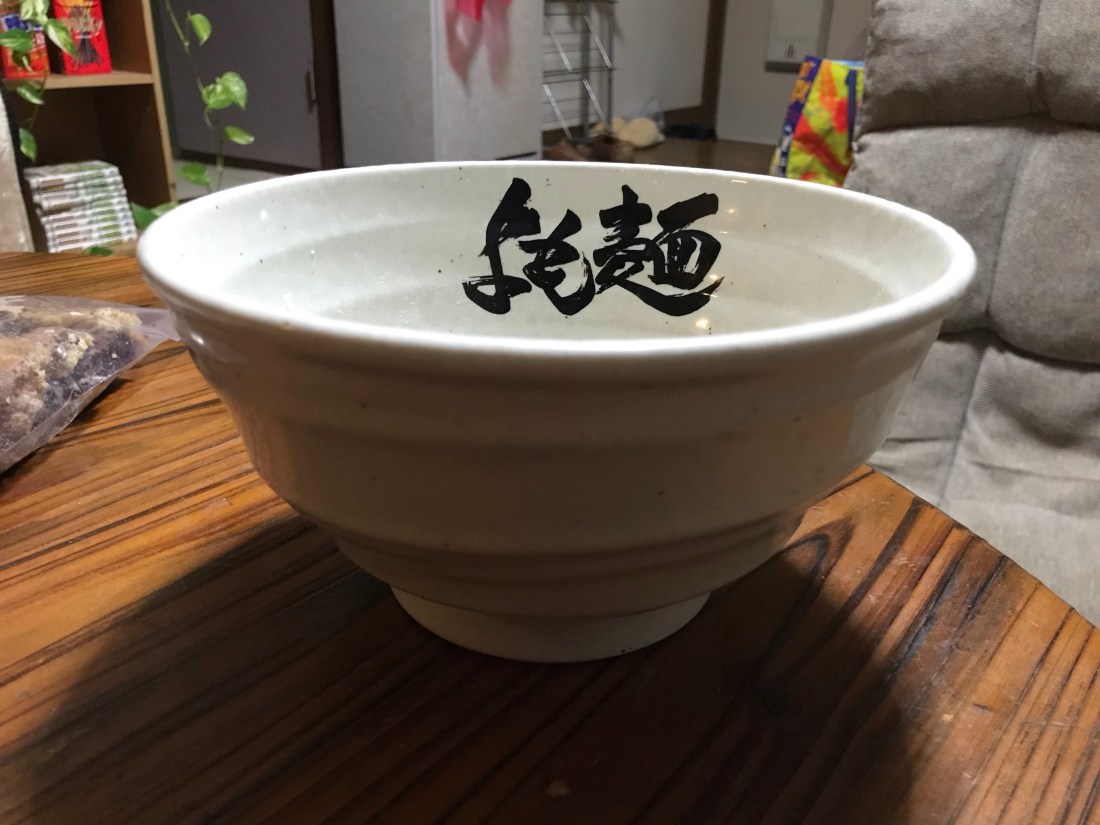
Now my friends and I are sitting, talking, waiting for the food, and after a few minutes, Annie’s bowl comes. I could say that Annie’s noodles came, but in that moment, the noodles were the farthest thing from my mind. What was on my mind, then, was not the noodles, but the bowl, because the second that I had laid eyes on that bowl, I was struck with a thought, and the thought was this – That is a really nice bowl. On reflection, I realized that I have never been struck by a bowl in this way. I wonder if I ever will again. But this bowl, as soon as I saw it, I was aware of it, it’s quality, it’s shape. To me, it looked just like the shell of a conch snail, like the queen conch I had spent some time working with on my study abroad in Belize. It was large and layered and spiraling. It was a nice bowl. And I comment on this to my friends. “That’s a nice bowl!” I say. They look at it, and give some slight nods of agreement, a pretty muted response. As Annie goes in for the first slurp, and I’m still watching it. I say to them, “It looks just like a snail’s shell!” Annie looks at it one more time. “Yeah..!” She says, noncommittally. It’s clear that I’m the only one so moved by this bowl, but it does not frustrate me. I think more about the bowl. How I’ve never felt this way about a bowl. It is a fine piece of craftsmanship. Where did it come from? Custom made? Did they make it themselves? My bowl comes. I then note the size – it’s a sizeable bowl, larger than any of mine. A great size. As I’m eating, I make yet another comment to my friends. “This is such a nice bowl!” And then I added, half-jokingly, “I wonder if they’ll sell it to me!” And Annie replies, “You should try!” And at first, it wasn’t a serious thought, not entirely. But after her response, I realized – I should try. This bowl could be mine, and all I have to do is ask. The shopkeeper must already think I’m somewhat ridiculous. I would only be living up to the first impression I’d created for myself, by straight-up asking her if I could buy this bowl. I have nothing to lose, and a bowl to gain. And so, the next time she walked by, I caught her attention. “Excuse me..” “Yes?” “This is a really nice bowl. I was wondering, uh.. can I buy it?” My friends are now laughing, but I’m not – I’m completely serious. The shopkeeper is unsure what to say. She thinks about it for a moment. “Well, I’ve never sold a bowl before.. and they’re all used. Is that ok?” I reply, “No problem.” She thinks for another second. “Ok,” she says. “Just a moment.” She goes into the back of the store.

I am surprised. It’s farther than I thought I’d get. I turn to my friends. She’s going to sell me the bowl! And now the question is forming in my mind. What will I pay for this bowl? What is my maximum? What can she get me for? I try to come up with a good number, if she asks me for a price. I want the bowl. Clearly, I am moved by it. I am impressed with the quality, the design. I am also not a man who knows anything about pottery or bowl-making, and so I have no idea what the real worth of this bowl is. 1000円?4000円? I can’t tell, but I settle on 2000 being my maximum (that’s about $20), although I probably would go for 2500, if it came to it. If she asks me to give a price, I don’t want to offend her, either. If I go too low, maybe she’ll think I’m not even worthy of having the bowl after all. I’m not trying to rip her off – I want to give her a good price for the bowl. I’m thinking about these things when she comes out from the back and walks over to me. “Ok,” She says. “I have a bowl. It’s used. You’re ok with that?” I say again yes, and then I ask the question. “How much?” Hoping she doesn’t have me name a price. Wondering if I’d really hold to my maximum. She thinks for a moment, then says, tentatively, “Mmm, 500円?” And I couldn’t believe it. “Really?” I said. For that price, I’d buy five, ten of these babies. I almost told her then that I’d pay more for it, and part of me felt like I really should give her more for such a magnificent bowl.. but I said nothing more than an emphatic, “Yes!”

For having never sold a bowl before, she knew how to wrap it. I walked out of there with my new bowl, bubble-wrapped and encased in cardboard, feeling like a brand new man. As we left, I said my many arigatougozaimasu, and promised that I’d be back. Bowl aside, the noodles were incredible. And I’ve since been back, and I made sure to thank her again for the bowl, and to tell her that I use it every day. I think like me she must have a fond memory of that day, because it can’t be often that one of her customers orders takeout without wanting takeout, requests basashi-less noodles, and asks to buy a bowl, all in the same visit. I told Mr. Parker Junior about the bowl, and the story, and when he finally got to see it, I said “What do you think?” And I don’t think he was too impressed with it. But whether it impresses anyone else or not, that doesn’t matter. It will always be a special bowl for me, not just because it is functionally and aesthetically flawless, but because it also has something else, something better: a story.

So, that’s the end of the bowl story. It came out to be about eight pages of fully baked thoughts. I feel like a weight has been lifted off my shoulders. This is a significant moment, an achievement, a milestone in this blog’s history. The day the bowl story was finally told!

I’ve already written so much. I wanted to talk a bit about the clothes. I don’t want to write much now. My hand is cramping. For now, I’ll just say this. I am investigating. This is a complex issue. I’ve since bought a sweater and a pair of pants. Expensive, somewhat. Made in Japan. The pants were 100% cotton. Where does the cotton come from? The sweater was 66% synthetic fiber. On synthetic fibers – 35% of the microplastics in the ocean come from synthetic textiles (according to a report from the International Union for Conservation of Nature). We absorb toxins from these textiles through our skin. Not good stuff. There is a lot to consider. I also bought some secondhand clothes. Did you know that only 10% of the clothing in secondhand stores is sold (as of 2015)? I’m starting to acquire a lot of little facts like this.

Anyways, that’s it for this post. It’s the holidays! Ho ho ho! I should be writing about Japanese Christmas. I can sum this up in a single paragraph. They like Kentucky Christmas (ordering KFC takeout on Christmas). Last Christmas and All I Want For Christmas Is You are the two most popular Christmas songs here. Japanese snowmen have two balls in their body. None of my students know the name of the reindeer with the shiny red nose. They also don’t know that Santa lives in the North Pole, or that he’s married. Most of them don’t know that bad children get coal for Christmas. Some of them know that people give Santa milk and cookies. Some of them know that the toys are made by elves. (When I pose this question to my students, “Who makes the toys for Santa?” I often get the answer, “Small human.”) Only kids get presents, in Japan, and the parents usually put the presents on their pillows, even when they have a Christmas tree. Some people put up lights and decorations on their houses, but not most. They do not know about gingerbread houses or gingerbread cookies. They do know about stockings, and snowball fights. I have told my students that they should get presents for their parents for Christmas, and I don’t think anyone is going to take me up on that suggestion. Home Alone is popular. I guess that’s a Christmas movie? I didn’t know that. I’m not a movie guy. I have surprised more than a few Japanese people by telling them that I haven’t seen Back To The Future.

Ok, this is the end for real. I hope you had a Merry Christmas and are gearing up for a fantastic New Year. Happy Holidays, and unless the hot fire of inspiration strikes me before then, see you in 2021!

Part 2 – The Fall (Destruction of the Back, moving on with life, chilblains, Kappas) 背中の破壊

Howdy ho buckaroos.

I think about you guys. That’s really why I’m writing this post right now. As opposed to say, in a week, or a month from now, when I might finally get around to writing because I feel worked up about something and want to spin another story. But this time, I’m writing because I feel a bit guilty, I suppose, and because with time passing, there will be no difference in the outcome of the post regarding “The Fall,” and so I need to just get on with it. I also think I should stop making you guys so many promises about future stories, but maybe just for my sake it’s a good way to keep me accountable, and not let too much time pass between posts.

So, I promised you a part 2, and here we go! (Don’t ask me about the bowl story, one thing at a time now.)

The Fall. I tried to write about this twice, actually, and each time I sat down and wrote a few hundred words or so, attempting to craft an epic, full of irony and intrigue and life lessons and cultural education and yada yada, and both times it just wasn’t working. And I’ve come to the conclusion that it’s just not going to work, that way, and all that really needs to be said is this: I threw out my back while playing in the sensei handball tournament. And there you go. Throwing out your back sucks. I couldn’t move for two days without going, “Ohhh!!” or “Ah!!!” And the people around me would turn to me in surprise and concern. Almost every sensei I knew was in the building that day, because out of the four schools that I teach at, three were there, and so they all bore witness to my thrown back. The senseis who weren’t there, of course, still found out about it, because someone felt the need to announce it at the all-hands meeting (at least at Shoyo), or they had a spouse who was playing (at Kuroishibaru) and so all day I had teachers who weren’t even at the handball coming up to me and saying, “Your back.. ok?” And finally I asked Nakamura sensei, who is a charming home economics teacher, how did she know about it, and she told me it was announced at their morning meeting, I guess as a heads up, so that no one expected any piggyback rides to class, or wanted to have a quick passing period wrestling match. I was treated very well by all teachers, and I do feel extremely lucky to have such a supportive group of people around me. Everyone was bringing me treats, asking me how I was, telling me their personal remedies for thrown back (in Japanese, ぎっくり腰 (gikkurigoshi, another word I will never forget, like shorui, the special papers), and sympathizing with me. Last year, the handball tournament was a moment of peaking for me, scoring many goals, and having a good time bonding with the teachers, and demonstrating my worth, physically, winning the ganbaru trophy in the end (remember this word?). This year, I spent almost all of it on the floor, shivering, surrounded by small children, who became my good friends, by the end of the day, and I thought, that’s really just fitting given how totally wacky this year has been, compared to my last year. It’s hard to imagine that I’m still in the same place, at the same job, as I was just a year ago, because it feels so different, but I know everyone is going through this, the corona days, and we just deal with it how we do. And going on about the shivering on the floor, the floor was ice cold, I may as well have been laying on a sheet of ice, and I was the only person who was stupid enough to wear shorts that day, which I noticed when we took to the floor to warmup, and I have to admit I felt a little superior, like a, well I’m just strong! type feeling, although it was really just because I only have a single pair of sweatpants and I had run in them several times already, and they were not clean in any way, and so I just thought I’d bear it out in shorts, but that turned out to be the wrong move, as I spent the rest of this day on an ice cold floor. And with each shiver, I would groan with pain. And for the next several days, the moment before every sneeze was a moment of terror, and the sneeze itself, pain. But, what I wanted to get back to again was this, that the senseis are incredibly considerate, and they took pity on the poor American that they had inherited, and saw how he shivered, in his pair of shorts, and found all the spare warm things that they had, and by the end of the day he was clothed in Fukukoucho sensei’s jacket, Kawaguchi sensei’s pants, and Nishida sensei’s jacket and blanket.

I had made friends with several small children that day, who were one of the sensei’s kids, and who continually brought me treats. The first time they brought me treats, they approached me very cautiously, like one might approach a starving, wounded bear, and placed the treats at a distance where I could reach them if I just stretched out for them, coming no closer. I asked the youngest girl, who had just turned five, what her name was, and her mom told her to say her name, and she says, “Yuna.” And then I said, “Thank you Miss Yuna.” And her mom whispered to her, “Say you’re welcome!” And the girl just shook her head. But the third time that they came to me, she looked at me, summoning a bit more courage, and smiled playfully, and said to me, “Do you want to play tag?” And this just blew my mind. I could only laugh. It was so innocent. I was laying on my stomach, because it was only slightly more comfortable than being on my back, and I was craning to look up at her, and I felt like some sort of enormous turtle, washed up on land, hardly able to move, and as I am craning up laying belly down on this freezing floor, she asked me if I wanted to play tag. What she really asked me was, “Onigokoshitai?” Which is, “Do you want to play Oni Gokko?” Which is the Japanese version of tag, where someone is the oni (demon) and the other kids run from the oni. And after a second of just wondering how to respond to her, I said, “Yes, but I am not a very strong oni.”

After the tournament Nishida sensei did take me to a massage. It was the first massage I’ve ever had. Professionally. It was 1500円 for 30 minutes, which is crazy, right? So cheap. I’ve been meaning to go back, but I can’t seem to justify it.

That’s about everything I wanted to say with the destruction of the back, “The Fall.” I have to say that I do feel like it was a positive thing in that it brought a lot of other people enjoyment. And I can now sympathize with everyone who’s ever had a thrown back. I told all of my classes that I had gikkurigoshi, and that I don’t recommend it, and I asked them all if they’ve ever had it, and they were like.. no. Which I’ve also done recently with my frostbite, because yes, I’ve gotten frostbite.

Winter is here in Kumamoto. The season has been here for a while now, since early, mid-November you could say that the season had really begun to shift. It’s very interesting how our bodies respond to the shift. For me, personally, I’ve noticed that I hardly play piano anymore, I read much more, and I eat less. The eating thing is also partially because I made a conscious decision to lose some of this chub I’ve acquired, and because I’ve found that fasting gives me a little bit of a cognitive boost, and I’m exploring what that’s all about. Winter in Kumamoto is interesting. Kumamoto is at about the same latitude as Los Angeles or San Francisco (just glancing at my trusty Google Maps). It has a warm and temperate climate. Actually a website has told me that it is most similar to North Carolina. Right now, there are still many flowers in bloom, although it has gotten significantly colder in the past week or so. The sun sets earlier and earlier, and is now setting at around 5 o’clock, which is damn early. I don’t like this season, but there is one thing about it that almost makes it all worth it, and that is the sunsets. The dusk sky here is absolutely incredible. Almost every night I’m thinking to myself, my god this is the most beautiful thing I’ve ever seen. It really is that beautiful. The palette of colors is just unbelievable, every shade of pink and red and orange and yellow and purple and blue and light blue that you could imagine. My pictures never do it justice. It does make me think that we are really missing out on something by not being able to see the full, raw majesty of the night sky, every night. I have seen the night sky in its full beauty once, and I still think about it. I wonder how that would change us as people, if we could look on that every night, once again. I am really serious about that. When I look at that setting sun, and the way it paints the entire sky in this incredible array of colors, I feel comforted, and small, in a good way, like there are things in this universe that are just bigger and more beautiful than me.

Then, later in the night, I check my phone, thinking it must be about nine o’clock, and it’s only six thirty, and I think, wow, this is just terrible.

Another thing I wanted to get at about differences in winter in Kumamoto and Indiana, is the way that the people deal with it. Winter in Kumamoto is not that bad. It only snowed a few times last year, and it never stuck. There are no icy roads, there’s no snow days, or closures due to dangerously low temperatures. Now, combine that with the Japanese spirit of gaman (endurance), or ganbaru (perseverance, fighting, I mentioned before) and you will not be surprised by what I am about to say, which is that when it comes to the winter there is a great deal of just, endurance. The insulation in my apartment is horrible. The schools are not heated, usually. The girls are still wearing skirts. They actually are required to wear skirts until December. Meanwhile, I’m wearing my Uniqlo heat-tech thermal underwear, and my sweater, and sometimes my coat. Everywhere is colder than it usually is, because the windows are all wide open, to bring in the fresh air, a preventative measure against corona. I sit right by a window, at Shoyo, and all day yesterday, as I sat at my desk, I was having a nice, comforting, frigid winter breeze blow over me. And also, from yesterday, I can give you a great example of this spirit of endurance, which is, from this example, perhaps indoctrinated into the students while they’re in school. Yesterday was the Shoyo high school’s culture festival, and for that, we gathered all the students, and sat them down on the gym floor, in front of a screen, to watch recorded performances, for almost two hours. All of the doors and windows are open. The gym floor is ice cold. It is a cold day. And all of the students are sitting there, on that ice cold floor, in their thin ankle socks, and the girls in their skirts. And here I am in all my cold-gear, and I’m still cold. And everyone is saying, samui! samui! (It’s cold!) We’re all in agreement about this fact. And I’m watching them, sitting there, shivering, reminding me of my recent experience with a cold gym floor, and I’m thinking.. why are we doing this? What is the point of this? There is a better way.

So I tell you this, so that you can see that while winter in Kumamoto is not as cold, and does not have the same problems, it is still winter, with it’s early darkness, and bearing the cold, and waiting it out. And, with the way things are here, you may find it easier to understand how I’ve been able to get frostbite, here, and have never had it once in Indiana, where the winters are much harsher.

The frostbite story is basically this – at the beginning of this week, my left foot started getting itchy. On Tuesday, it was bad enough that I noticed it, and thought about it, several times in the day, and would wiggle my toes around, but not to the point where I had to scratch it, or thought much about it, as in that there could be something actually wrong. On Wednesday, however, it reached the point where my entire concentration would be disrupted, by the severe itchiness, and at one point I thought, actually, what the hell is going on down there, and so sitting at my desk, I took off my shoe, and sock, and took a good look at my foot. I noticed that my toes were red, shiny, and just the slightest bit inflamed. With the amazing power of the internet, I had a potential answer in less than two minutes – I just searched, “itchy toes in winter” and I found what appeared to be my problem. At least, the toes in the pictures I was looking at were perfectly identical to the toes that were attached to my feet, and so I thought, this seems to be it. However, genius google said that my problem was chilblains, which I’m not sure if is exactly frostbite, or a symptom of it, but either way, it sounded like something that happened to people hundreds of years ago, living in wooden homes, or adventurers out in the arctic, or mountain climbers, and not to an English teacher in Kumamoto, who has lived in a much colder place, and has never had it before. So, one of the perks of working at a school, I walked right downstairs, and asked the nurse about it. She took a look at it, and she said, do you know about shimoyake? And I said, no. And she went over to the computer and typed it in, and she said, “Furosutobaito.” (Frostbite.) And that was it. She gave me some magic cream, which really helped, and she told me to go buy a pair of slippers, because my apartment was too cold, and my feet were too cold. And I was quite surprised, because I didn’t think it was that cold in my apartment, to the point where I’d be getting frostbite, because you know, I still associate that with snow, and ice, and mountains, and such things, but that night when I got back to the apartment, I realized just how damn cold my floor really was, and that my poor feet really must have been frozen, and have been freezing. And I promptly bought a pair of slippers, and when I take them off I’m struck again by how cold the floor is.

I again told all of my classes about this. It went the same way as my gikkurigoshi story. Recently I’ve gotten shimoyake. Or, in English, frostbite. Have you ever gotten frostbite? And they all just look at me like, no, Steven sensei, and what are you doing in your life, that you’re having all these problems?

To me, chilblains just sounds like a word out of a totally different era. I’ve never heard that word before. I’ve never heard of anyone having it. It comes from a time when people put coal in their furnace, or had milk delivered to their door in bottles, or rode a carriage to town. I do feel kind of special for having had it, now.

I know I’m writing a lot here, and I’m not sure if this is all that interesting to you. This will be the last thing I write, for this post, and maybe it will be interesting, but please don’t judge me too much, for this, because I’m going to tell you this in confidence.

On Friday, I was at Shoyo, and I was talking to my friend, Hiroyuki sensei, who is a geography teacher, a young buck, who will be going to teach in Tokyo after this year. He is slender, likes English, has large glasses, and is always teaching me interesting things, and we both like history, so we have good conversations. He is very cat-like, to me, and it’s hard for me to offer a lot of concrete examples of what I mean, here, but you know what cats are like, so just imagine that Hiroyuki sensei is kind of like that. He approaches my desk in the way that a cat might approach you when you’re out and about, one that wants pets, but is alright if it doesn’t get them, or one that is just curious in you, and is coming up to get a better look, and may want to be petted, if it likes what it sees, or if you’re interested, in giving it a pet. Not that Hiroyuki sensei is wanting to be petted, but, you know what I mean. He is cat-like, alright? Anyways, I was talking to him about some Japanese authors, and why Japanese commit seppuku (an honor suicide through stabbing oneself through the stomach with a short sword and then being decapitated), and then Japanese suicides in general, and he was telling me about Kawabata Yasunari, a Noble Prize winning Japanese author, who tried to commit suicide three times, succeeding on the third time, and how in one of his interviews, he made the interviewer cry just by staring at her. Which is when I learned the word, 目力 (mejikara), literally meaning “eye power.” The next day I asked Goto sensei about this story, and she told me that, apparently he stared at her for about thirty minutes, without talking, and then she finally broke down crying. So, it goes without saying, I’d like to read some of his work.

But, in a lull in our conversation, and Hiroyuki sensei is wondering if he should get on with his business, or let me get on with mine, it strikes me to tell him something. I say to him, Hiroyuki sensei, I have a secret. And he goes, oh. I know I can trust him with this secret, and so I tell him, that I’ve been wearing the exact same clothes every day this week (it was Friday). He laughs, and offers some surprise, but mostly interest. I tell him a lot of strange things, so I think he isn’t all that surprised by what comes out of my mouth anymore. I told him about how I don’t really have a lot of clothes, especially warm clothes, and that now that it’s winter, my clothes don’t dry in a day, so I can’t just wash them at night and wear them the next day, and how my suit has gotten a little too small, and how I can pull this off because there are no days where I go to the same school two days in a row, and so I have now found myself wearing the same pair of clothes every day. And he offered that, because it’s winter, we’re also not really sweating, so you don’t smell bad, and I agreed. And then he asked me, what are you going to wear tomorrow? Which is exactly what I had been thinking about earlier that day, because that did present a little bit of a problem, as I would be coming to Shoyo two days in a row, and then it’d be a little risky to wear the exact same pair of clothes to the same school, and so I did have to make a change, somehow. And I ended up wearing jeans, which was the first time I’ve worn jeans to the school, but it was a special day, and they were nice jeans, and so it went well. But that got me thinking, as well as a recent conversation with my mom, who was horrified by this story, that I should probably buy a few more clothes. And that is my goal for today. But, as a final bit, I’d like to explain why it is that I don’t have many clothes, because you might think, like my mom, that I don’t care about my appearance, but that’s not true, because I do. I’m actually very conflicted about clothes, and the wearing of clothes, and so this has become somewhat of a confusing issue for me, and has lead to some paralysis, I would say, on the issue. I seem to be able to come up with points arguing for and against the necessity of clothes, and I go down a path that ends up leaving me with no answers. For example – frugality is a virtue. It is good not to be wasteful. And it is good not to have more than you need. Right? To only buy what you need, or what will really benefit you. I think about that, and I try to live that out, although I think I could be doing a much better job of it. So, I have to ask myself the question, do I need new clothes? And that’s actually a tricky question to answer. You can see that I can wear the same clothes every day, and get away with it, although I might totally be an idiot here, and everyone has noticed that I am in fact wearing the same clothes each day. But then, is there anything wrong with that? Inherently? No, right? I don’t smell. They’re clean. I look presentable. They’re nice clothes. So, why should I change them every day? Now, here we get into the realm of, it’s for the people, to keep up a good impression. I don’t want anyone to think I’m sloppy, or that I don’t care about my appearance, or whatever judgement they may draw from this. So, clothing is certainly important, in striking a good impression others. But, at the same time, how good is it to judge another based on their clothes? How good is it to judge others based on their physical appearances at all, for that matter? I think it is true that you can make inferences about someone based on their physical characteristics, but those inferences may turn out to be totally false, and so in that case, is this a good habit? Now, reasonably, most people probably do not go so far to assess whether their impressions of another based on their physical characteristics are accurate ones or not, and that would really be impossible to do with everyone anyway. You meet so many people, and some meetings are so brief, and it is important to be able to make judgements, to navigate through the incredible amount of information that we’re trying to process at any given moment, and you have to have something to go off of, and many of your judgements are subconscious anyway, and can’t even be really scrutinized, not readily. So then, it is good to dress in a way that you you maximize that chance that someone will have a good impression of you, because, it’s just smart. But, at the same time, if we only judge based on what we see on the surface, we may judge incorrectly. I suppose that I don’t want to fall into any habit of thinking that someone is in any way superior to another just by the way of their appearance. So this is one thing that I think about, when I think about clothing, along with whether or not I even really need the clothing.

I would also touch on that everyone, or almost everyone, must feel good when they wear new clothes, that make them feel sexy, and confident. And of course, those are good things. And humans have been dressing themselves for a long time, and appearances are important in signaling your status, and health, your good genes, really. But, is confidence inspired through clothing, true confidence? Is it well-placed confidence? What has really changed about you, except that you now are going to be perceived as being more attractive, or say, more successful, or however you will be perceived, or however you think you will be, because I suppose what matters more is how you think you’ll be perceived, rather than how you are, in terms of self-confidence. You see what I mean, right? Is confidence based in clothing any kind of true confidence? What would happen to you if your head was shaved and you were dressed in rags? Would you be able to carry yourself with the same dignity? But inside, you are the same person, are you not? So I don’t how I should feel about buying new clothes just to look good. Now, that is the more detached way of looking at it, or, non-emotional, and it doesn’t do anything to change the fact that I feel fresh when I get a good haircut, when I swap out my shoes for ones that I think are cooler. And, I wouldn’t go as far as to say that anyone should feel guilty, or shouldn’t feel confident in their new clothes either. And I do think that dressing is a form of expression, and that is a way to show some personal style, artistry. I guess, looking at it from that standpoint, of self-expression, then it becomes something more.

So, I think about these things, and don’t come to any definite conclusions, and this is before I’ve even set out to buy new clothes. Now let’s say that I’ve decided to get some new clothes, because I want to change the way other people think about me, strike them in a different way, perhaps change the way I feel about myself, shake up my image. I know you can say that it’s just fun to buy clothes, too, but that can be a double edged sword, right. Now actually, before we buy the clothes, there is something else to consider about needing new clothes and about deciding if you really need new clothes. When you get clothes, they have to come from somewhere. The material has to be grown, or made. That takes a field, or a factory. Someone has to put your clothes together. Who is that someone? What kind of wages are they getting? What kind of rights do they have, as a worker? What are their working conditions? Are the clothes you’re buying perpetuating a cycle of suffering, or are they elevating someone out of poverty, giving them economic opportunity? This is thinking about the person – then, think about the planet. How much of an environmental cost went into making this product? What kind of land was cleared for the field for the material? Or for the factory? What volume of greenhouse gases were emitted in the act of bringing this product, and all the different pieces of it, all of the steps that were required to assemble it, to you? Is it worth it, then, for you to buy it? Are you doing net good, or net bad, with this purchase?

Should you buy secondhand? You can circumvent all of these considerations when you buy secondhand. But, what if I don’t want the secondhand? Or, it takes too much time? It’s hit or miss, right? Or what I want is something I just can’t find at a secondhand store? Well, you can still buy something new, but it has to be done with care, doesn’t it?

So, it’s much easier to avoid doing any harm, or headache, for me, by not buying. If we had organizations, government bodies, responsible companies, that we could trust were being fair to the worker, were supporting environmentally responsible practices, materials, etc., then it’d be much easier to buy new things. (I know they’re out there, those companies, and I mean to do some research, but for these companies you probably have to buy online to get their products, and then you can’t try the clothes on, or if they don’t fit you have to send them back, a whole other can of worms.) If the transport chain wasn’t helping to destroy the earth. If my buying these things is also my buying into a culture that tells me that I need more to keep up cultural or societal norms, a culture that is complicated and that I am still not sure about, but am learning more towards, it’s not a good one. In one of my school’s English textbooks, I was reading about the lives of Japanese people living during the Edo period. I believe it was the Edo period. 1603-1868. Edo is the old name for Tokyo, also, fun fact. It was a period of time where people made use of every little thing that they had. People repaired broken things. People reused, recycled, their food waste, their old tatami mats, even their poop. Actually, their poop was regarded as highly valuable, because it was some of the best fertilizer. I think about that, and then I think about how, when I was a substitute teacher, I would watch a third of the kids in a class throw away their breakfast without touching it. A sugary, crap breakfast, made with plastic. I think about how, when I used to work at Menards, I watched them throw away bags of dog food, door locks, mattresses that might have been used once, just because the packaging was damaged, or it wasn’t new, and the employees couldn’t take it (policy), and the store could write any such good off with the distributor, without considering it a loss. I think about how our wanton use of fertilizers has led to massive algal blooms, that consume all oxygen in the shore waters, and lead to massive die-offs of ocean life, and we are not immune either, as the poisons infiltrate the food chain, our water supply, and end up tucked away, nice and safe in the recesses of our bodies, where they can wreck our sperm counts, cause cancer, and deform newborns. I am all for progress, but I want responsible progress. I don’t want to contribute to, to be a part of a culture that so shamelessly and recklessly wastes, poisons, and destroys.

I think about all of this, and then it becomes very hard for me to want to buy anything, beyond what I really need. I wish it was easier to do this, but this culture is kind of a core feature of the systems that are essential to our lives. When I buy my groceries at the store, I take my avocados as they are, I don’t put them in a plastic bag. If I go through the cashier-assisted checkout, they’ll put my avocados in a small plastic bag, if I don’t stop them. Why do they do that? There’s no point to it.

I guess we’ve just totally perverted things. Our way of living is totally out of balance with the natural world. I know that you could consider humans a product of the natural world, and so by extension, it’s impossible for us to do anything that isn’t natural. It’s all natural. So maybe, a better word to use isn’t natural, but healthy. And thinking not just in terms of human health, but in terms of planetary healthy, ecological health. And to think that our health is not tied to the health of the natural systems that we live in, is hubris, right? I’m thinking back to how we can’t see the stars at night. What are we sacrificing in the sake of progress? In the sake of convenience?

I will be thinking about all of this when I go out to buy clothes today. I now have talked myself out of what little desire to do this I had – but the thought of another week of wearing the same outfit is driving me onwards. If you have any thoughts about these issues, because I’m sure I’m not alone in thinking like this, please comment or say something to me. Anything that strikes you or you’d like to bring up.

Anyways, that’s my little Sunday post. I really have to get going on. It is a really beautiful day today. I was just talking about my frostbite, but’s warm enough today that you could almost get away with being out in a t-shirt. At least, I’m sitting outside in a flannel and jeans and feeling a bit warm. There probably won’t be many more days like this until the spring, soon.

I will leave you with this promise – the next post, I am going to tell you the bowl story. Yes, I really will. Whether you’re tired of me talking about it or not, I have to make this promise, for both of us. So I will. Until then!

UPDATE: I went shopping. I bought two pairs of socks. Made in Japan. I found a shirt that I really liked. 100% wool. Made in China. I didn’t buy it. I met one of my English club girls, Green peas, as I was leaving. She’s cute, always laughing. She tried to get me to speak Japanese with her, I wouldn’t do it. They don’t have many opportunities to speak English with a native English speaker, and I’m going to make sure they do it. Also, it’s fun for me to play dumb.

The Rise and Fall of Steven Swanson (Part 1 – Emergence From the Marathon as a Man Triumphant) 誇らしげな人

Hello. Good evening.

I am writing this fourth post. It’s not what I imagined I would be writing about.

How these blog entries take shape.. it seems that they are mainly born out of amusement. At least this one definitely is. Amusement and, suffering.

You might think I am talking about the marathon. I’m sure you want to hear about that. And that is an important part of this post, because you need it help understand “The Fall.” As I’ve titled this post, in my life, in the span of ten days, there has been a rise and fall, and they are both related to my physical state.

First, I’ll tell you about the marathon. Did I die? Did I bleed? Cry? Run the entire time? The last one is correct. Surprisingly, the marathon (I shouldn’t really call it that, it wasn’t a marathon, it was 30 km, I’m going to just refer to it as the marathon, although I could also refer to it at the Charrenji Taikai, meaning “Challenge Tournament/Event”, which is what it is called at Ozu High). That was an incredibly long paragraphed insertion.. I’ll start a new sentence. Sorry this is kind of time wasting, but I have to say that I now find that I have an abundance of time of my hands, due to “The Fall.” And I’m having a lot of fun writing that. Unlike the bowl story, I will actually tell you about this, in this very post. So let’s continue.

The “marathon” was fine. Fun. Enjoyable. Not death. Actually, hardly even any suffering. I think this is largely attributable to the fact that I started the race with the first year girls, and specifically, my English club girls, who are all first years. This was much better for me, and my survival, than if I had started with, say, the first year boys, or the athletes, and I was asked if I wanted to join the athlete group, which I thought about for as short as it’s possible to think about something, without not thinking about it at all, and said, “No.” This is because the first year girls, and especially my English club girls, except for Kanochan, are not fast. They were actually far below average, in terms of their finishing times. So in the beginning, which may have been a treacherous time, for an overly excited first time marathon runner, I was shepherded, perhaps protected against my own untrained and incorrect instincts, which would have been, if I had been with the athletes or even the first year boys, to try and keep pace with some of them, and sacrifice a lot of energy, that would have left me coming up empty before the finish.

So the first year girls were slow, and essentially the opposite scenario happened, which was that I went quite slowly in the beginning, and gradually increased speed, until I found myself burning through my abundance of energy at the end, finishing in a sprint with another first year boy, Takemura kun who I think humored me by letting me somewhat close to him, and then ultimately asserting dominance and dusting me at the end.

Highlights from the marathon..

Japanese people have a flexible and useful word – ganbaru. 頑張る This is a fundamental word in the world of the Japanese. This is a very important word. This word is I’m sure used millions of times a day every day in Japan. What does it mean? Ganbaru is flexible, and for that reason it is a little hard to directly translate it. Here are some of the meanings that I’ve just taken from my trusty favorite dictionary: to persevere; to persist; to keep at it; to hang on; to hold out; to do one’s best. To me, these definitions don’t quite capture the feeling of it, because there are many times when someone will say Ganbatte, or ganbattekudasai, which is a command, or a “please ganbaru” when you might wonder why they’re saying it, as you don’t really feel like you need to be told to persevere, or hang in there, because you’re not currently struggling. Maybe what I’m trying to get at is it’s used pretty casually, but it also can have power behind it, and it just depends on the situation. Maybe the Japanese like this word so much because they are a people of persistence, and I do think that they feel like the answer to many of life’s difficulties is to persevere, and never give up (I learned recently of the Japanese proverb, fall seven times and get up eight). This feeling is embodied in other words that the Japanese favor, such as the phrases shouganai, and shikataganai, which means “it can’t be helped” and “there’s nothing we can do about it.” But I am thinking of one of my friends, who feels that Japanese people are sometimes too quick to use these words, who said, when she was told “shouganai” she was thinking, “But yes! Yes, it can be helped!” And it could be that this mindset leads to one putting up with more than they are truly able to bear, or feeling that they do not have the power to change their own circumstances, when they may. And while I’m on this, I’m also thinking about a theme, or an ideology, I’m not entirely sure what you call a thing like this, that came up often in my book, Japanese Fairy Tales. This theme is that of obligation, and I’m thinking specifically of two of the tales. In one, the obligation is towards the neighbor, and in the other, it is towards the step-mom, but in both cases the level of obligation is the same, and it is essentially that one should respect whom they are obliged to, whether the parent, or the neighbor, or perhaps a member of the royal family, and bear all injustices, and oblige all whims and desires, no matter how absurd or unreasonable, willingly and without complaint. In one of the stories, the main character has a special dog, a very good boy, who finds him some gold, and his neighbor wants to borrow the dog and find some gold too, but the dog just finds some buried trash, and the neighbor gets angry and kills the dog, and the main character is just like, “Oh, my dog!” And he’s very sad, but there’s no anger towards the neighbor, who actually killed his dog. And several such things happen, where the neighbor wrongs the main character, and the main character never blames the neighbor, and continues to oblige him because he is, after all, his neighbor, and so he must. And then the main character is rewarded in the end, and the scumbag neighbor gets his just-desserts. In the other story as well, the main character shows unyielding obligation and is rewarded in the end. I’m not sure how old these stories are but they’re quite old, so this is an aspect of the culture that has deep roots, and is probably why Japanese people may put up with more than they maybe should put up with, at times.

That was a tangent, and is not necessary at all for what I wanted to tell you about the marathon – all you really needed to know was that Japanese people have translated Ganbaru into English as “fight.” Which is funny, because that means in all the situations where they want to use ganbaru, but they also want to speak English, they will say “Fight.” And I think that most Japanese people (by now) know that this is a little strange, or at least funny, but they’re not sure what to say instead, and also it generally gets the point across, and so they say, “Fight.” As an example, I may be sitting at my desk in the morning, and a teacher will say to me (at least in the early days when they knew that I generally understood almost no Japanese) “How many classes do you have today?” And I’ll say, “3.” Or 2. Or whatever. Doesn’t matter. Then, they’ll say, “Fight.” And that’s funny, right. Especially when my class schedule for the day consists entirely of playing English Jeopardy. I’m like.. Hase sensei, do you know what I’m doing today? I’m actually playing games all day. I am almost ashamed to say that I am doing nothing close to fighting today. And I say ashamed because these other teachers are not playing games all day, which is also rare for me, but there is no doubt that my workload is significantly lighter than theirs. So.. Japanese people say “Fight.” When they want to say ganbaru, and if they themselves are ganbaruing (ganbatteiru) they will say, “Fighting!” How is this related to the marathon?

As the native English speaker, it is my duty to expose the students to as much English as I can. For this reason, and because it was also very fun, I shouted at the other students, in the first half of the race, when they would pass me, or in the second half, when I would pass them, were things like – “You can do it!” or “Go go go!” or “Yes, great job, keep it up!” Stock motivational boosters like this. And what I would generally get in response was, “Fighting!” Or, “Ok!!” Or, “Bikkuri!” Which is what the students would say when I would stealthily jog up on them and then shout a stock motivational phrase in passing. (in this case it means, “Surprised!!”) As I got increasingly tired, I just decided to adopt what all the Japanese are using, and which is the shortest and easiest stock motivational booster, and that is “Fight!” Although for the larger groups of guys I would generally unleash my whole set of stock phrases. Anyways, I was just starting to unleash my stock motivational phrases, to maybe the three hundredth group of the day a group of four or five boys, and immediately one of them cuts me off and shouts, louder than any other student had responded that day, “NEVER GIVE UP!!!” I was simultaneously impressed and shocked. After so many of the same responses, it just didn’t see something like that coming. This is one of the joys of being an English teacher in Japan. There are times like this where you’re hit with some English that’s totally unexpected, that leaves you wondering, how do you know this? Why do you know this? Where did you learn this? And for me, in this moment in particular.. How did I manage to leave this out of my set of stock motivational phrases? So, from this moment on, which was probably for the last third of the marathon, I said only one thing – “Never give up!”

There are two other sources that come to mind when I think of entertaining English in Japan. One of those is from advertisements, products, T-Shirts, things like this. I can and should write an entire post about this. You could have a whole blog dedicated to this and I’m sure it’s out there. I have many pictures saved of such English. There were two large posters of a pretty lady I saw just a few weeks ago when driving, on the side of Pachinko parlor (a type of gambling establishment that is extremely popular in Japan – they are not arcades but they look like arcades and have tricked me several times, until I was given this bit of advice from a friend, “If it’s big, shiny, and looks like fun, it’s a Pachinko parlor.”) These posters were simply pictures of the pretty lady, with text at the bottom, and the text said, on the first poster, “It’s Nice season. What shall do now?” And on the second, “Let’s stay healthy today!” Which is interesting considering there are not many hobbies you could choose that would be more corrosive to your health than Pachinko.

Perhaps the greatest of the events that made their impression on me during the course of this marathon was one not actually related to running. It was unexpected, small, yellow, and delicious. It was a banana.

It won’t take long to explain this. (Every time I’ve ever written words such as that I have had to go back and delete them.) But really, this was a short and simple problem. I ran two thirds of the race with a partner in crime, Miss Iwamoto (or, translating that English, Origin of the Rock). Origin of the Rock was the only one to survive, or rather the only one that was willing to subject herself to matching my speed, out of the original group of first year girls that I started with. Origin of the Rock was about half my height, and was a good running partner, because she was from Ozu, and from a part that I knew nothing about, being kind of really in the boonies, and as we ran the course, she gave me little bits of knowledge about the neighborhoods, and their names, and local attractions or points of interest. I was glad to have her company, although I was really worried about her for most of this, wondering if she was really overexerting herself in trying to keep pace with me, and I would constantly ask her, are you alright, and she would say, “Daijyoubu, daijyoubu,” (I’m good, I’m good). Finally, when we came to the last major hill, and this baby was steep, she was not daijyoubu, and I did end up leaving her, which was sad for a brief moment, but I came to run, and run I would. But, before that, we had run a good deal of the marathon already, maybe we were around the halfway point, and we came up to a large rest stop. There were several of these stops along the way, manned by teachers, parents, and soccer players who were too valuable to risk being injured. (Ozu High School is one of the strongest soccer schools in Kumamoto – several of the players are from big cities like Tokyo and Osaka, there are probably over 100 students on the team (it’s run like a small army), there is a wall of signed jerseys and cleats by professional players that graduated from Ozu, I know at least one Ozu graduate went to play in the World Cup in 2008, all of these have had some impact on my decision to stay out of the Ozu soccer club) I was told there would be bananas along the way, and I was looking forward to it, to recharge my batteries, although I didn’t need it as much as I thought I would have before I started, because most of the girls running in the marathon had brought treats, and would give them to me, or swap them with each other, throughout the race, which was very wholesome, seeing these girls stop and swap their various candies and crackers with each other (“Do you want a caramel?” “Have some gummies!” “Ooh, you brought oranges? So smart!!”) So we come to this stop, Iwamoto and I, and we have a rest, and I get my banana, and she gets hers, and I promptly devour mine, and she does not promptly devour hers. And we’re hung out there for a bit, gotten a drink, had a rest, and I ask if she’s ready to go, and she says yes, and she still hasn’t eaten her banana. And so I think, ok, she’s saving it for later, provisional banana, got it. And we get started and I say, hey, I can hold that for you if you’d like, since she’s just running with it in her hand, and she already has a fanny pack, so I thought, why not. So from here, on we’re running, running, maybe a few kilometers pass, and at first I don’t mind, but as we go, I realize, I’m starting to get tired of holding this banana. When we get to the next small stop, we have another drink, and I say to her, hey, do you want to eat your banana now? And at this stop there are also bananas, so I’m thinking, this was kind of a waste of energy, carrying this. So I ask her if she wants to eat her banana, and she looks at me and shakes her head. “No,” she says. “It’s a present for you!” And I’m like.. what the hell is this! You’re telling me I carried this banana, all this way, for your sake, and now you’re giving it to me? This was certainly a twist. Did she panic when they were handing out bananas and took one without wanting it? Was her plan to give it to me the entire time? Did she ever have a plan for it at all? I don’t and didn’t have the answer to these questions and I don’t and didn’t need them – I just needed to figure out what I would do with this banana.

I couldn’t eat it – I was full off of the first banana, and off of the various treats I had received from these treat giving high school girls. I didn’t want to risk cramping or being uncomfortably full. My next thought was to set it with the other bananas. It was a perfectly good banana, entirely edible, and just slightly, maybe greatly, heated, from having been clutched by a jogger for thirty or so minutes. I wanted to just place it on the table of this next rest station, with all the other bananas, but there was a problem. The bananas were all set out in row on a table, and were being watched, by a flock of mothers, and there was no way for me to discreetly set it down without a high probability of it being noticed. And Japanese people are picky about their cleanliness, and their fruits, and with the shadow of corona ever-looming in the background, I just couldn’t bring myself to put that banana on the table. I also couldn’t bring myself to throw it away, because it was, after all, a perfectly good banana. I thought about flinging it into the woods, and decided against that too – and so, it appeared, that I was now stuck with this banana, and for the foreseeable future, until I either decided to eat it, or finished the race with it. With this realization solidifying in my mind, and the banana warming in my hand, Iwamoto and I returned to our marathon.

As we’re running, we’re starting to pass many students, who had started before us, but had since gotten too tired, and were now walking it. The students had a variety of strategies in the running the race. My favorite was the strategy adopted by two of my English club girls, one of them being Chinatsu, meaning “1000 summers,” who I call Hamachi, a type of fish. At our first English club meeting, I was getting to know the girls, and was having them do self-introductions, and asking random questions. I asked 1000 Summers what pet she would have, if she could have any animal as a pet, and she said, “A penguin.” And I said, “What would you name it?” And she said, “Ha-ma-chi.” And I said, “How much?” And she said, “Hamachi.” And her friends are giggling. And I thought, alright, I don’t get it, it’s a strange name, must be some kind of inside joke.. and I write down “Wants to have a penguin named How Much,” in my little notebook. Because you see, what I thought this girl was saying to me was “How Much”, pronounced in the way that Japanese will pronounce English when not trying to model correct pronunciation, ハーマッチ, but what she was actually saying to me, was actual Japanese, はまち, which is a fish. So I wrote down, “How Much,” and another girl sees this and she says, “No, no. Not how much, はまち!”

So that is Hamachi. She has actually since left the English club, for some inferior club that I can’t remember, I think soft tennis (it was months before I knew what this actually was, it’s tennis with a softer ball played on dirt courts). Her English club friend that she was running with, I call Green Peas, because her name is Saya, and saiyaendo means green peas. It’s not all that creative, my nicknames never are, but she likes it, I’m pretty sure. Anyways, Hamachi, Green Peas, and another friend, had adopted something of a HIIT style strategy. HIIT stands for High Intensity Interval Training, which is where you perform a high volume of work for a short period of time, and then rest, and then repeat. They would “sprint” (really just a quickened jog) for an indefinite period, walk, and then sprint again. This did not strike me as a winning strategy for 30 km run, but I didn’t question it, and who knows, maybe it was only phase one of their plan. I don’t know what the other phases were, as I didn’t see them, as I left them behind in the very early stages, but I don’t think they finished too long after me, so they didn’t do that bad. But this HIIT style was especially entertaining for me, because I when first ran up to them they were walking, and I shouted my stock motivational phrases, and they immediately entered into their high intensity state. This only lasted for fifteen or twenty seconds, when then they would resume their walk, and when Iwamoto and I had caught up to them, jogging at our constant pace, I would shout the stock motivational phrases again, and they would enter into another round of high intensity running. This continued for three or four rounds, with Iwamoto and I never changing speed, with them ending in a final sustained burst, and then giving up and falling behind us.

Why I’m even talking about this – student’s strategies, starting off with the banana in my hand, right. Iwamoto and I depart from the checkpoint, banana in hand (my hand), and we’re starting to now pass students who had started off strong, and had since burned out. And these kiddos still had a long way to go. As we pass them, I shout my stock motivational phrases (I guess I should just abbreviate it, SMP). Some of these students are holding their bananas, nourishment for the long journey ahead. As we pass one boy, he sees I’m holding a banana, and he holds up his banana, in solidarity, and says to me, “Yes banana!” We pass another two boys, who seem particularly winded, and I slow down and I ask them how they’re doing, and the one boy is sweating and out of breath, and he says repeatedly to me, “Sugoi, Americajin, sugoi. Sasuga, Americajin.” Which we can translate to, “Incredible, American, incredible. Just as I expected from an American.” Sasuga is a word that you use as like a “Just as I expected” but in a positive way, maybe more like, “I wouldn’t have expected anything less.” So, I’m not sure where or how he formed his image of the average American, but in that moment, to him I must have been living up to it. And I was glad that he had this image of us, and not another, that some others may hold, which is that a large proportion of us are large and in charge (obese). We’re working our way through this procession, overcoming the stragglers, passing a few checkpoints, and we come up to a fork in the road, and lo’ and behold, standing at the corner is my tantosha (supervisor, caretaker, guardian angel) Goto sensei. And in this situation, I would put her into the category of guardian angel, because as soon as I saw her I knew I had found the answer to my banana problem. As we jogged by, without breaking stride, I moved over to her, said, “A gift for you!” And put the banana snugly into her hands. There was no opportunity for questioning, no time for resistance – the banana was in her hands and out of mine in the blink of an eye. As I handed it to her, it struck me just how hot it had become. I think she said thank you, but Iwamoto and I were already making our escape by then. And so, the present had been passed on, and in this way I was relieved of my banana problem.

The bananas were an intimate part of the race. A group of girls, in their finishing dash, came through, triumphantly holding up their hands, and in their hands were bananas. One of the girls had four, I believe, two in each hand, and was holding them up in celebration, like she had just returned from a long and arduous quest in search of the special yellow fruit, and returning to her people victorious.

Goto sensei said to me, this Thursday, “That banana that you gave me became banana bread.” I was happy to hear this. She said something about how hot it was after I had given it to her, and she couldn’t eat it that way. I told her that I was very grateful for her, and she told me that several students after me tried to do the same thing, but she already had one banana, and didn’t need any more. This is a lived embodiment of “early bird gets the worm”, or in this case, “early marathon runner gets to hand their unwanted banana to unsuspecting supervisor.”

Well friends, I have a confession to make. I seem to be getting into a bad habit of doing this, which is to say I’m going to tell you about something, and then not telling you about it. I do not want you to think that I’m not a man of my word. The reason why I do this is because I want to do these things justice, and I’m not always sure how that justice will be done. I’m saying this now so that you are not too disappointed with me when I tell you that I am not going to be able to tell you about “The Fall” tonight. We just don’t have the time. Or the energy. On my part. And I want to do it justice. Of course, it goes without saying that I won’t be telling the bowl story either, and I wonder if I should even stop talking about the bowl story, and just move on, and I have to say I’m somewhat in agreement with you over that, but at this point, I’m in too deep, and I’m going to tell it to you, someday, when all of the other things have been said. But, I have told you about the Triumph, at least, which was the running of the 30 kilometers, with minimal pain and suffering, and that must be enough for this post #4!

Until #五。。Fight!

Update: (Like the picture? This is my favorite plant ever right now. I saw this in a garden in my neighborhood. It’s called 鶏頭、keitou, or silver cock’s comb. The first time I laid eyes on it I audibly gasped.)

The Marathon and Joyfull with Mr. Parker Jr. マラソンとジョイフルとミスターパーカージュンヤ

We did it. The third post. I’m gonna get right into this one because we just don’t have the time to dilly dally here.

Why don’t we have time to dilly dally, Steven? As I’m sure you’re wondering. You probably came here to dilly dally, and you know that I love dilly dallying, it’s true, and it’s hard for me to tell you that this won’t be a day of dallying and dillying.. but today is not that day, because tomorrow I am going to run 30 kilometers.

Do you know how many miles 30 kilometers is? I’ll tell you. It’s a lot of miles. I actually don’t know how many. It’s slightly more than 2/3 of a marathon. For any of you who have ran a marathon, you must know how I’m feeling, you can think back to running your first marathon. I think the most I’ve ever run at once was probably 6 miles in high school, which would be something like.. 10 kilometers?

Why am I doing this? Ozu High School has a tradition. This tradition started some time ago, over ten years ago. And this tradition is a school marathon. This marathon is not optional. It is not normal either – apparently some other schools have “marathons” but they don’t actually mean marathon marathon. Not the whole shebang. Well, Ozu High School means the whole shebang. In Japan, students take entrance exams for the high schools they’d like to enroll in, and I’ve heard that the marathon is something that students consider when they’re thinking about enrolling in Ozu. That and how cute the uniforms are. So it’s a big deal. Last year, I watched, like almost every teacher except 校長先生, the principal, and 副校長先生, the vice principal, who was probably forced into doing it by the principal. Who is, I should add, extremely genki. Energetic. I don’t want to get his age wrong here, but he is at least in his late 60’s. And he is a big fan of the marathon. My supervisor, Goto sensei, messaged me yesterday night and said, “There is a rumor that the marathon will be cancelled. But no one’s saying it out loud. Because the principal wants to run. Really.” (it’s supposed to rain tomorrow, possibly heavily. It’s currently thunder-storming)

So last year, I was a volunteer, helping keep the students alive during their trial. I had a post somewhere in the first third, to give water and disgustingly sweet sports drinks and encouragement, and after all students had passed through that point, I went back to the school to meet the finishers. And there I saw it all. Triumph, defeat, agony, relief, elation, misery, complete and utter exhaustion, friendship, perseverance. It was all there. I saw students end at a sprint, afterwards putting their hands on their hips and panting like some people might after going for a jog around the neighborhood, and I saw students drag themselves and their friends across the finish line, the weakest supported by their stronger friends, limping, in some cases being carried. A fair number of students had bloody socks – my Kikuchi family’s high school daughter couldn’t finish due to injury. And of course, I saw all of this, and I thought one thing – I want in. I personally have two goals for tomorrow – survive, and run the entire time.

I didn’t actually realize what I was signing up for until today, when some of the teachers got on a bus and drove the course. Did you know that 30 kilometers is a long distance to run? In your head, if you don’t have a good concept of distance, like me, such a number is abstract. 20, 30, 70 kilometers.. sure, at a certain point you just get tired, and you keep on running, and it’s no problem. Well today I saw what 30 kilometers looks like, and I realized.. it’s kind of a problem. I was trying to gauge at what point I thought my regret for participating in this would start, and the point that I decided my regret, coupled with suffering, would start at was around 10 kilometers. When we came to the sign that said 16 kilometers.. well, it hit me hard. And this would be bad enough if I was running back on those flat lands of Indiana, but of course, this is Japan, and the masochist who chose the route for the course (a previous principal) thought that it’d be nice to make the students climb a few small mountains while they run their 42 kilometers (this year we’re only doing 30 because of corona).

So I’m running tomorrow. It may just be me, the principal, and the students. Will there be blood? Will there be tears? Will I say “f it” and just walk? We’ll find out tomorrow!

Now, with that out of the way.. what’s this Joyfull business, you may be wondering? But before I get to that, I want to insert a mini-story, which might be interesting as a glimpse into what it’s like to live somewhere where most people don’t speak your language and you can hardly speak theirs.

Today I went to my town’s 役場, which is basically the town hall. It’s the place where ish gets done. I had to go there and get some ish done. And that, like it always is when I go to get ish done in Japan, without my guardian angels Goto sensei, Hayashi sensei, or Nagata sensei, was an adventure. It’s an incredible thing, to understand 90% of the words that are being spoken to you, and yet understand almost none of what’s being said.

I had gotten a letter in the mail, about a car tax I had to pay. I thought, finally, something easy. I walk in, announce, “I’m here to pay my car tax!” Pay it, and leave. But, of course, it’s never that simple. There was a catch, which I came to realize after I handed my paper to an unlucky young man named Daisuke, announced, “I’m here to pay my car tax!” and then proceeded to become increasingly confused, aware of only the fact that this was not going to be as simple as opening up my wallet, handing over some cash, and leaving. My poor friend Daisuke spent about 10 minutes staring into my soul and trying to explain to me what this catch was, and at around the ten minute mark, I had understood this much – there is a special paper that he either needs me to have or he needs me to get. This special paper is related to my shaken, my expensive special Japanese car insurance that I have to get every two years, along with a checkup on the condition of my car. Where this paper was to come from, who it was to be provided by, whether it was already in existence – none of this was known to me. A nearby employee took pity on him, on me, probably more on him, and came over to help explain, which meant that she said all of the things that Daisuke san did in almost exactly the same way, which meant that her joining the effort was almost futile, and after they realized this they had a small discussion, in quieted voices, but of course right in front of me, discussing what the best course of action would be. They had me write my name and address on two papers, and then pay the tax. After I’d paid, I was surprised to receive the special paper, and then I understood clearly what they wanted, which was that they wanted to give me a special paper that I needed to have when I went in to get my shaken renewed, but they didn’t know when my shaken would expire, and they wanted to see my shaken paper first. Perhaps the great source of confusion from this conversation was the fact that there were actually two special papers, the second being dependent upon the first, but that was lost on me until after. Throughout all of this, I probably apologized 6 times for not understanding his Japanese, and said that I was still learning about 3 times, and he apologized to me multiple times for not being able to explain clearly. After this great ordeal was over, both of us glad to have it resolved, we had a brief conversation, one that did not involve total non-understanding. He asked me if I was an English teacher (good guess), and I told him I taught at Ozu and Shoyo. He told me graduated from Ozu High School, and I said I was running in the marathon tomorrow, and he told me that he ran the whole 42 kilometers, and that it was, “Taihen.” (a pain)

Experiences like that always leave with me with a little more motivation to study harder, like a horse when a cowboy sticks it with his spurs, because it’s not a great feeling having that look on your face, that face you have when someone has tried their best multiple times to get you to understand something, that face that says, “Buddy ol’ pal… I know you’re trying you’re best and I’m trying my best and I have to say that I still have absolutely no idea what the hell you’re saying to me.”

I will never forget the new word I learned from this experience, “shorui,” which I take to mean “special papers.”

So that was a highlight of the day, and now we’re on to the main event. The Joyfull story. To start this I have to familiarize you with the most popular chain restaurant in Kyushu (the southernmost of the four main islands that make up the body of Japan). This restaurant is Joyfull. Joyfull is so popular that there are three of them in Ozu. Ozu is not a large town, and all three are located along the main highway that bisects Ozu, so that you can pass by all three Joyfulls in less than 5 minutes. I have been to Joyfull maybe 7 times already, and it was never by my own volition. I am always dragged there by Japanese friends, or Lewis, who also drags me to McDonalds, which I am slightly more of a fan of, because McDonalds has a shrimp burger that’s pretty good. Joyfull, on the other hand, has almost nothing to offer for a vegetarian, there being two or three wimpy salads on the menu, and only slightly more for a pescatarian. I’m not sure what to compare Joyfull to exactly, it’s like a Denny’s or IHOP or Bob Evans or whatever that class of restaurant is. Also, maybe you noticed, it’s spelled with two lls, which I actually thought was unintentional, because of the numerous and commonplace misspellings I see every day, which I am a big fan of because they are often extremely entertaining. But, a friend pointed out to me that it is in fact intentional, like you’re happy because you’re stomach is full kind of thing. Anyways, I’m really not a big fan of Joyfull, and when I go there I use the drink bar cups without paying for the drink bar, because they’re bigger than the pathetic tiny cups you get if you don’t do the drink bar (but I’m a good boy, I still drink water). It’s my way of getting back at Joyfull for having enticed whoever it is that took me there to take me there. Who, most recently, happened to be Parker, or “Mr. Parker Jr.” as he and the Japanese have taken to calling him.

Parker is my friend living to the east in Oita, in a town called Taketa, that is larger than Ozu, and in a more mountainous area. He’s from Nashville, and has a slight accent, which came out just this weekend, when we were talking about The Ring (scary movie) and he says “well” and he’s talking about an actual well that you dig for water, but what he actually said was “whale.” The Mr. Parker Junior name is coming from a skit that a Japanese comedian has been doing recently, where he puts a hood over his eyes and he says, “I’m Mista. Pahkah. Junyah!!” And that’s the whole thing. The first time I met Parker he showed up to the party with a small boombox and played good music for us the whole night. He’s tall, has a huge smile, and is friendly, open, and goofy. He has a great deal of friends, buys mainly secondhand clothes, owns a greenscreen, and makes highly entertaining music videos for his songs. He also has inherited about 10 or more schools, all elementary and middle school, and the trunk of his car is a well organized school supply room. Parker has visited me twice now in Kumamoto, and so it was about time that I came out to Oita to visit him and see what was going on out east, where I rarely go, having previously had no friends in that direction, past Aso.

I came into Taketa, about an hour east of me, to check out a local castle (Okajyo), see beautiful autumn leaves (kouyou), and go to a jazz concert (jyaazu konsaato), with Parker and two of his friends. It was going to be a great day. The weather was perfect, the leaves were at peak color, in various hues of greens, yellows, oranges, reds, purples, and all the in-betweens. After a beautiful drive through Aso, I arrive in Taketa, and Parker is going over the plan of the day for me. We’re talking about where to go for lunch, and he says, “You know, there’s not many places around here. There’s a local chicken place but they don’t have a great vegetarian selection.. and then there’s Joyfull. Did you know, they’ve got corn mayo pizza now?” And immediately, I’m surprised to hear him say that. Because, this is certainly not a Joyfull time. We’re not desperate, and we’re not in inaka, and so there must be 15-20 better places that we can choose from in the immediate area. So I’ve been alerted to something about Parker that I didn’t know before, which is that he is one of the Joyfull people. And more significantly than this, because the Joyfull people are many, there’s another thing that I’m thinking, and it’s this. Is Parker a fan of the corn mayo pizza? This is significantly more meaningful, because Parker has been in America, and must have had good pizza. And the corn mayo pizza, it’s not a pizza at all. Corn mayo pizza is a few pieces of corn and a slathering of mayonnaise on a thin piece of cracker bread. It combines the Japanese obsession with mayonnaise with the Japanese concept of pizza, with corn taking the unlikely role of bringing these two together. To me, corn pizza is like the watered down soup that people make when they have nothing more substantial to eat, and are only trying to keep starvation at bay. You eat it because you have nothing better to eat. The creator of corn mayo pizza must have been in a similar position, and instead of a sad meal of mushrooms and lettuce, had at his disposal only a few bits of corn, mayo, bread. At least, that’s how I see it.. but that’s not how the Japanese see it, because they love corn mayo pizza. The Japanese, and Parker. He saw then that I was not one of the corn mayo pizza people, and threw out another his other selling point. “They’ve got a new apple pie!” So I said, in this moment not really caring, and because I didn’t want to shoot him down, and after giving him some heckling for the corn mayo pizza liking.. Parker, if you really want to go to Joyfull, we can go to Joyfull. But after enjoying a leisurely tour of the castle and the leaves, we found ourselves hungry, and for me, the thought of coming all the way to Taketa, to enjoy it’s new sights and charms and culture, just to end up going to a Joyfull for lunch, it was too much. So I said, Parker, I’m sorry, I know you want to go to Joyfull but I just can’t do it, I’ve never been here before, there’s gotta be something better, something local, anything. And he cedes. “Alright, we can go to the chicken place. It was rated #1 toriten in Japan.” And here I do a bit of a double take. Toriten is an Oita specialty, and it’s an extremely juicy, rare, in the double sense of being slightly undercooked and hard to find, chicken. With that in mind, and with the number one rating backing it, I made a decision, and I ate some chicken. It was the first time I’ve eaten chicken in I don’t even know how long and well.. it was pretty damn good. Incredibly juicy. I was also especially receptive to the deliciousness of chicken after having not had it in so long. If you go to Oita, and get a chance to try the toriten.. I won’t tell you not to. And if anyone is judging me, saying, Steven how could you! I’ll say that I don’t see any harm in eating a bit of meat on occasion, and I would do it more often if I could be sure that the meat I was eating was treated humanely and was grown in such conditions that weren’t damaging to the health of this planet, but unfortunately at this time, such meat is hard to come by, and it’s much easier to forgo eating meat almost entirely. (It’s also healthier).

So.. I narrowly avoided having to go to Joyfull, and ended up getting a chance to try the best toriten in Japan. Which just goes to show you what happens when you avoid Joyfull. After the toriten, Mr. Parker Jr. and I met up with his friend Nick, the other ALT in Taketa, and his girlfriend, Lynn (or Linn, or Lin, I don’t know but I do know it’s some form of that and not Rin, which I called her at first). And Nick is an interesting guy – a little on the short side, possibly coming from the fact that he’s a quarter Chinese, confident, knowledgeable. Nick moves quick, which Parker had given me some of idea of, but which I experienced firsthand when, at the castle, Parker was on the phone with him, and I said, “Hey Nick!” And he made some kind of grunt or other sound that wasn’t a word in response (Parker said after he hung up, “He’s not a fan of small talk.”). Nick is not a fan of small talk, but he is fan of sharing his knowledge, and in our short period of time together, he taught me that the first murder hornet nest in the US was just destroyed, that staring into a red light will help your eyes more quickly adjust to the dark, and that Buffalo Buffalo Buffalo Buffalo Buffalo Buffalo Buffalo Buffalo (I do believe it’s eight Buffalos) is a grammatically correct sentence. He looked me in the eyes on two separate occasions and said to me, “Do you know about the _______ effect?” The first blank being Mandela, and the second being Hobbler. I would like to hang out with Nick again. His girlfriend, we’ll just go with Lynn, is a Canadian from Toronto, and she’s not a JET, making her one of the rare non-JET foreigners in my circle. Us four went to a jazz concert, which I could write about in more detail but I’ll keep it short and just say this: the organ player was a man possessed, the cello player had one of the deepest voices I’ve ever heard, and Nick was TikTok (I had to look up how to write this) interviewed by a Chinese woman.

After the concert, we’re making our way back to Taketa, and we’re going over all of the Japanese that we didn’t understand, and Nick is generally doing the filling in of the gaps in Parker and I’s understanding, him being the best Japanese speaker. Some of this included a reference to us, when the singer asked, “Who here is from outside of Oita?” And looked jokingly at us (this went completely over my head) And asked if anyone had seen the James Bond movies (which in the moment I thought, “Is she talking about James Bond?” To which I got the answer yes, when they started doing Skyfall.) So we’re talking, and the conversation dies down a bit, and after a few moments of silence, Parker says to me, “So… what do you want to do for dinner?” This we had talked about earlier in the day, and had settled on just scrounging something together at his apartment. He said he didn’t have any food, and we’d have to go somewhere. And he said, “What do you want to eat?” And I said, “Veggies.” And I was serious, I hadn’t eaten a fruit or vegetable all day – up to this point it had been a produce drought. And Parker said, alright. And it’s quiet again. A few seconds pass, and he inquires further. “But really, what are you thinking?” And I say, you know, I’m serious, I really just want some vegetables, and otherwise I don’t care. We can pick out some things that look good when we go to the store. “Alright,” he says, ambivalently. Then again, silence. Some time passes, and we get back to Nick’s place. We say our goodbyes, and Parker and I get in the car, him driving, and he says, “So what do you want to get? There’s a HIHirose around here (generic department/grocery store thing).” And I say, “Sure, perfect, anything’ll do.” And it’s quiet again. And clearly, at this point I realize, Parker is thinking about something, and it must be related to what he wants to eat. And I’m wondering, Parker, what exactly do you want to eat? A brief moment passes, and then Parker, not taking his eyes off the road, says to me, “Do you wanna go to Joyfull?” And then I realized. Of course. It was Joyfull. He’d been thinking about it this whole time. He had never stopped thinking about it. He had been waiting, biding his time, for the right time to try again, and here it was. Sure, he was asking me, but what was it really, but a plead, a cry for that sweet sweet Joyfull apple pie, that poor man’s pizza. I didn’t know what to say, because it really wasn’t a question meant for me, it was a statement, the way he said it – please Steven, let’s go to Joyfull. And after a pause, I just said, “Do you?” And he looks over at me and says, “They’ve got apple pie!”

So, yes, we went. It cost me nothing, and it meant so much to him, and I am not one to deny another’s Joyfull when it truly calls them. Now we’re sitting there, at the Joyfull, and it’s got a decent crowd, like Joyfull usually does. I’m browsing over the menu, looking for anything more promising than their wimpy salads and finding nothing. Parker says he’s not hungry enough for the corn mayo pizza. Good, I don’t have to see it. I find the apple pie and the corn mayo pizza on the menu. It says, New! Parker never looks at the menu. I know he’s going to get the apple pie, because he’s been talking about it all day, it’s the reason why we came, it’s why I said yes, so he could finally get his Joyfull apple pie.. As I’m thinking about which and how many wimpy salads I’ll order, I look at him, and I say, “You know what you want?” And he says, “Yep.” I decide and say, “Alright, I’m good.” He reaches over and pushes the button, the magical waitress summoning button. And after pushing it, he pauses. There’s a moment of silence, and he stares straight ahead. After a second, he picks his head up, and with an air of decidedness, and a sigh, like he’s just resigned himself to some unmovable act of fate and has no choice but to face it boldly, he looks me in the eyes and says, “You know.. I think I’m gonna get the strawberry parfait!”

This was too much for me. I was floored. After all of this, from the very beginning, from the moment that the specter of Joyfull had descended on this day, since it had reared it’s ugly head and forced it’s way into our plans, it had been about the apple pie, it was always about the apple pie, and the corn mayo pizza, but if it wasn’t about the corn mayo pizza, the apple pie was all that was left. And here he was, on the brink of achieving his heart’s desire.. and yet it wasn’t his hearts desire after all, as the simple act of pushing that button made clear to him. For when he pushed that button, he realized, someone would come, and he would have to tell them, then, what he wanted, and then it would come – and there was no turning back. In that moment, with the thought of the waitress, hearing the chime, making her way to the table, preparing to ask his order, he realized then – apple pie is not what I want. What I want is the strawberry parfait. And that’s what I’ll order. And thinking about it now, what happened right there may be exactly what happens when a bride or groom gets cold feet at a wedding. Up until that moment, they tell themselves, this is it, this is right, this is what I want, this is what’s best for me – until they’re faced with the stark reality that what they’ve been wanting, what they thought they’ve been wanting all this time – they don’t. Parker was the groom, the apple pie the bride, me, the best man, and the waitress the preacher, and when he walked into the church of Joyfull and stepped up onto the altar, in a flash, he understood. He wanted the strawberry parfait.

I had nothing to give Parker but a look. A look of actual shock, of raw surprise. I shake my head and say, “You’re kidding me.” He shrugs his shoulders and says, “I haven’t had it in a long time!”

Thinking about this story now, it brings me a lot of joy. I now don’t know if I should thank Joyfull for it. It doesn’t sit well with me but I think I have to, and I definitely have to thank Parker. What’s interesting to me about this, and what I’ve been thinking about some of these stories I’ve been collecting, is what you can take away from in a day. What stands out as being that defining thing in your day, that thing that makes your days unlike the others, and finds a way into memory, so that when you do a quick scan back through the log, it pops up and you have a chuckle, or a groan, or a good feeling? And for me, and I suspect for most people, it’s more often than not those little things, something unexpected, like this Joyfull, the only thing we didn’t plan for (I should say I, because Parker had clearly been thinking about this) is the thing that I end up writing about.

It’s late, and I’ve gotta wrap this up. Big day tomorrow, there will be slightly more pain and suffering than usual. It should be a great day.

I know I promised you a bowl story. It’s coming. I swear it is. I’ll recycle it and use it as the cliffhanger for the next post. That juicy post number 四!

The Second Post! 二番目 Gobo Goes to Canada and Japanese People Working Too Much

Codo

Goda

Gogo

Goba

Coba

forg

flog

frags

flogs

I spork about frogs.

I spork about flogs.

International Frags 2020

International Flogs 2020

I joined intartnational FROGS 2020.

I spork about flog.

forg

Frogo

Frogs like to dance. The frogs are dancing when they listen to the music.

speach

sperch

spearch

spech

Yes, recently I have given the students a creative writing assignment. Yes, it was about frogs. Specifically, it was about a character I created, Gobo (the speckled bacteria looking thing, who is named after burdock root, which was what many of the students were calling her back when she had no name) who traveled to Canada for an international frog conference, called International Frogs 2020, to share her discovery with the world, and went to a dance party afterward. I drew up four pictures detailing the story, and had students write about each picture – what Gobo was thinking, feeling, saying, etc, and I was surprised by some of the quality and creativity of their responses. What also surprised me, even more so, was how many ways they could misspell the name of a character when it has been written into the title of the worksheet, and is on the board next to a large drawing of said character. What you have just read is the cream of the crop of their misspellings. The worksheet was titled, “Gobo Goes to Canada”, in large font at the top of the page, and yet we got FIVE Gobo variants: Cobo, Gogo, Goda, Goba, and Codo. I’m thinking about incorporating them into a future worksheet, or the next Ozu Times comic strip (where Gobo made her original appearance), as Gobo’s siblings or something (update: I did this).

The day that I checked these worksheets was one of the days I’ve laughed the most. I mean come on, I spork about flog? Can you say that without laughing? Intartnational FROGS 2020? It’s too good. So all day I was sitting at my desk, trying and failing to stifle my giggling. I couldn’t help it. I need to give them more creative writing prompts.

So that’s been one of many highlights of these past few weeks. Other highlights..

Well, I’ll tell you another story in a minute, but while I’m thinking about it..

These teachers work too much. It’s not a secret that the Japanese work too much, but I’m seeing it firsthand, and it’s rough. Overworking is the norm, it’s expected. Every week multiple teachers will tell me about how they’re working too much and need more sleep, a vacation, whatever. In the past two weeks alone I have had five instances of teachers mentioning that they’re overworking. Here they all are.

Today, I’m talking with a teacher friend, I don’t know her name, I am ashamed to say, and she tells me that she’s very tired, because she was at the school working until 9 last night. She told me, “I need to escape.” And of course we laughed, like all the teachers do when they’re talking about working too much.

On Tuesday, I stopped by Hayashi sensei’s desk to tell her about how I just sprayed some kind of cleaning fluid on my desk and accidentally got them on my grapes, and still tried to eat my grapes, and how god awful it was, and how I had to throw them all away (and I did try to wash them but it was no good), and we had a nice conversation about how Japanese people peel their grapes (they peel their grapes and their apples, crazy I know, although some of their grapes actually have a pretty thick peel) – and actually this is another little story – when I first came here I would eat apples at school and I would eat them like a normal person does, which is to just bite into them and enjoy their crunchy goodness, and everyone would be like, woah, what are you doing, you’re not gonna peel it?? And I was like.. no.. why… would I do that? The peel is like the best part. And that’s how I learned that Japanese people peel their apples, and grapes, and whatever else is peelable. I have also astounded them by eating large raw carrots at my desk (which today got three! teachers to stop at my desk. “Is it your lunch?” “I’ve never seen this.” “Why don’t you cut it?”) and eating a loaf of white bread every day for lunch for two months straight (It got to the point where one teacher was asking me daily, Steven, what’s for lunch? Shokupan? Did you have shokupan? And she already knew the answer, she just wanted to hear me say it, and I would always respond, “Yes, every day shokupan.” And she would throw her head back and laugh.

So.. anyways, I told Hayashi sensei this story (about the grapes), and then she tells me she has a headache, and she is working too much, and I told her that maybe she’s dehydrated, and she told me she has drank two cups of coffee today and that was it, and she holds up this TINY mug, to show me how much coffee she had consumed, and I was like, uhhhh you’re crazy you need to drink some water. And she told me, I don’t have time to go to the fridge (the fridge is on the other side of the staff room from her – it would take about ten seconds to walk there). So I went and got her water for her. And we laughed again, like we always do when we’re talking about overwork.

So that was the second instance.. the third was when I spoke with Uramoto sensei, who told me he was tired, because he is ALWAYS tired, because this man works at the school from like 6 in the morning to 8 at night every day, and has an hour commute to and from the school. Every other time I see him he tells me he is working too much and needs more sleep. And we laugh, like we always do. And this guy is always smiling, he is one of my favorites. He is the head of the teaching staff, which is why he has some of the longest working hours out of all of the teachers.

Fourth instance, last Friday, I was talking with Sanaoka sensei, who is also one of my favorites (I have a lot of favorites). There is something about him that I can’t really explain. He is one of those people who is funny without being aware of it and without any intention of being funny. He is very curious about things, and his demeanor is usually very flat, but not in an off-putting way, more in like a he-just-isn’t-really-fazed-by-anything way, and he has this quality where he simultaneously appears to be both serious and completely unserious at the same time. He is also the tallest Japanese person I know. He is like 6’2″ or 6’3″. I can give you a little story about him to illustrate why he is funny. Kumamon is Kumamoto Prefecture’s official mascot. He is a black, sausage shaped bear, with soulless snake eyes. People love him. Anyways, there is a video of him falling off of a train, when he is trying to walk down the steps to get off the train, and it’s very funny. It’s just a good video. They’re recording a news show where they have Kumamon go around and try new things or show off some aspect of Kumamoto culture or whatever, and he has these two guides that do the talking, and then they have some people who are watching from a set and they put their faces in the corner of the screen and show their reactions (this is typical for a Japanese news/entertainment show). So anyways, Kumamon falls off the train, everyone is like, oh my god!, and Kumamon is rolling around, and doesn’t get up, and they don’t know what to do.. it’s funny. And because I’ve dang talked about it for so long, I feel like I owe you the link, so here you go: https://www.youtube.com/watch?v=c6f4_OEm1bo&ab_channel=bitoshakure. Skip to 1:30 for the falling off the train action, although the first bit is good too. So.. I told Sanaoka sensei about this video, and I told him to watch it, and he said he would. And I asked him every day for two weeks if he watched it, and he always said, “No.” So I stopped asking daily, and asked weekly, and then forgot about it, and at some point after a few months, I remembered, and I said, “Hey did you watch that Kumamon video??” And he said, “Yes. But, no laugh.”

So, back to the whole teachers working too hard thing. I asked Sanaoka sensei last Thursday if he was having a great day, and he said, “No. Not great. Too busy.” And I said, “Well, at least tomorrow is 華金 (pronounced hanakeen)(which is like the Japanese version of TGIF)!” And he said, “No, no 華金.” And I said, “Why not?” And he says, “Hana means ‘happy’.” End of conversation. Well, not really, because then I said, Kanashikeen, meaning sad Friday, and that got some laughs.

This man is working so hard that he sees Friday as a sad day. Or at least, it’s not a happy day, because it’s another day of work for him. It doesn’t matter that it’s the last day in the week, it’s another day of work.

Finally, the fifth.. two weeks ago, all of the teachers had a meeting. My supervisor Gotou sensei said to me, “You know Japanese people are working too much, so recently we had a meeting about working too much.” She said that some government or specialist guy came in and told the teachers how to work less. I thought, this must have been bs, and asked her how it was. She said nothing he told them changes the amount of work they actually have, and that after the meeting, they all had a good laugh, and then stayed an extra hour late that day to finish the work they couldn’t do while they were in the meeting about how to work less.

Actually there’s a sixth. I said good morning to my friend from Shoyo High School’s office, and he was the only one in the office at the time. He is basically fluent in English because he lived in California for several years (he is actually one of three of my Japanese friends who have great English and have lived in California for a number of years). He has told me repeatedly about how much work he is doing. On one weekend, we had two days off, making for a four day weekend, and he came in on three of those days to work overtime, filling out some forms related to coronavirus that students had to submit to the school. So I said to him this morning, good morning, and asked him if he was surviving. He said to me, “It’s too much. If I had known how much work this job was going to be I never would have taken it.” And that’s pretty much how all of our conversations about work go, and I always walk away thinking, jeez.

It’s not just the teachers either.. the students are working too hard. There’s this whole business with cram school (jyuku).. basically sending your middle schooler to like four hours of extra school 3 nights a week plus weekends so that they can do well on their high school entrance exams. I’m like.. do you guys know about diminishing returns? Does this actually work? How do these students survive? I actually didn’t see my host family’s middle school daughter for like 4 months because every time we did something together the daughter was at cram school. Some of these students are also commuting from far away. They might have over an hour of train rides + walking or biking to get to school, then they have club, take an hour to go back home, and then have homework on top of it all. I have had a ridiculous number of students tell me that they get 3,4,5 hours of sleep a night. Those students are suffering. Sometimes as many as one third of the students in a given class are asleep. It’s especially bad at Ozu because Ozu has all the soccer players, who are fatigued from all the practice, but they’re not the only ones who sleep.

I learned about 黒会社 (kurokaisha) recently too. I went bowling with some friends, and one of them mentioned that he didn’t have a job. I asked about it later, and he said that he worked for a 黒会社 in Tokyo, a ‘black company’, which is a company that has terrible working conditions. At least he was smart enough to quit.

So that was a little bit about what I’ve seen of Japanese work culture.. I wanted to tell my BOWL story (not about bowling, but about an actual bowl), but I don’t have time. I can leave you with that little cliffhanger, to give you something to look forward to post #3!

P.S. I have a lot of good bug photos, but uploading here is a pain. It takes wayyy too long. I am thinking about either posting them on Facebook or making a Flickr and putting them there. I will do this someday. Someday..

The FIRST POST (いよいよ!)

世界こんにちは!Hello world!

I am proud to say that this is my very first post. Ever. On any blog. I can finally check this off my bucket list! After one year and several hundred dollars (ok maybe not “several” but at least $200 were spent, part of that money going to security, because you know blogs with absolutely no posts and consequently no viewers are so desirable) I have finally made a post. You may be wondering, Steven, what in the world were you waiting for?

I was waiting for a sign. Actually, I wasn’t really waiting for anything – I was just lazy. I don’t have internet in my apartment, so I have to actually leave my apartment. I can’t post from work, because I work hard at work and don’t do silly things like make blog posts (also wordpress is blocked on my work computer). I also had to come up with something to say for my very first post. It’s not like I have any lack of stories.. maybe it’s that I have too many, and so I’m confronted with the whole indecision over having too many options. And you know, the first time you do anything it takes slightly more effort, just to take that first step. So there you go.. that’s why I’ve had this blog for a year and haven’t made a single post. So, why am I posting now?

For that I have my good friend Catherine Vaerewyck to thank. Maybe two weeks ago, Catherine sent me a message about a dream she had, and in this dream she was reading my blog, and it was very entertaining and she was having a great time reading it. So, when she woke up, she asked me, you know, hey did you ever start that blog that you were telling everyone you were going to write? And I said, well Catherine, no I didn’t. But you know what.. I will. I will make your dream come true. Some dreams, they don’t make sense, it couldn’t be possible, or would take too much effort to make happen. But this dream, I can do it. And I should do it, because then I can say that I didn’t totally waste $200+, and I can feel slightly better and don’t have to spend the rest of my life saying to myself, “Hey Steven, remember when you spent all that money and told all those people that you were going to write a nice blog about your fun times in Japan and you never did it?” And I’ll say, “Yes me, I remember, I will always remember.”

So this first post is dedicated to Catherine and making her dreams come true. I’m sure there are many other dreams she would much rather come true instead of this one, but one dream coming true is better than no dreams coming true, and I’m not a miracle worker so I’m doing what I can, okay, Catherine? Jeez.

I have been doing some bug photography, and will be doing much more, now that I’ve got a nice 3.5X-90X Zoom Trinocular Stereo Microscope with Table Pillar Stand from AmScope on the way, and of course I got a camera to go with it, so if you thought it was up close and personal before (and it really was, I’ve hit several bugs with the lens of my camera in trying to get as close as possible) just you wait! I want this to be a space for all my insect photography – Facebook is nice too, but you know.. it’s Facebook.

So.. about Japan. I’m writing this from my friend Nagata sensei’s apartment. She’s a good friend, and she has great internet. We live in the same jyutaku (apartment complex, jyutaku means ‘living place’) and she gorogoros a lot (chills at home) so I can walk right on over and get this sweet sweet internet! Before she moved in, I was driving to the closest conbini (convenience store) (also, is this annoying? Using Japanese words and giving their definitions? Is it interrupting the flow? I’m going to keep doing it for now. You can learn some Japanese it won’t kill you!). The closest conbini is 7 and I. Yes, it’s called 7 and I, because the Japanese are all about groups and inclusion and all that good stuff. So I would drive to 7 and I and sit in my cramped car seat and log-in to that sweet sweet conibini wifi and go ham. Which usually meant making a last minute PowerPoint for class. Man, those were the days. I don’t miss them at all.. but they were good days.

It has been just a little over a year now since I’ve been here. I came to Japan at the end of last July. When I think about all the things that have happened since I walked out of that Kumamoto airport with this strange new woman that would be my supervisor, coworker, and a great source of entertainment, I can say for certain that it’s been a very good year. And now I’m really regretting having not started this blog earlier.. all the good stories. I did write many of them down in my journal, or have them tucked away in my memory, and I will share some of them at some point. Aaaand why not start with one right now!

This happened soon after I came to Ozu. I had just gotten to Shoyo, and was having a conversation with Yamamoto sensei AKA YamaP (cute, friendly, and looks exactly like Edna Mode, the designer that makes the suits in the Incredibles). Seriously, at one of our enkais (coworker drinking parties) she showed up in this red dress and I thought, who does she remind me of right now, there is a woman who looks exactly like her, and then BOW, Edna Mode popped into my mind, although I didn’t know her name and had to look her up, like I did just now once again. She was one of my good friends early on because her English was pretty good and she liked to talk to me. Anyways, YamaP asked me how I’m coming to school. Here is how our conversation went.

“Steven sensei, how do you get to school?”

“I drive.”

“Jog?”

“No, I drive every morning.” (I mime holding a steering wheel and driving – she interprets it as me holding my arms up as I jog)

“Jog.” (She is now miming a jogging motion with her arms)

“I have a car.”

“You’re really healthy!!”

End of conversation.

Nowadays, I do walk to Shoyo. This was before I made the switch. This was also before I was comfortable using any Japanese at all when I could get away with English, so I didn’t clear things up with Japanese, and just opted to let her think that I jogged to school every morning. Which would actually be impossible to do, especially now that it’s tortuously hot and humid, without showing up drenched in sweat, and proceeding to suffer immensely for the hour or so until someone can’t stand it anymore and asks to turn the air conditioning on, and then after that you just suffer lightly, because the temperature will only go down by about one degree Celcius, and it will still be wayyyy too damn hot.  These kinds of conversations happened often, and were always entertaining. I’ll share one more now that I’m thinking about it, another amusing misunderstanding.

Without going into too much detail (I will have to write about him another time) I was visiting my best friend Tamanaga san, who lives in a house next to my apartment complex. I have visited him many times, and it has been bug related almost every time, and every time I visit him I leave with something in my arms. Things I have left with include: a large bottle of Kagoshima shochu (2/3 full), many different kinds of pickled vegetables, 12 small fish, cabbages, melons, caterpillars, books. This time, Tamanaga san gave me three eggs. I was actually halfway back to my house when I heard him yelling for me, so I turned around, thinking he must have found an exciting new bug, and came back to his house. Instead of bugs, he had three eggs for me (the Tamanagas have four chickens, someone didn’t perform). He proceeded to tell me about these eggs, and what I came away from the conversation with was this: Do not eat these eggs raw. Fast forward to a few days later, and I’m whipping up something to eat in the apartment, and I think to myself, like usual, what can I make that requires the least amount of effort and gives me the maximum amount of sustenance? So this time around I settled on eggs and rice. So I take out the eggs, excited to try a fresh egg from the Tamanaga farm, and I go to crack it on the pan, and.. nothing happens. The egg is firm, even hard, and it hardly cracks. Immediately, my thoughts go to a conversation I had with a friend recently (Ryoka, she will show up again, possible many times, so I’ll just name drop her now) about her fear of cracking open an egg and seeing a baby chick. She claims to think about this every time she cracks an egg. I have this fear as well, but it’s more of on the level of, oh you know I wouldn’t like it if that happened, and not, oh my god is there going to be a chick in this egg that would be horrifying. But now that I’ve cracked this egg, and it’s clearly not a normal raw egg, I’m thinking about this conversation, and I’ve come to the conclusion that there must be a chick inside. So, I take a moment, and then I do what I’ve gotta do and I peel back the egg shell, expecting to see baby chick, and what do I see? White. It’s a hard-boiled egg. Maybe you saw that coming, I didn’t. And I started laughing, because I realized, Tamanaga san was not telling me not to eat it raw. He was telling me it ISN’T raw. Whoopsie! The next time I saw him I told him, I thought you gave me raw eggs! And he was like, no! And we had a good chuckle.

So there you go, you got two stories tonight, you lucky dogs!

Tomorrow I’m going to Yamato to see a waterfall bridge with my pals James (big character) and Emily (nice girl). Although Nagata sensei has just told me there will be a typhoon tomorrow so..

And with that cliffhanger, the first post is finished! Until the next one.. will it take me another year?