Stormwater Management (Rain Garden!)

I have started the Tennessee Extension Master Gardener program. Somehow, they let me, mainly based off of my pure passion, love and desire. Not via my experience. But I’ll tell you what – my brain wants to know every little bit of this information, and finds it fascinating. I am just eating it all up. Who knew? This obsession continues.

They are wonderful people. I feel like, we all feel like, (37 of us), we are in a room full of people who want to talk exhaustively about the same things that we want to talk about. This is an amazing thing, when someone, rather than hitting a limit, is even one-upping you in what they know and how much they can talk about the thing. The thing being, a white strain of cosmos, using peppers as a natural barrier to keep critters out of the garden, growing a pineapple plant, methods of composting, etc. etc. etc.

Our most recent lesson has been about stewardship, which is a term that is mostly interchangeable with sustainability, and specifically, all about water. I’m just going to share a little bit of what I learned here, because I have thought it was very interesting.


The number one source of pollution in our waterways (in TN, at least), is sediment. It’s just dirt. Isn’t that surprising? It mainly comes from human development that results in bare dirt exposure and erosion. Removing trees, or creating impermeable surfaces that rapidly funnel water into the watersheds (creeks, streams, rivers, lakes). This leads to large amounts of sediment ending up in the water, and this is bad for a number of reasons, such as darkening the water, which can cause issues for the fish and result in higher temperatures in the water, and more heavy metals/chemicals in the water, as these better stick to sediment particles.

The below photo is clearly showing the effects of sediment pollution. (The brown in the water is sediment.) This is happening on a large scale and is the #1 source of watershed pollution.
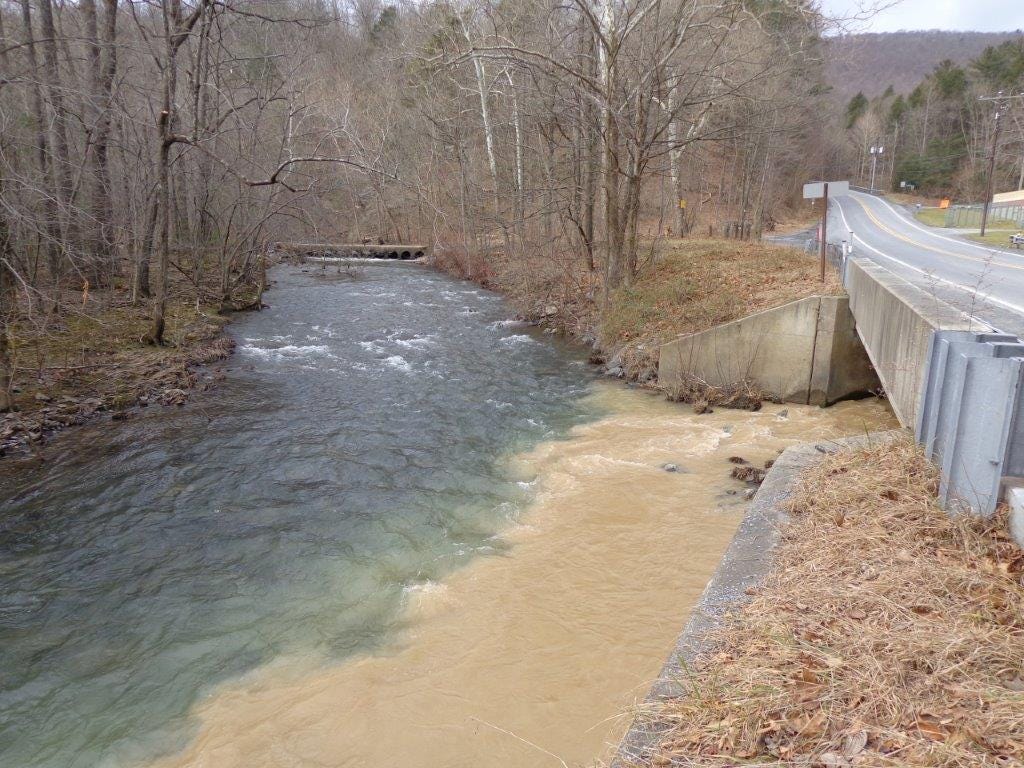
Erosion and Sediment Pollution | Wayne County, PA
Example of sediment pollution of waterways

90% of watershed pollution comes from nonpoint sources, meaning, no specific pollution source. Pollution that is accumulated from all over and ends up in the creek or river, as opposed to being directly dumped into the waterway by a specific pipe or factory. Pollution that comes from our yards, from construction sites, from parking lots, would all be pollution from non-point sources.

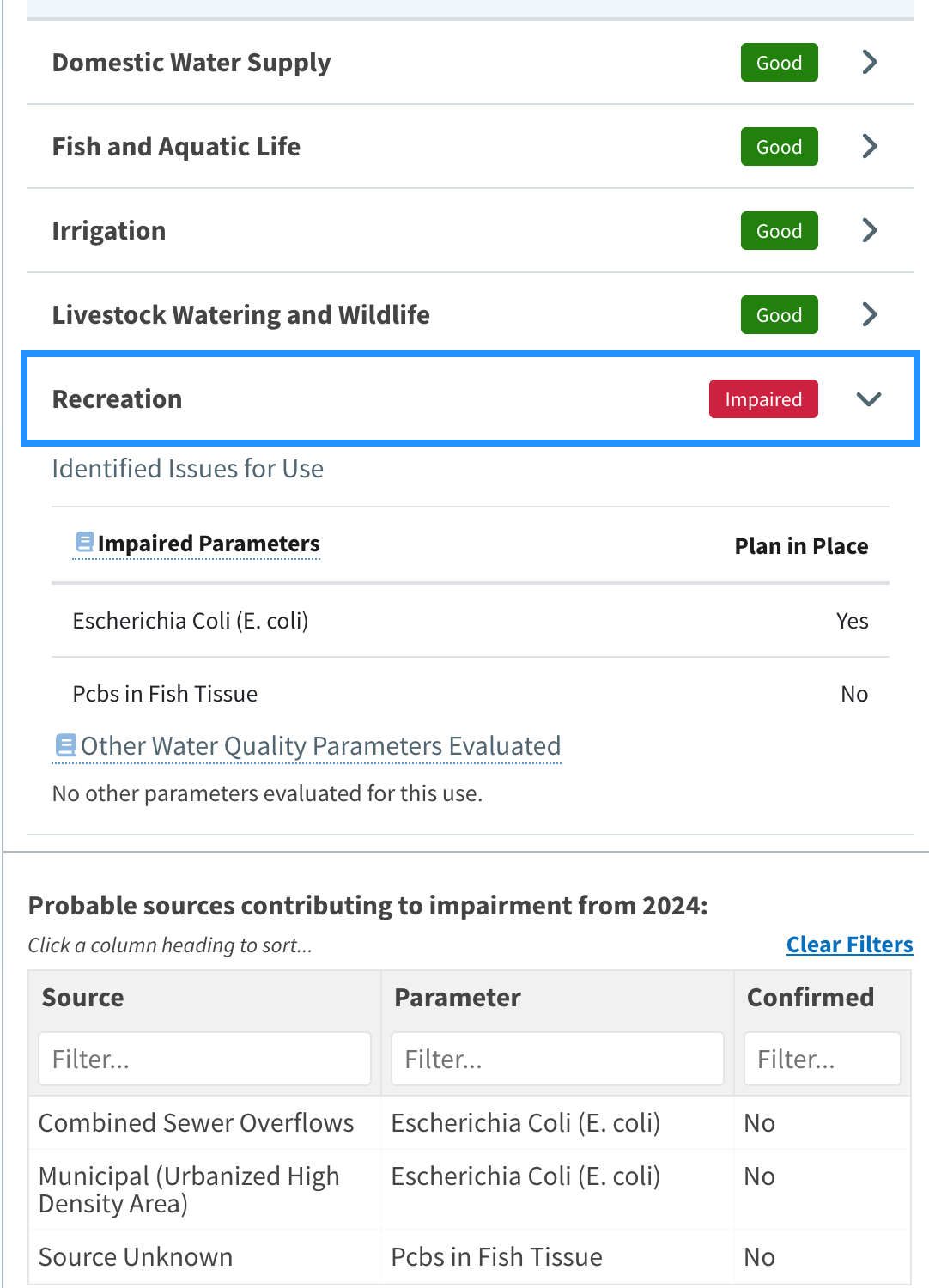
The second largest source of pollution, almost as much as sediment, is pathogens. That is, for example, E. coli. The Lower Cumberland (Cheatham Reservior), that is our largest watershed (the river that runs through Nashville), is considered impaired because the E. coli levels are too high. (It is also considered impaired because of high levels of PCBs, a highly toxic, durable, man-made chemical, accumulated in fish tissues.)

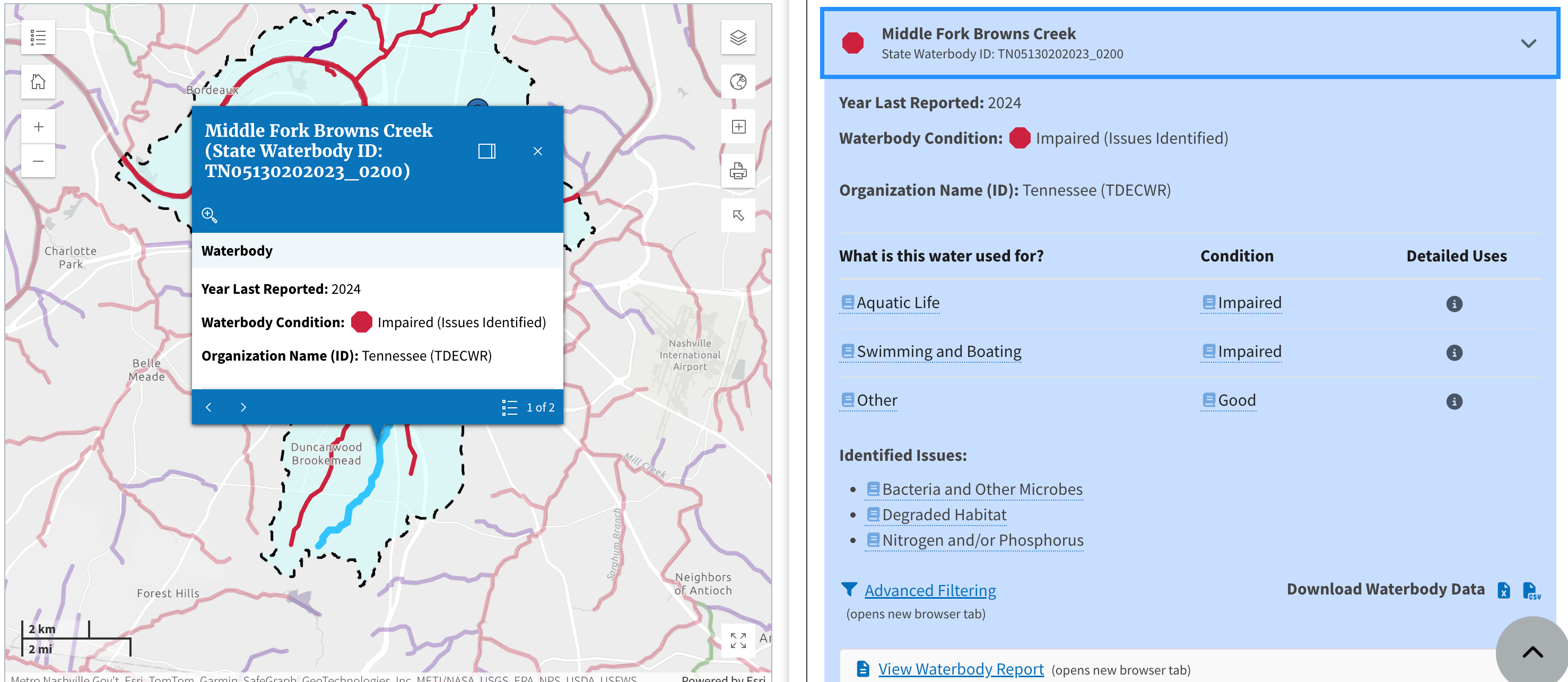
The below image is from an EPA website that tracks the health of watersheds: https://mywaterway.epa.gov/ (You can use this to see what your nearest watersheds are, and what their conditions are.)

An impaired watershed is a body of water that does not meet established state water quality standards and fails to support designated use. And there are about 4,000 miles of impaired streams and rivers in Tennessee.
The Middle Fork of Browns Creek, a large creek that runs off of the Cumberland River, is impaired for a similar reason, having high levels of pathogens, but is also considered impaired because the habitat is too degraded (due to human development activies), and because the levels of nitrogen and/or phosphorus are too high (due to fertilizer runoff).
One of the “possible sources” of E. coli pollution for the Cheatham Reservoir is “Combined Sewer Overflows”. That would be from the amount of water flowing through the system overloading the system, and so resulting in overflow. And this is common, and happening because human development is generally not accounting enough for managing and slowing the flow of water to the watersheds. Impermeable surfaces (concrete, asphalt) are major drivers of this, but a house would be contributing as well, by funneling all the water off of the roof and into the stormwater system, as most buildings probably do.

Runoff also carries fertilizers, which are the third largest source of watershed pollution in the state of TN.

So what can we do to protect our waterways? There are many things.

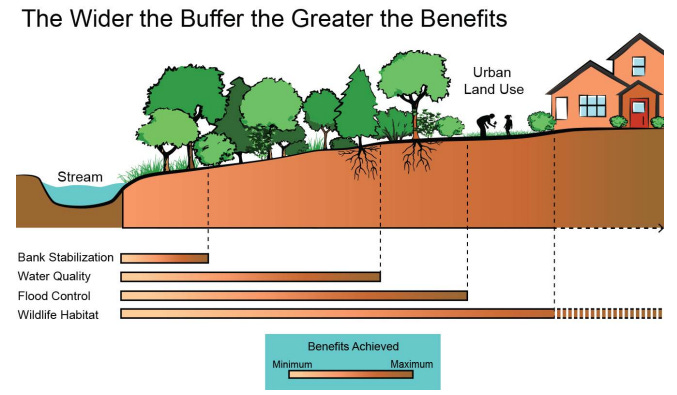
  1. Plant buffer plants, to protect habitat along the shores of creeks and waterways. They will act as buffers, slowing water that flows into the creek as runoff, and protecting the bank from erosion, which contributes to sediment pollution in the water. (They also provide important habitat for wildlife).
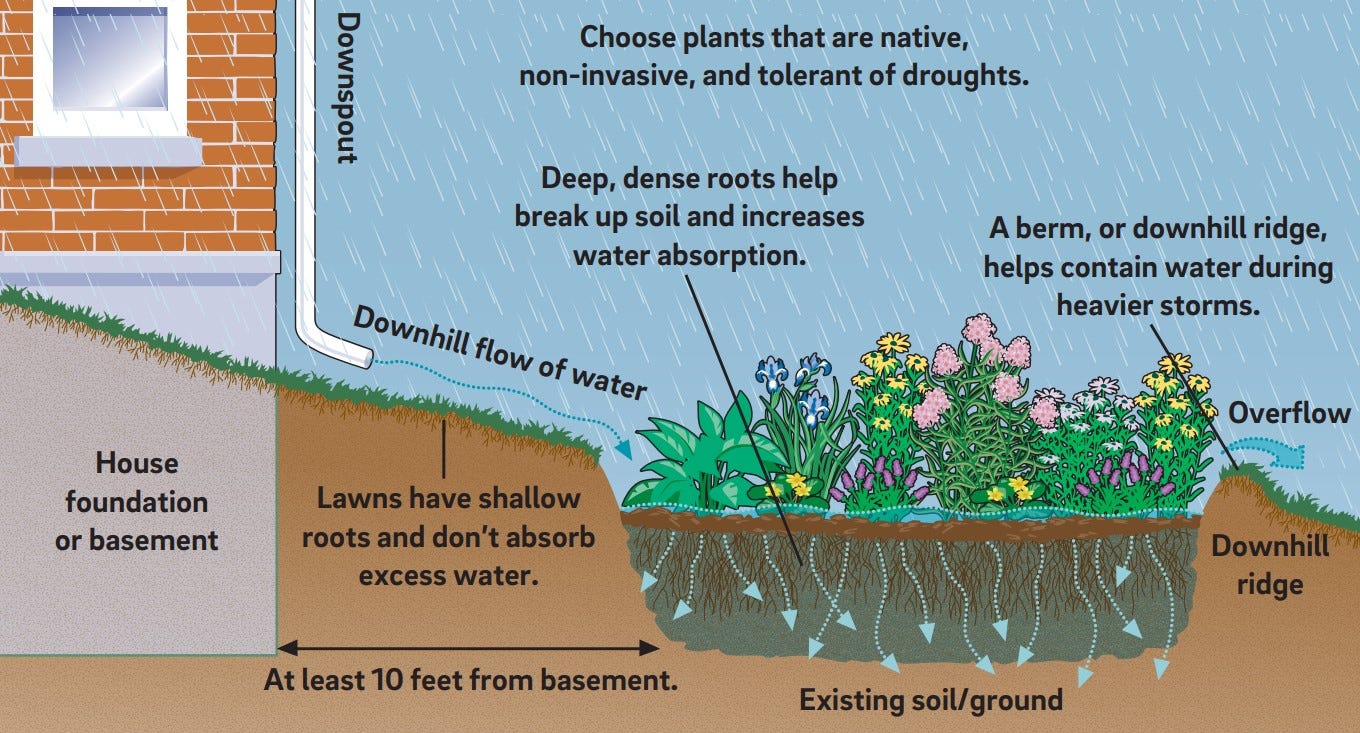
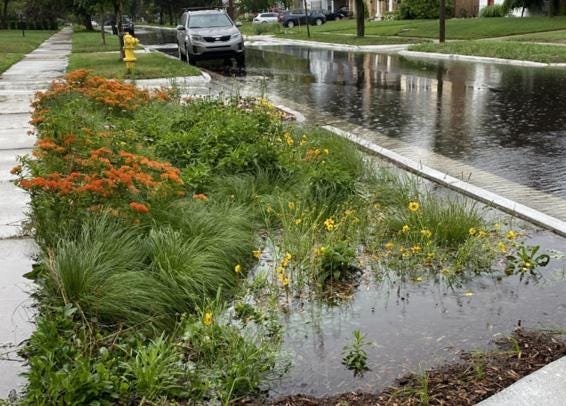
  2. Have a rain garden. Put plants that tolerate wet conditions in places where water accumulates. Source water (runoff from your roof, water from the downspouts, water running through the street curb) into a dedicated zone full of plants that can make use of that water, absorbing and filtering it.
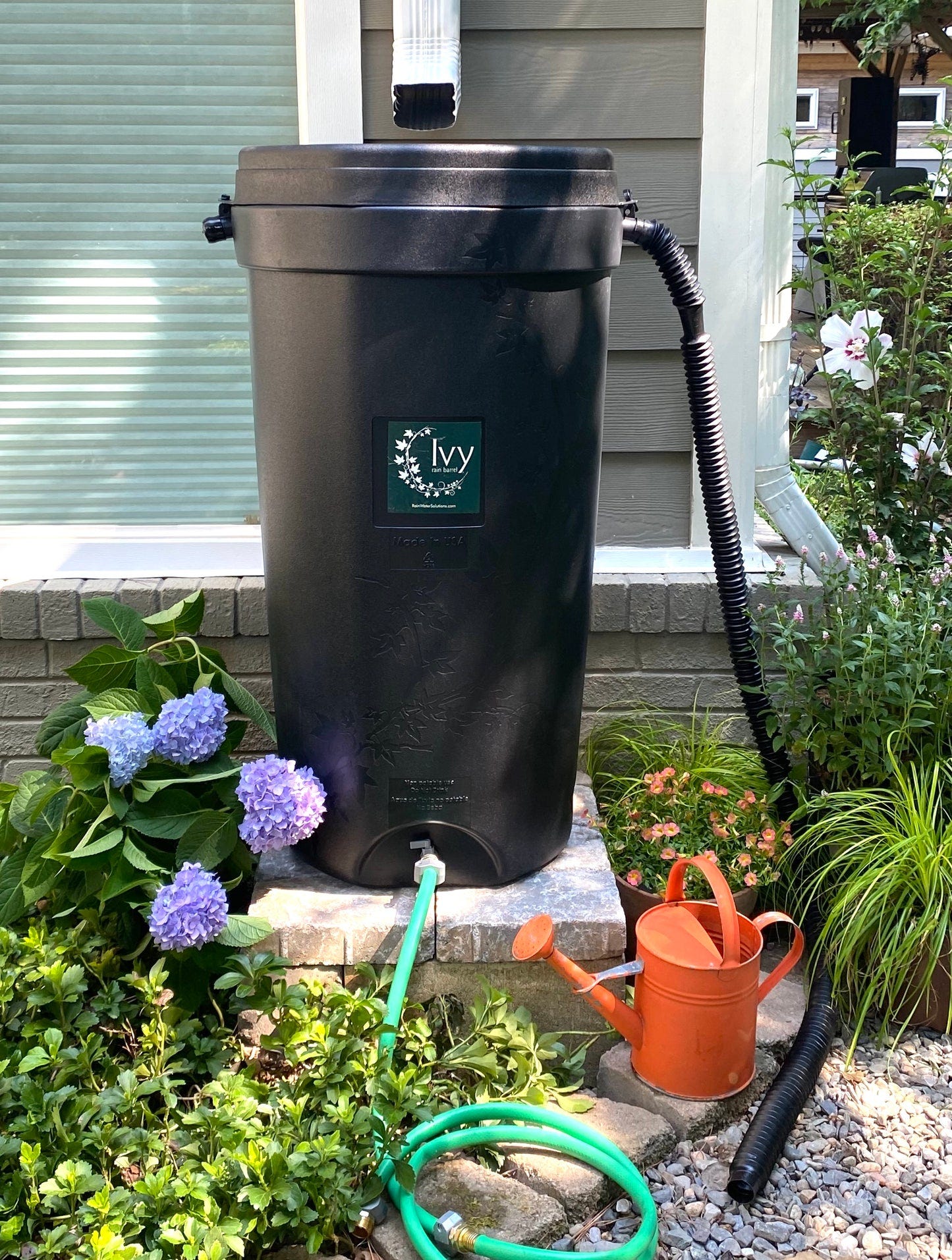
  3. Rain barrels. Capture rainwater instead of letting it flow as runoff, and then use it as a resource, for watering.
  4. Permeable surfaces. Gravel instead of concrete, etc.
  5. Protect bare soil. Bare soil easy washes away in rain and contributes to sediment pollution. Covering the soil with mulch (and/or plants) will increase absorption and greatly decrease sediment runoff.
  6. Use less fertilizer.

I have really wanted to plant a Buttonbush, and have been enamored with this plant since discovering it at Shelby Bottoms. I thought my yard wouldn’t be able to tolerate one (or at least, it wouldn’t thrive), because we currently don’t have wetland conditions. But it seems that all you need to do to make a rain garden, and create some wet conditions, where the soil stays wetter for longer, is to dig a small depression, and source your runoff into this area (say, from your downspouts). That is your rain garden. And so, by channeling the water into a dedicated place where it can be stored, you can plant plants there that thrive in these conditions. It seems that this is the concept, and I am very interested in trying to create a rain garden, for one, to capture to the stormwater and decrease the load on the water systems, but two, because it will mean I could plant some plants that otherwise I couldn’t have in the yard.
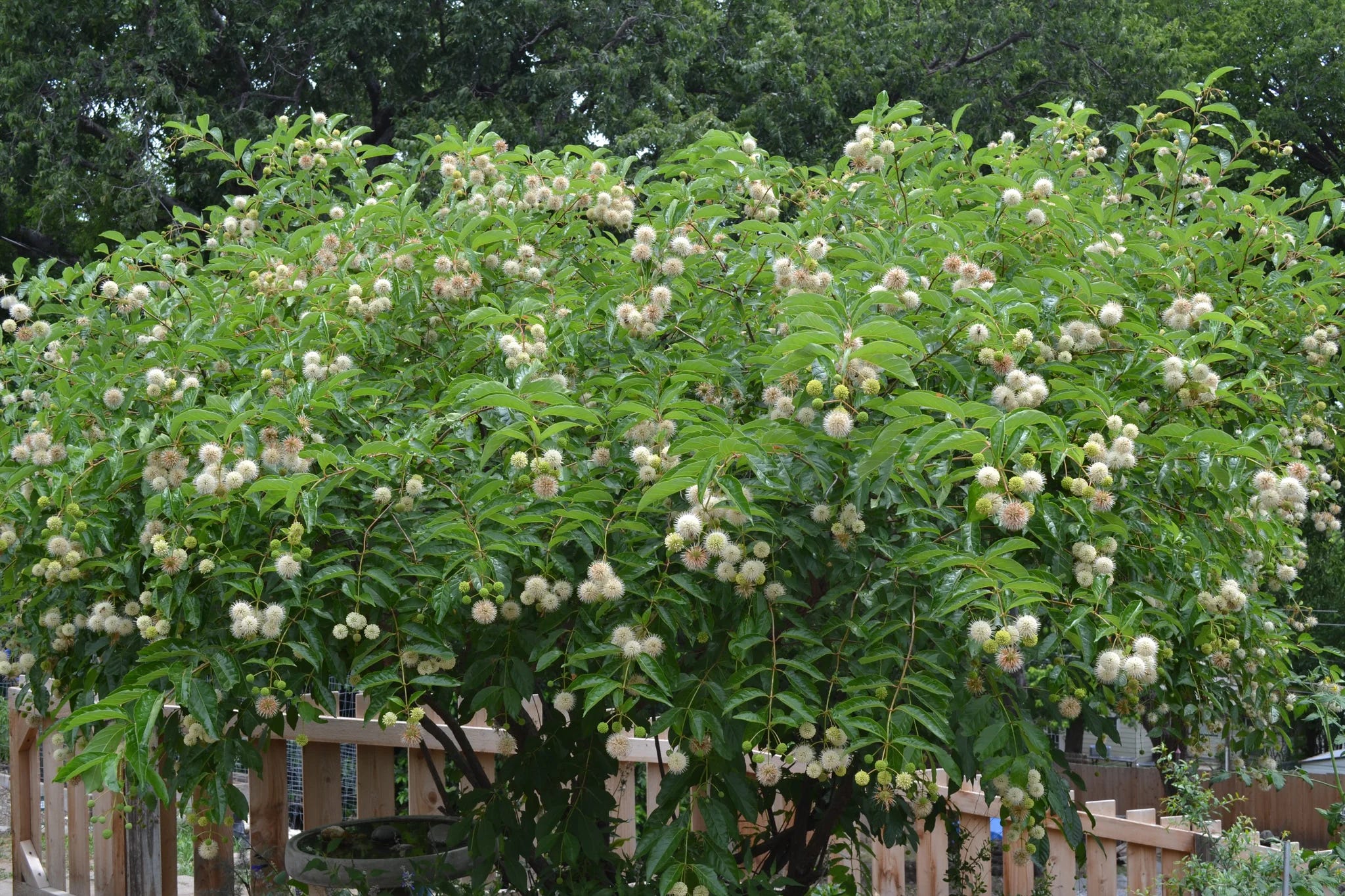
Buttonbush – iconic TN native!!!
A rain garden – designed to hold runoff water
Rain Gardens – Green Stormwater Infrastructure
Rain garden

The below image is demonstrating the value of a buffer, between a stream/watershed and urban land use. It will help with erosion control, flood control, improve water quality, and of course, will be good for wildlife. As our expert stormwater management scientist said in the lecture, “any amount of buffer is better than no buffer.”
Plant buffer to protect waterway
City of Chattanooga
A rain barrel, to capture runoff water

Plastic Bag Bans

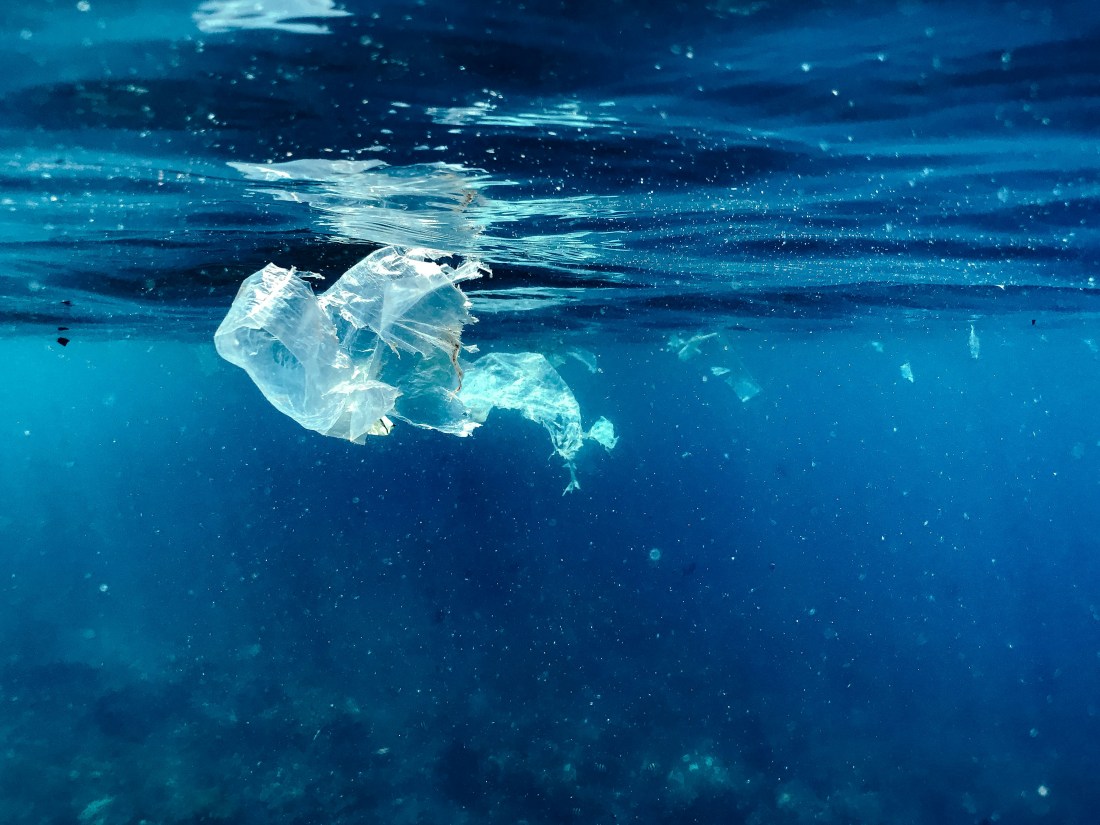
plastic bag floating in water

I woke up this morning thinking about plastic.

Again.

I have developed a minor obsession with plastic. It helps that plastic is literally everywhere, all the time. There are many opportunities to think about it.

I have recently been getting emails from my environmental sources that have been touting the benefits of plastic bag bans. And yesterday, as I went for a walk through the neighborhood, I followed behind a man carrying his groceries home in a plastic bag.

I followed him for awhile, walking the same route, and thinking (again) about plastic. Specifically, plastic bags.

Plastic bags are one of the most common sources of plastic pollution. I mean, I don’t really have to even say anything about them, right? We all know. We all know now that plastic bags are a problem.

I don’t think I’ve taken a plastic bag at a grocery store in years. I can’t remember the last time I accepted one. I keep reusable bags in my car. I bring a bag when I walk. It doesn’t cause me any trouble or hardship. It seems like this is really a low-hanging fruit. Cutting out plastic bags.

Many states and cities have already banned them successfully.

Here are some facts about plastic bags, from publicinterestnetwork.org.

  1. “The U.S. uses over 280 million plastic bags
    every day on average. We use these plastic
    bags for a few minutes and then they pollute
    our communities and environment for decades.”
  2. “Plastic bags are not readily recyclable and
    can jam up recycling equipment, hurting
    the overall recycling system.”
  3. “Plastic bag bans work. Just four years after
    Seattle banned plastic bags, Seattle homes
    threw out 50% fewer plastic bags. In 2017,
    after hundreds of local governments and
    the state of California banned single-use
    bags, 72% fewer plastic bags were found
    during beach cleanups, compared with
    2010.”

Let’s get these plastic bags out of here!!!!!!!!!!!

Environmentamerica.org has a calculator for how effective a plastic bag ban would be if instituted in Nashville, TN.

(Calculator: https://environmentamerica.org/center/resources/plastic-bag-bans-work/)

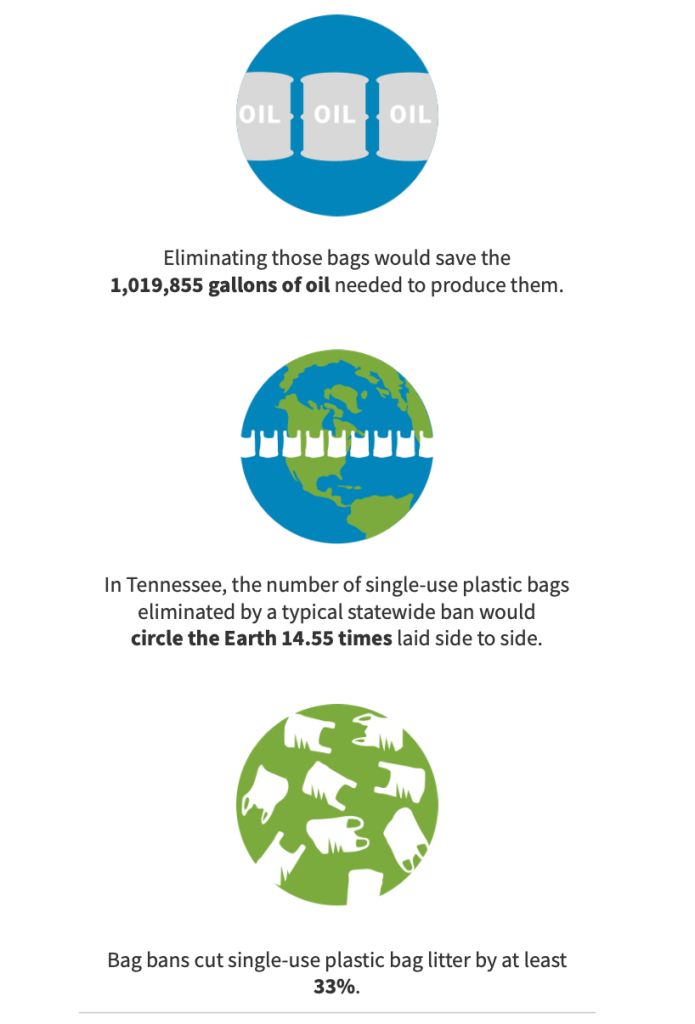
Over 200 million bags kept off of Earth a year, just from a ban in Nashville.

The other persuasive point here is that we would also save over 1 million barrels of oil by banning plastic here in Nashville. At a time where we want to reduce our energy consumption and especially of fossil fuels as much as possible, that could be some really welcome savings.

It seems to me that we need this action as soon as possible, and this is an easy step. Most of our plastic usage is just based on convenience. With a little more foresight and planning most of our single-use plastics can be eliminated, and money and energy can be saved.

Thinking about it from an efficiency perspective helps motivate me to action as well. Generating less waste and consuming less waste means that we don’t use as much energy on production and removal. Less water, less oil, less electricity, less cleanup cost. And anywhere where we can save energy and effort, that reduces costs elsewhere, and that energy and labor can be utilized somewhere else.

This is something that is in my mind when I think about mowing lawns. Where are we wasting energy? Where could we better utilize human time and resources?

I see wide tracts of land that are mowed that are not really being utilized for anything. (I say not used for anything but perhaps there is a reason why they keep them clear and I just don’t know about it. I admit I am not a land use expert.) It costs energy and labor to keep that mowed, while not serving much of a role (that I can see). It seems to me that if it were allowed to grow freely, it would be a carbon sink, and it would also not require energy use of mowing, of watering, and would not need any human labor either.

What if our lawn mowers were also gardeners? What if they cultivated instead of cut?

I know I’ve strayed a little off topic here, but this was in my mind as I watched the mowing crews cut a large swath of grass around a small strip mall near my house. Nobody is walking or playing in that grass. So what if it was a garden instead? Or a patch of wildflowers or grass, which would require less effort than a garden? We are already spending time and energy to cut it. Why not cultivate it instead? It seems that that would be a better use of the land and cost less resources over time.

In many ways, we’ve fallen out of sync with nature — swept up by the momentum of our industrial and societal engines. But there are plenty of chances to restore balance. With a little imagination and effort, we can make meaningful changes. A simple plastic bag ban looks like one easy place to start.

Trash Quest Pt. 3

June 30th, 2025

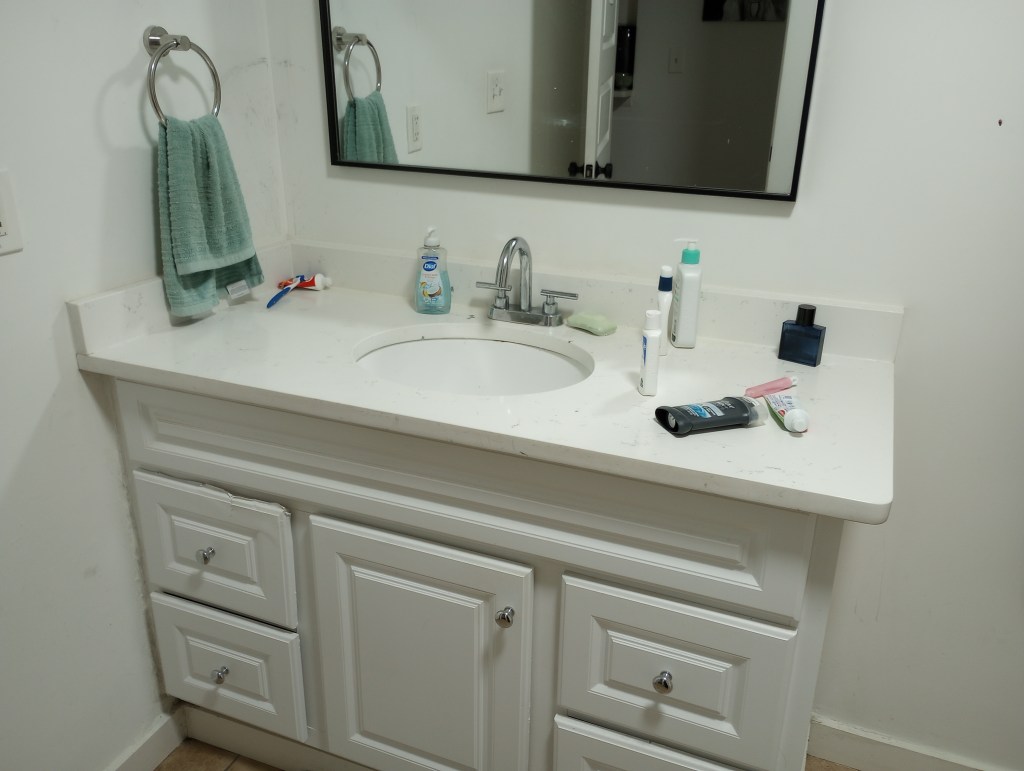
This is not a staged photo.

This is a photo of our bathroom that I took yesterday. And this is what I mean when I say that “what has been seen cannot be unseen”.

What do you see here?

Prior to even a week ago, this scene meant nothing special to me. It was just a bunch of standard bathroom items. Deoderant, skin care solution, toothpaste, toothbrush..

But yesterday, with my new obsession, all I saw was plastic.

Before me, in my very own bathroom, a field of petroleum products. Every single item there on this counter made of plastic, and destined for a landfill, and for existing on the earth for forever.

I’m at the coffee shop again with my sister, and she sat down with her drink. I looked over and said, checking it out, “That looks good. What is it?” She said, “It’s so good. You have to try it. It’s a pistachio latte.” And then something caught my eye. Right next to the latte, resting on the table, was a cursed item.

A black, plastic spoon.

It will be used once. It has already been used once. To stir her drink. And what happens to it now?

You already know.

We have to wean ourselves off of this plastic addiction. Actually, we have to cut ourselves off cold turkey. We have to do it, for the whales, for the babies, for everything and everyone, for the Earth.

So, I’m trying out as many ways as I can think of to generate as little waste as possible and avoid plastic. Here are some of the things I have already adopted successfully:

  1. No paper towels. This is very easy. Just use a rag instead. I have not had a use for a paper towel in months. Rags are good enough, even better.
  2. Asking for “for here” ware. All the coffee shops should have for here ware, so you are not throwing anything away. Starbucks should even have this.
  3. A new discovery: buying “bulk” from a local store. You can bring a container and fill it up from their bulk containers, and weigh whatever you put in it, and pay for it. You acquire no packaging this way.

A new idea I experimented with for the first time just yesterday: using baking soda instead of toothpaste. Apparently this is something you can do. Both my roommate and his girlfriend already knew about that. I had no idea. Baking soda in paper boxes instead of toothpaste in plastic tubes.

But what about toothbrushes?

There are bamboo toothbrushes you can buy, which will probably be what I do. You can apparently also use twigs. I’m wild enough to actually try that, although it seems like you’re supposed to use specific kinds of twigs. Any twig would probably be alright though. For the blog.. I have to give that a try.

(479 words)

Trash Quest Pt. 2

Note: This post is 683 words, excluding this note. It’s not 500 but it’s the best I could do. It started at 1000. I refuse to cut any more!!!!!!!

After writing up my morning post about my trash quest, I opened up my bag of collected trash and plastics. It was time to see what I had. I haven’t thrown anything away, except for a broken, metal door hinge. I regret throwing it away.

I examined my trash, and found a few things. There was paper of various kinds, mostly paper from mail. That’s recycleable. Easy. It’s not compostable because it contains small amounts of plastic film that act as a window, to see the sender’s address.

I had a poster from Gibson Garage that was not laminated, and so recycleable as paper.

Then, there was plastic. Strange hard items, rigid plastic like trays and containers, and then a lot of plastic film/bags. The plastic film I found could be recycled at a few grocery stores near me. The Publix was the closest, so I took my bag of plastic and set off to investigate.

Now, I was successful. They did accept plastic bags and plastic wrap at a recycling bin at Publix. That was most of my plastic. Great. But then…

When you see it, when your eyes are opened, to the scale and scope of the problem, you cannot unsee it. It’s like being in The Matrix.

I walked into the Publix. I wanted to see what I could buy, without acquiring any plastic.

The answer was, nothing.

Nothing at all.

I was supposed to be in a place for buying food. I was in a grocery store.

Yet, all I saw was plastic.

A sea of single-use plastics: shrink wrap, bags, rigid containers, stickers—everything encased in plastic.

This is the problem, people.

Now, that was bad. That was horrifying, even. But what was worse?

On my walk back home, I picked up 9 plastic bottles.

I picked up other pieces of trash as well. Wrappers, food containers. With each piece of plastic litter, my rage was rising. And then?

The literal icing on the cake, was an actual cake.

I saw it up ahead in the road. Two plastic bags, fluttering in the street.

I approached. One bag had half of a cake in it, in a rigid plastic container. The other bag had a bundle of bananas.

Hundreds of ants were swarming the cake. I decided to dump it, let the ants feast. I took the bananas with me to put in my compost hole.

I took the stickers off the bananas. They’re plastic, and won’t degrade. The cake I was disgusted with, and I threw that plastic away. I should have gone farther and cleaned it, and added the rigid plastic container to my collection. I threw the bananas in my compost hole.

This pissed me off. I was getting angry. I found two cans and two bottles on the last minute of my walk.

Now I was really fired up. I wasn’t done. I knew that our trash can itself would be full of recycleable and compostable trash. Why? Because of our roommate.

The dude chugs Dr. Pepper like his life depends on it. Like it’s his Holy Elixir of Everlasting Life. And he throws all of those cans in the trash.

I talked to him about it. I’m not angry with him is because he’s absent-minded. He doesn’t realize what he’s doing.

The biggest reason why we should not allow these permanent items out in the world, in the size and scope that they are: Even if they can be meticulously recycled, there will be people who don’t do that, or things that go wrong. And they will end up in the environment.

I pulled four Dr. Pepper cans out of the trash. Then, there was mailing waste. That could be recycled. Paper towel waste, and two chunks of bell peppers: compostable.

Parker and I haven’t been using paper towels for months. We just use rags instead. But the other roommate bought some recently.

This is the trash quest I am on. The size and scope of the problem is huge, y’all. But we have to do it. We have to solve this.

Experiment: Trash Quest (Pt. 1)

I am doing another experiment now that has been going on for about three weeks, which is my trash quest. I’m trying to account for every single piece of waste that I generate, and am conscious about every piece of waste I take on and take ownership of, and nothing is allowed to be thrown away.

I currently have a medium sized gift bag in my closet, full of miscellaneous plastic and other trash that can’t be recycled with our street recycling. Eventually, soon, I’m going to have to figure out what to do with that stuff.

There are lots of strange plastic items in there that aren’t #1 or #2, which are the only two plastics that our Nashville street recycling takes. So for everything else, I have to find something else to do with, which includes plastic wrap and plastic films.

Since I’ve started this experiment, I’ve quickly come to see plastic as an enemy. I don’t look at an empty bag of Cheetos in my driveway the same way. I don’t see everything in the store wrapped and encased in plastic in the same light as I did before. It’s not a natural thing. It’s extremely unnatural.

Plastic waste litters my neighborhood. When I first moved here I was shocked by the amount of plastic waste in our streets and yards. Parker and I filled up an entire trash bag just by walking the block and picking everything up.

The problem with this plastic waste is that it literally will last forever. You use it one time, to eat with, to carry your water, or some food, and then that’s it. It’s been used. And then it lasts forever.

We know that plastic is a problem and it’s bad for the Earth and even bad for human health, because of the chemicals that leach off the plastics, the endocrine disruptors, that cause cancer and infertility and human birth defects, etc. We also know the microplastics that are in our lungs and in our fat, and every part of our bodies. Turtles choking, rivers clogged, beaches trashed.

Yet, none of that combined information has lit the fire in me. So what did?

I read a story about a month ago now, and it hit me just right. This is what caused me to draw the line.

https://www.cbsnews.com/news/pregnant-whale-plastic-pregnant-whale-washes-ashore-italy-nearly-50-pounds-of-plastic-in-stomach/

“Pregnant whale washes ashore in Italy with nearly 50 pounds of plastic in her stomach.”

-CBS News

That’s it guys. I’ve had enough.

This is a horrible crime against nature. We are starving whales and killing them with our waste. Reading that disturbed me and I’m still disturbed a month later.

Our obsession with plastic is literally filling the stomachs of whales with trash to the point that they cannot digest their food, and they starve to death.

It can’t be like this.

This is not working. We have to change.