Translation As Language Study

I spent some time this morning attempting a translation of this short passage, a caption from an ecological book about wolves (オオカミと野生のイヌ, published by X-Knowledge), beneath a photo of an Arctic Wolf.

The original Japanese:

北極圏に生息するハイイロオオカミの亜種で、体毛は白い。アルビノや白変種など白色の個体は、さまざまな種でみられるが、季節にかかわらず種や亜種に属するすべての個体の体毛が常に白い肉食哺乳類は、シロクマと並んで極めて珍しい。

My translation:

A subspecies of Grey Wolf with white fur that inhabits the Arctic Circle. Individuals with white coloration due to albinism and leucism can be seen in a variety of species. However, along with the polar bear, it is extremely rare for all individuals within a species or subspecies of carnivorous mammals to have white fur year-round, regardless of season.

Translating is a great way to study language. Even in translating a short passage such as this, there is so much to chew on.

I find that in translating, as opposed to simply reading, I’m forced to check my own comprehension of the language. In translating, by actually transcribing the words into English, you are forced to choose and explicitly state the meaning of each word, phrase, or passage. And each time I’ve translated a piece now, especially these harder passages, I discover that, when I take this critical, close look, I have actually assumed some meaning that was not correct. I was close enough to understand generally, but I was not understanding specifically, perfectly. And ultimately, we do want to understand exactly what is being said. Translating forces you to take it word by word, to break it down and confirm your understanding.

For example, in the above passage, there is the word 個体. When I first read this passage, several times, I assumed 個体 to be another word that I have seen, 固体. They are similar, and have the same reading (kotai). In my initial reading of the passage, I misread this word. They are close in appearance and pronounced exactly the same, but 固体 means “solid”, and 個体 means “individual” or “specimen”. In reading the passage and misreading this word, I understood the meaning to be “the physical body” (of the wolf). My interpretation of meaning did work somewhat in my reading, but it was not correct. First of all, my understanding of 固体 was not accurate, as it really just means “solid”, and then, I was reading the wrong word anyway, because in the passage the word was 個体, and these are totally different words. However, I only truly realized this when I started to break the passage down for translation.

I also initially translated 北極圏 as “North Pole”. I caught this mistake later, when checking my accuracy, as I realized that it isn’t exactly North Pole. “North Pole” is, precisely, 北極. I wasn’t paying mind to the 圏 part, but it is there for a reason. 北極圏 is actually “Arctic Circle”. I think I just saw the 北極 part of 北極圏 and immediately thought, “North Pole”, and that is close – but not precise. It’s a subtle difference, and for general understanding, not lethal. But ultimately, 北極 and 北極圏 are fundamentally different words and concepts, and for translation purposes, “North Pole” is not precise enough, and is incorrect.

A few days ago, I had ChatGPT check a previous translation I did (a passage from the same book), and I found it caught mistakes I had made that I hadn’t even considered. I had made assumptions and was confident about some words/phrases, or I had completely misread them, and was ultimately wrong in the translation. In most cases, close, but wrong. It was startling to see that what I had assumed to be true was wrong, and how sneakily I had been misled. Because of this experience, I’m now checking even the Japanese that I think I know. And, for example, in the above passage, when I first read the line, “シロクマと並んで極めて珍しい”, I took it to mean, literally, “incredibly rare to see wolves standing together with polar bears”. In my reading of the passage, that did somewhat make sense, and is a plausible statement. However, in taking the passage line by line, I realized that was not what was meant. Having a better grasp of the passage, I saw that 並ぶ was not being used literally, but figuratively. So again, looking at this example, my initial comprehension was wrong, and that was revealed only after the close examination required in translating.

In these dense, academic passages, there is a lot of information conveyed in a short span. It’s really crucial to have an accurate understanding of every word, vocabulary and grammar, because even a slight misunderstanding can change your entire interpretation of the meaning. It’s interesting that our brains are so good at making meaning and filling in gaps in understanding, and so you can really think you understood something, or come up with a plausible interpretation. You can form a narrative that feels right, and yet you didn’t understand at all – or not perfectly. I read completely the wrong word, 固体, with a separate meaning, and yet I was able to integrate it into a plausible meaning in my interpretation of the passage.

In today’s translation exercise, I felt very clearly the value of translation as a tool for language study.
The Weasel’s Last Fart

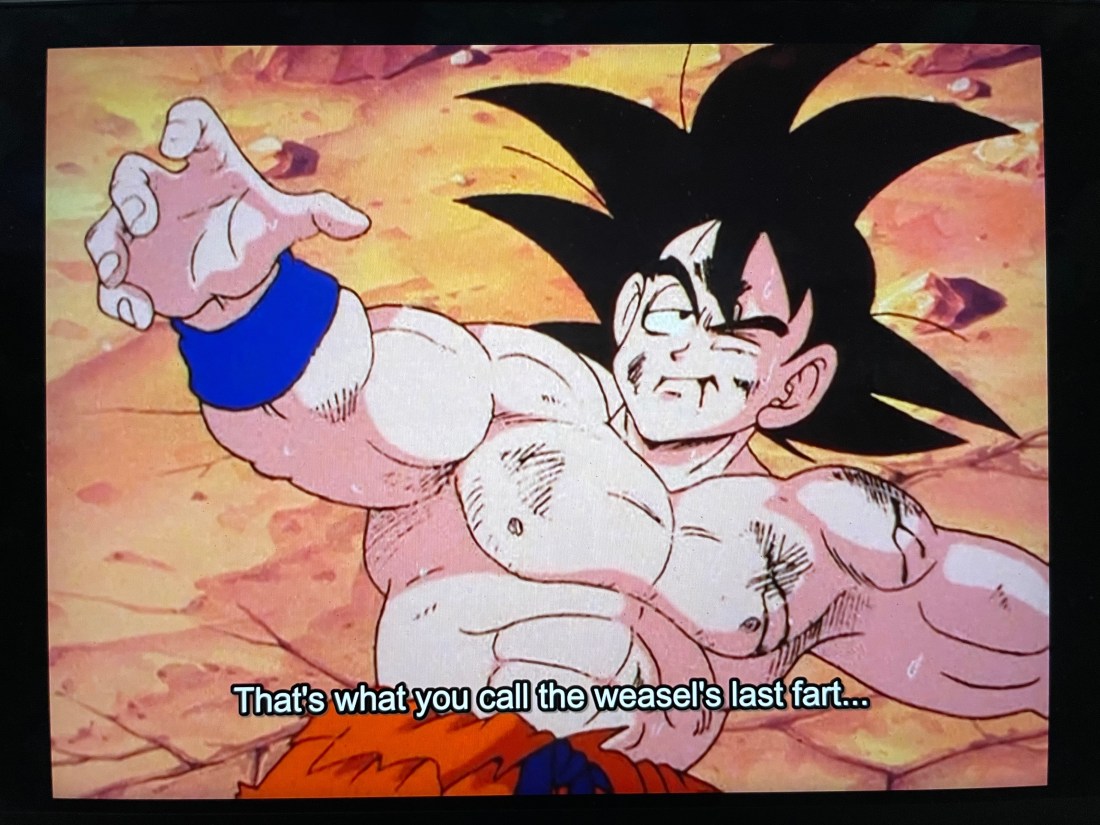
It is episode 32 of Dragon Ball Z. Vegeta has gone full monkey mode, creating an enormous shining star of energy to trigger his transformation into a giant beast monkey, which increases his power by 10x (10倍), and he’s got Goku on the ropes. He’s crushed Goku’s legs, rendering them useless, and now, he’s going for the final kill, with a single finger, moving to squash Goku like a bug, and it looks very dire for Goku. But suddenly, as monkey Vegeta brings his finger of doom down, Goku throws up an arm and fires off a powerful laser blast, shooting it straight into Vegeta’s giant red eye, his right eye, and blowing it up. Vegeta screams, immediately recoils, holds his face and cries out in agonizing pain. And there is a shot of Goku, laying there with his broken legs, chuckling, and he says – 「イタチの最後っ屁ってやつで」

That is, itachi no saigo ppe yatsu de.

Now, this was totally unexpected. We thought that, we all thought that it was over for Goku. Vegeta definitely thought this was the end of Goku, but Goku had one last gasp. And me, who is listening so intently, I am completely stumped by Goku’s line. I rewind, I listen three times. I hear “itachi”, so it seems, and I hear “no saigo”, and then whatever is at the end… but, itachi means “weasel”, and saigo means “final”. Surely, Goku is not talking about a weasel, and “the weasel’s final”? That doesn’t even make sense.

I turn on the English subtitles for guidance, relying on translators past, and I see this incredible English:

“That’s what you call the weasel’s last fart.”

So, the truth is that our hero Goku was actually saying “weasel”. The weasel’s last fart. Now, I had to Google this, because, what the hell are we talking about here? Is there truly a known Japanese phrase, in common usage, that is, the weasel’s last fart?

Well people. Yes there is. The phrase is exactly what Goku said here:

イタチ → Weasel

の最後 → ‘s last

屁 → fart

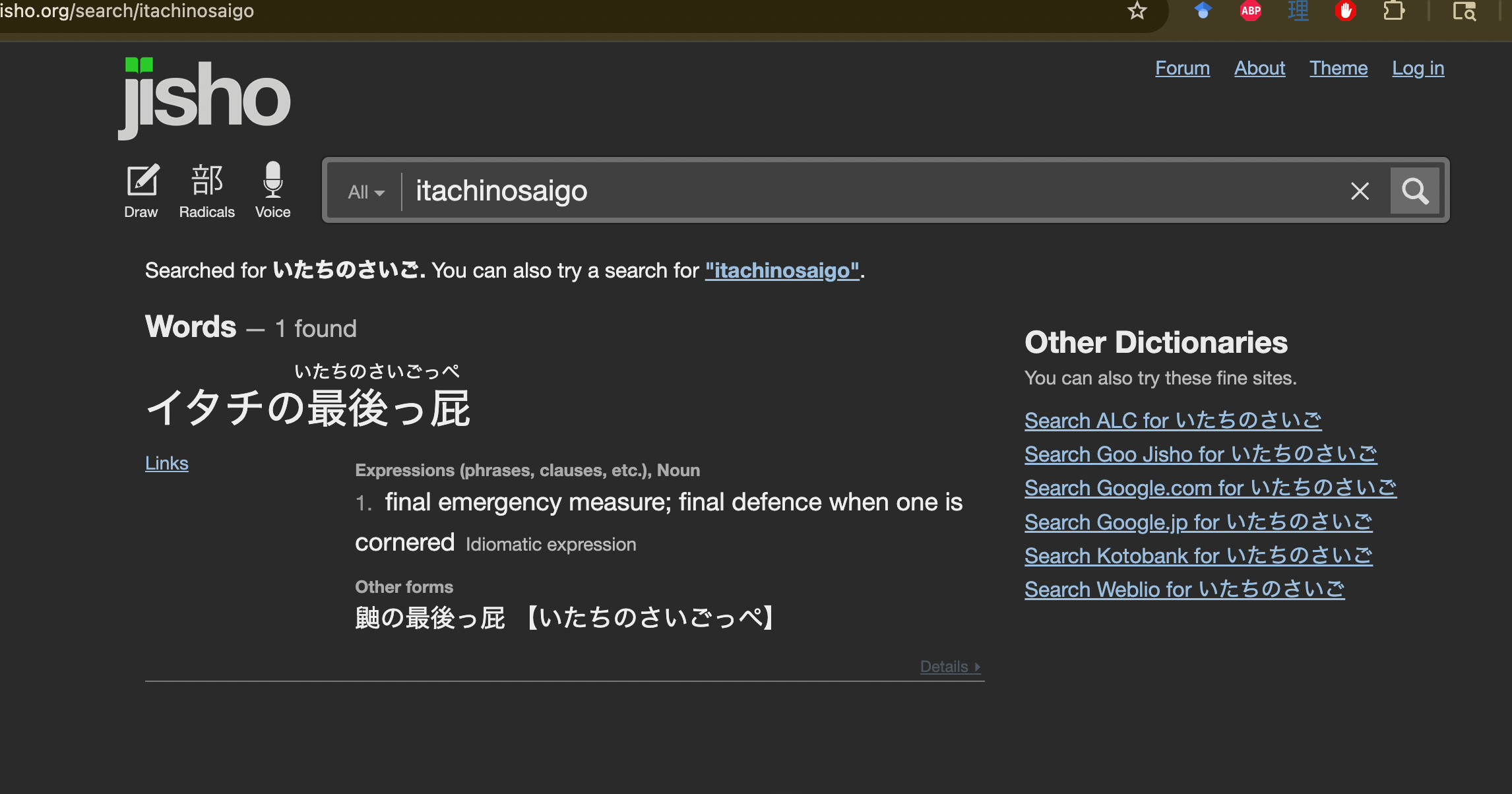
That is, イタチの最後っ屁. This is a known phrase used by the Japanese. We can easily infer from the context that we are talking about “a last ditch effort” or “last gasp”. My favorite dictionary, Jisho.org, chooses not to give a literal translation. As you can see, they say “final emergency measure” or “final defence when one is cornered”. It is basically “a last ditch effort.” And this makes you wonder, if you didn’t know already, do weasels fart in self-defence? Surely they must. Like a skunk?

Some brief research confirms that this is true.

Jisho.org’s definition of イタチの最後っ屁

The English subtitle translations are very trustworthy. As we can see from this example, and across the board, the translation team often stays very close to the original Japanese, which makes the subtitles especially useful for language study. In this case, they didn’t just preserve the meaning, but the imagery itself. Choosing “the weasel’s last fart” was probably a deliberate decision, even knowing it might sound strange or confusing to English speakers. Rather than choosing something familiar like “last-ditch effort,” they let the original metaphor stand. That’s a confident choice, and you have to respect that. It suggests the translators wanted viewers to know exactly what Goku said, regardless of it being received as quirky or strange.

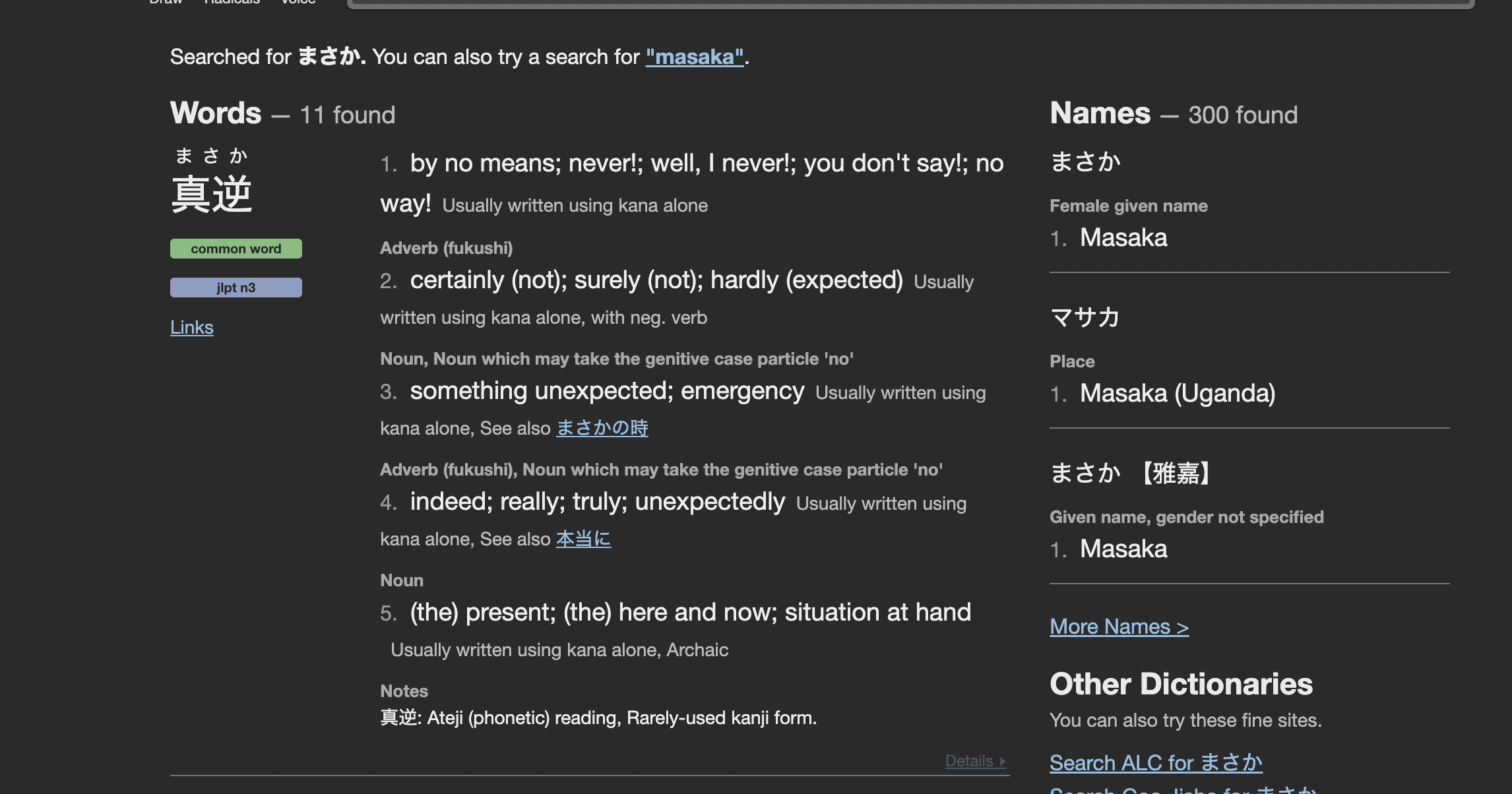
It is interesting to hear the Japanese and then see what the translators ended up translating it as. For example, after Tenshinhan has blasted Nappa with his final, most powerful move, and Nappa survives with barely a scratch, there is a shot of Krillin and Piccolo who are both shocked and horrified, and Piccolo says, 「まさか!やつ不死身か!」”Masaka! Yatsu fujimi ka!” The second part of this line, やつ不死身か, is relatively straightforward. やつ→He/This guy (Nappa), and 不死身(ふじみ), is a great word to have in the bank, meaning immortal/undying/invincible. In this case I would choose invincible as the closest meaning. But the first word, まさか, is one of those Japanese words that is flexible, used in various scenarios, and pretty “Japanese”, so you could translate it in quite a few ways. (Jisho offers 5 different situations and usages with many offered definitions.)

Masaka

I would translate Piccolo’s line as: “No way! He’s immortal??” or “You’re kidding me! He’s invincible!” You could also say “Unbelieveable!” or “I can’t believe it!” All of these would be fine choices here.

The DBZ subtitling team went with this as their translation: “Don’t tell me he’s immortal!” I think that also captures the meaning accurately and is a good translation.

Your Mom Has An Outie: Learning Japanese From Dragon Ball Z

After a bout with the flu, being down for five days, I have discovered the world of anime. And after doing some exploring, I’ve landed on a classic: Dragon Ball Z.

I can see why this is considered to be one of the best. The art is amazing, the characters are memorable, the dialogue is interesting, the story is unique and creative, the comedy is top-tier, and the music is awesome. The opening theme, the closing theme, and all of the audio in-between is outstanding.

I feel that the Japanese I’m learning through the show is really sticking with me, and when I look in my notebook and see what I’ve written down, I can remember almost every scene and voice from what was said. I can remember who said it, the context, and how they said it. The words and phrases are really alive. That helps a lot with learning words.

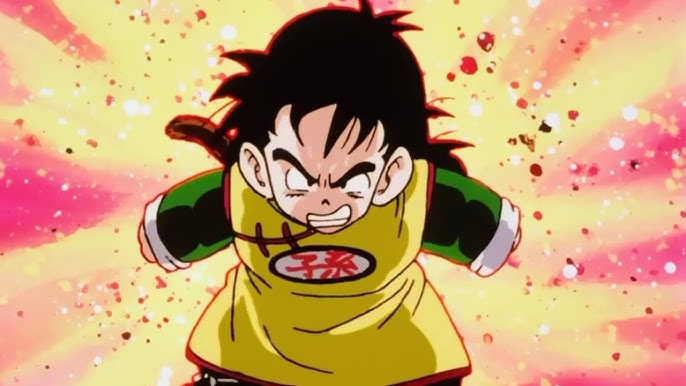
There was a scene where Gohan (5 years old), is finally getting really pissed off and ready to fight. This is after Nappa has killed three of his friends already, and has almost killed Piccolo. He’s finally had enough, and Nappa sees that he’s getting angry, and Gohan is about to say something possibly offensive, and finally talk some smack. Gohan is grunting for a minute, building up his courage and finding the words, before he unleashes this devastating line:「おまえの母ちゃんでべそー!!」

Angry Gohan

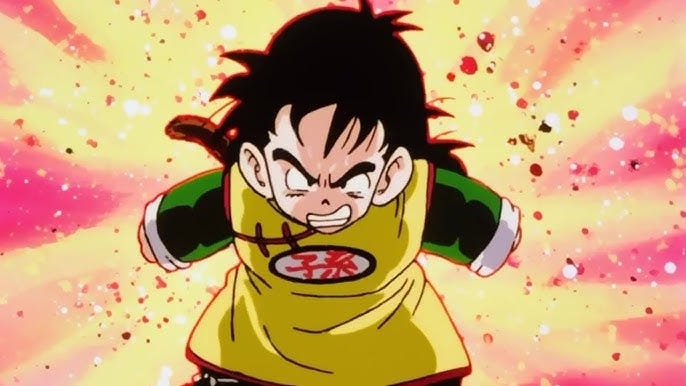
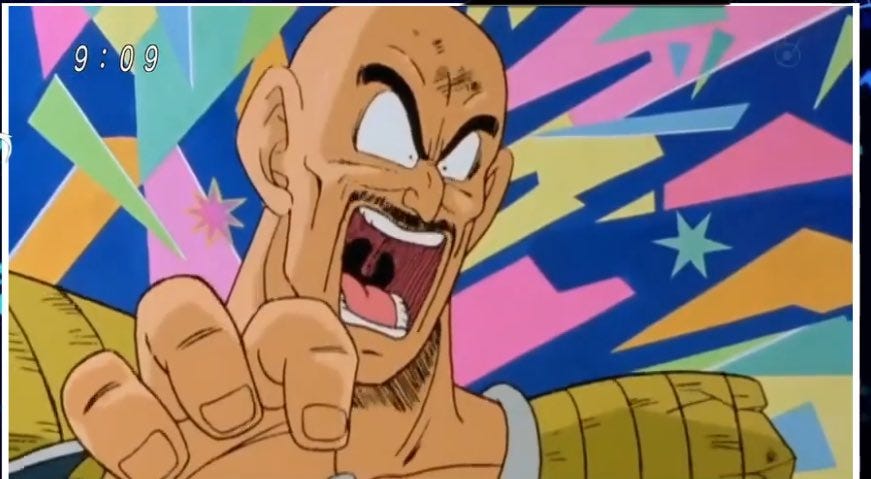
This was so shocking for Nappa to hear that the screen changed colors and became crazy (see image below). Nappa breaks out into a sweat, and says, shocked, 「“何???」(Nani?? What??) He is completely startled. He was completely unprepared for such a line from this five year old. I had to know what Gohan said that got Nappa so riled up. I knew Gohan was saying 母さん, “mom”, but after that? Nappa’s mom is what?? I replayed the audio twice, then turned on the subtitles for guidance, and I saw it. Gohan says, “Omae no kaachan debeso!!!!” meaning, “Your mom has an outie!!” And this was apparently an incredible dig, because that line sent Nappa into a frenzy.

The exact moment Gohan tells Nappa his mom has debeso

From this scene, we learn something about でべそ – if you are fighting Japanese-speaking aliens, and you really want to piss them off, tell them their mom has an outie.

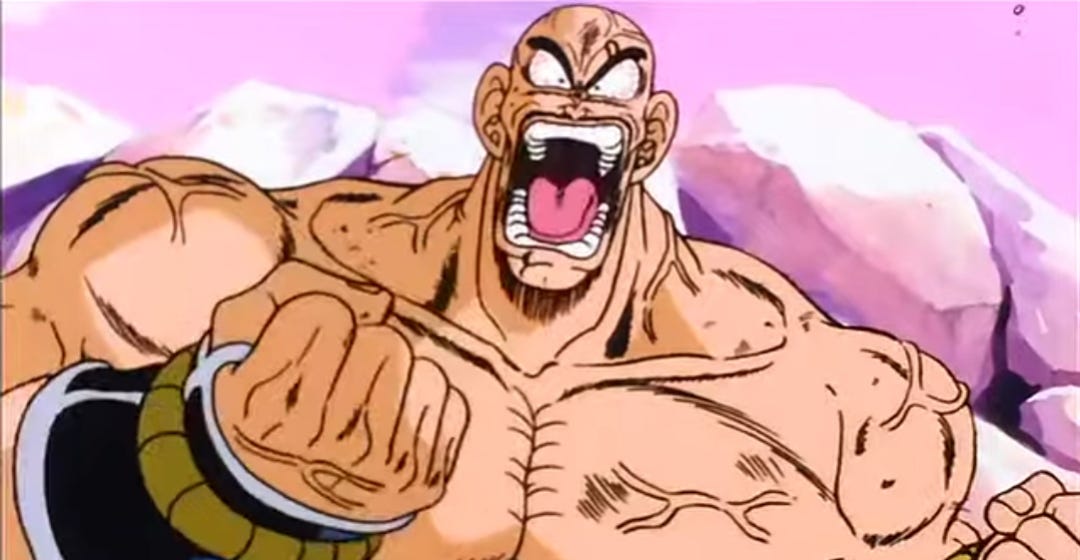
Angry Nappa

Piccolo has some really great lines. He’s cool, he’s tough, he’s sassy. I feel like every time he speaks, I want to know what he said. He doesn’t waste words.

When Gohan was turning into a raging monkey and going on a rampage, Piccolo realized that Gohan was transforming because of the full moon, and without hesitation, Piccolo destroys the moon. In one blast, he obliterated the moon. That’s badass. And afterwards, when Gohan has changed back into a regular five-year old human, Piccolo looks back up at the sky and says, 「月を飛ばすのは正解のようだ。」 ”Tsuki wo tobasu nowa seikai noyouda.” Meaning, “It seems that it was right to destroy the moon.”

Yep, you had no choice, did you Piccolo? Sorry, moon. Had to stop Gohan from going on a rampage.

Piccolo leaves Gohan in the wilderness, to survive on his own for six months. Gohan is crying, and before he leaves, Piccolo says, before he flies away,「恨むなら、自分の運命を恨むんだな。この俺のように。」

  • Uramunara, jibun no unmei wo uramundana. Kono ore no you ni.
  • “If you have to blame anyone, blame your own destiny. Just like I do.”

How badass is that? (Gohan’s destiny is to be a secret weapon and hope against fighting the super-powerful aliens who plan to eradicate humanity.)

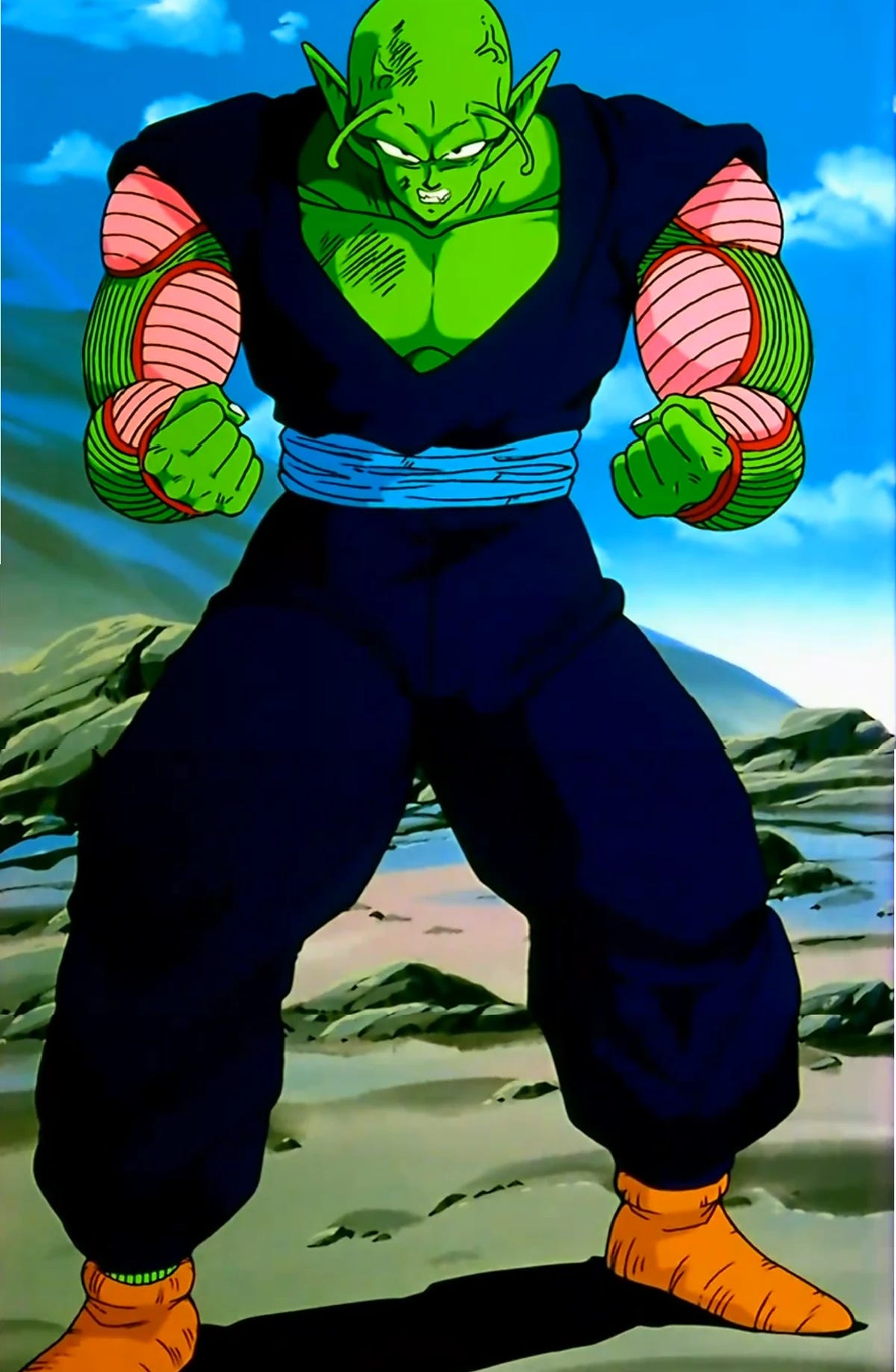
Piccolo

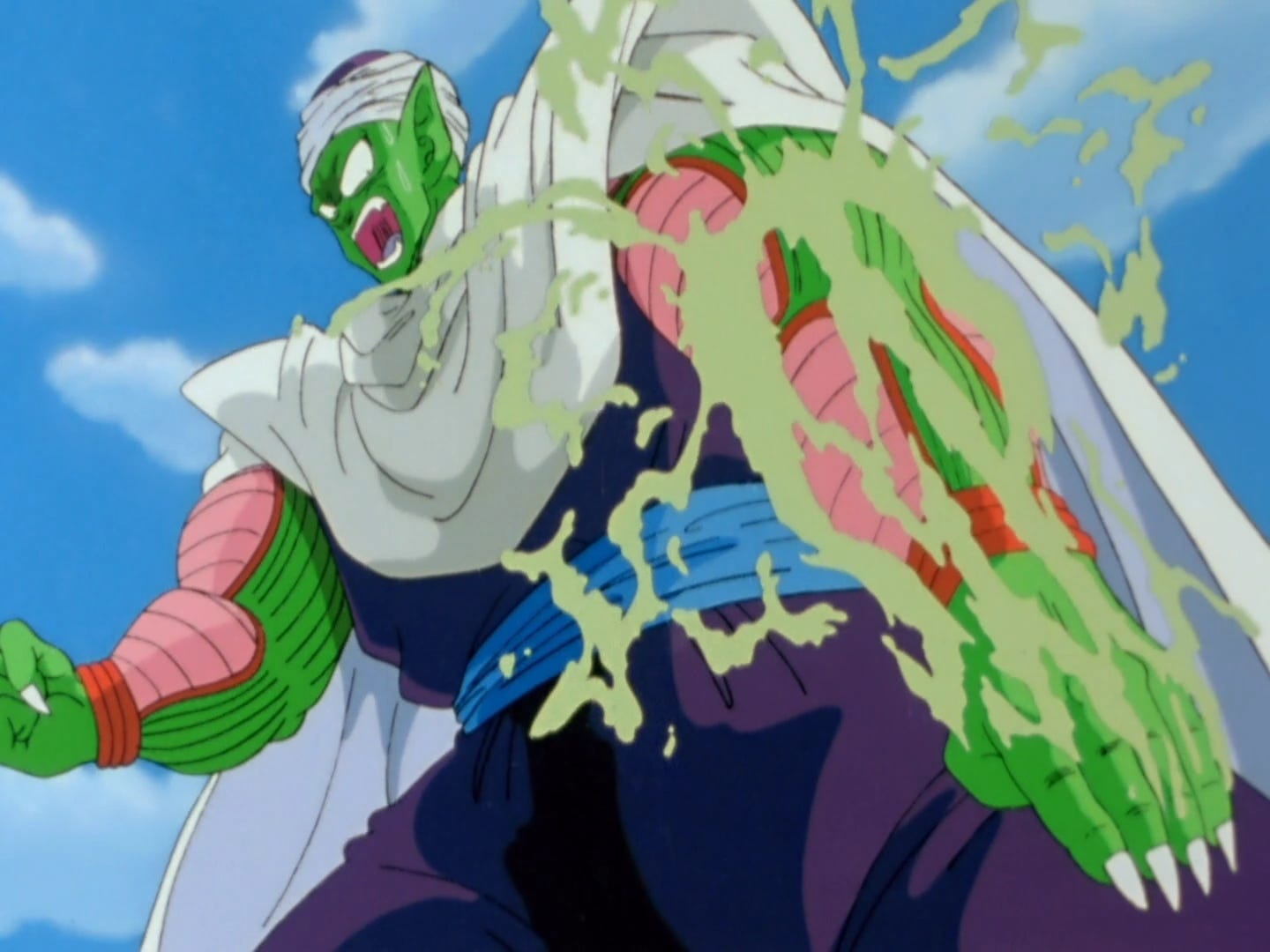
In the fight with Radditz, Piccolo loses his arm. I thought, “Well, he’s lost an arm. I wonder if he will get it back?” Just having a feeling that he would. And after the fight, and Radditz is defeated, Piccolo takes a moment, to start screaming, and to the shock and awe of all, regenerate his arm. What incredible power.

Piccolo regenerating his arm

While fighting Nappa, Piccolo drops a line that I had to rewind about five times, because he says so much so quickly. And finally, after about five replays, I caught the whole thing. Here was the line:

  • 「奴を攻撃に移るわずかな一瞬に隙ができる。その時を狙うんだ。」
  • Yatsu wo kougeki ni itsuru wazuka na isshun ni suki ga dekiru. Sono toki wo neraunda.”

Which means, “When he [Nappa] goes to attack, there is a very small window for us to strike. We will aim for that.”

If we break this sentence down:

  • 奴を攻撃にいつる → He goes to attack
  • わずかな一瞬に → Very briefly
  • 隙ができる → A window/opening presents itself / There is a window (for striking)
  • その時を狙うんだ → We aim for that time

This is a great sentence, and very Japanese. Especially the word 隙 (suki), represents more than a just single word. It is a concept, which is, in this instance, an opening in the armor, or a window of opportunity for striking.


Piccolo and Krillin fighting Nappa

Some other good lines from Piccolo:「いずれにしても、全員殺すつもりだ。」“In any case, they plan to kill everyone.” And, 「お前のような臆病者はいらん!」“We have no need for a coward like you!”

Deep in the fight with Nappa, and they have tried multiple methods of defeating Nappa, Krillin says to Piccolo, 「ピッコロ、どうする?何が手立てはあるか?」(“Piccolo, dou suru? Nani ga tedate wa aru ka? “Piccolo, what should we do now? Is there some other way we can defeat him?”)

And Piccolo simply replies,「ない。」

Nai.

Meaning: “No.”

Nope. There’s no other way.