
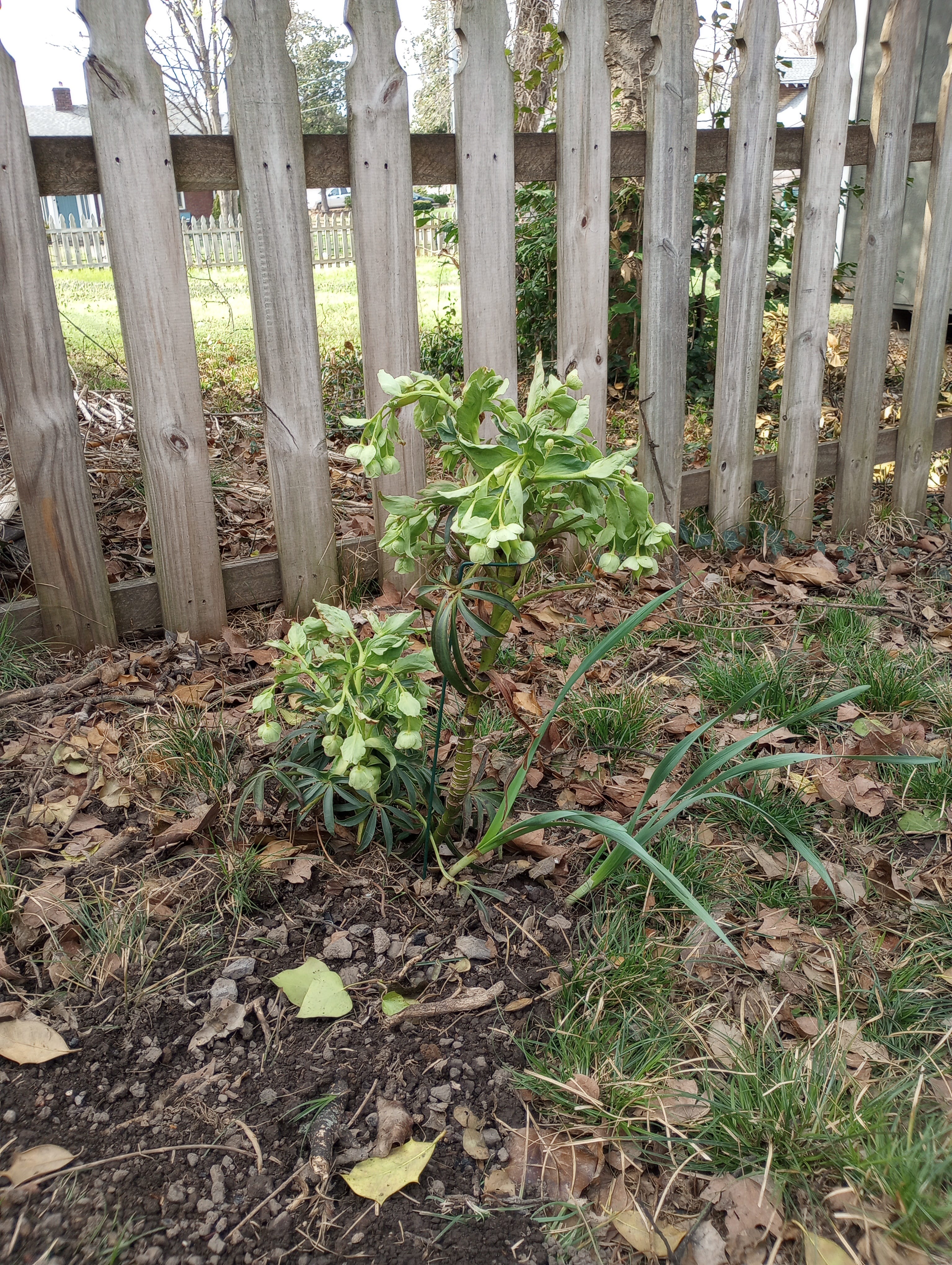
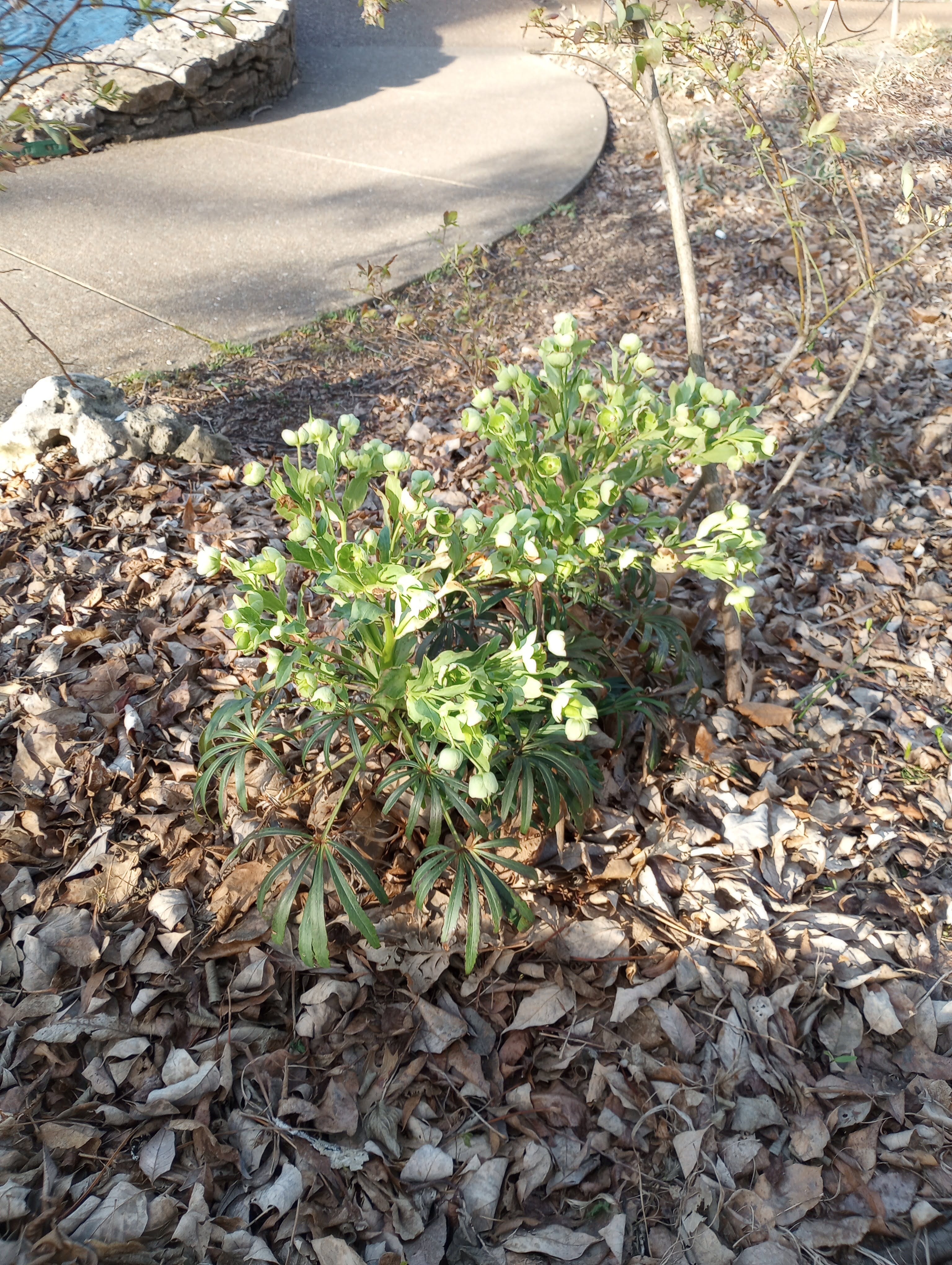
These days, Stinking Hellebore has my full attention. The above photo is my very own Stinking Hellebore, gifted to me by an incredible, comedian woman, named Donna Jo. Yes, the name truly is “Stinking Hellebore”. That’s what the people are calling this funky green beauty.
Donna Jo is a Master Gardener, the second Vice President, as in, the second of the two Vice Presidents, of the TN Extension Master Gardener program. Donna Jo held a public, group shaming of all individuals present at one of our meetings, who did not have their nametags, which they have stressed are very important. It was my third week of not having my nametag, three in a row, I was conscious of it, and Donna Jo, when she graced us with her presence, at the meeting, she had everyone who did not have their nametags raise their hands, and then she did a public shaming, and had everyone, on the count of 3, say, “Shame on you!” This public shaming was effective, and I have not forgotten my nametag since.
Donna Jo, in the same meeting, held another public shaming, I think purely because she really wanted to have another one, the earlier one was not enough, and she said, “Raise your hands if you were the bug killer in your family!”, and several hands went up, and she had us say, again, on the count of three, “Shame on you!” Our fearless leader Amy Dunlap had returned from her earlier absence, and was witnessing Donna Jo’s public shaming ritual with some horror and bewilderment, and she said, the most perfect line, “What are you doing??” We all cracked up at that.
Donna Jo could not help but be funny, can’t help but be funny at all times. You can see it, it was obvious from the beginning, that this is a real character here. We all knew it. Well, at my first volunteering event at the Nashville City Cemetary, where I learned what a hellebore even was, and cleaned up the beds, pulling the weeds, doing some pruning of the irises, I popped over to the bed with Donna Jo and Margarita, and at some point, she said, “What are you doing after this?” I said, “I’ve got yoga at 2 pm.” So, she said she had lilies if I wanted them, and I did. I am at the point where I will take almost anything I’m given, because I have space in the yard, and a willingness to give it a go. So, we cut out a little early, which was great honestly, I was hungry and getting a little bored (2 hours of weeding already), and so I followed Donna Jo across town to her house. I had heard great things about her garden, she had showed me some photos at our Master Gardener meeting, when I was asking her about some plants, and she gives a tour of her garden for the program, which is highly attended. I did not expect to get over to her garden so soon, that’s for sure, but you never know how things will go.
Donna Jo’s garden is a small paradise, and I have no photos of it, not right now, but it is a domestic botanical garden. You can immediately tell that hundreds if not thousands of hours, significant amounts of love and care have gone into the cultivation of her landscape. Tens, 30 or 40 forsythias that were in bloom, lining the driveway, forming a grove in the back, and large beds of daffodils, lilies, irises, daisies, etc., and then hellebores, and all kinds of other things that I don’t know the names for. She was giving me some of these lilies, to divide them, keep the garden bed from overflowing and being too cluttered, and she gave me plenty. I was then checking everything else out, as we walked around, asking her about things, and there was a really interesting plant, and I said, “What’s this one?” And she told me it was a “Stinking hellebore”. Except, she was 100% calling them “hellebora”, I’m almost positive. Well, I thought that was an incredible name for such a beautiful plant, and she said that they don’t even stink. Right now, with the flowers, it smells wonderful. Very pleasant and fragrant. So, not sure about the stinking part. But, after all the lilies, she had dug me up ten or fifteen, big ones, healthy, huge tubers, and I was admiring the Stinking Hellebore, and she said, “Want one? I’ll give you one.” And I was like, no way Donna, I can’t just take one of your amazing Stinking Hellebore. She insisted.
She initially was going to give me a really well-developed, large, beautiful Stinking Hellebore, but I was really unwilling to take such a wonderful specimen, that was clearly doing so well, and looked so great. It felt like too much. She ended up finding me a smaller one, still quite large, but it was mixed in with several, and so she dug that up and it was mine. I’ll tell you that I felt like I had gotten a puppy, I still feel that way, and I was extremely careful with this new baby of mine, all the way home, and I planted it immediately. I sent Donna Jo the photos, so proud, of the Stinking Hellebore in its new home.
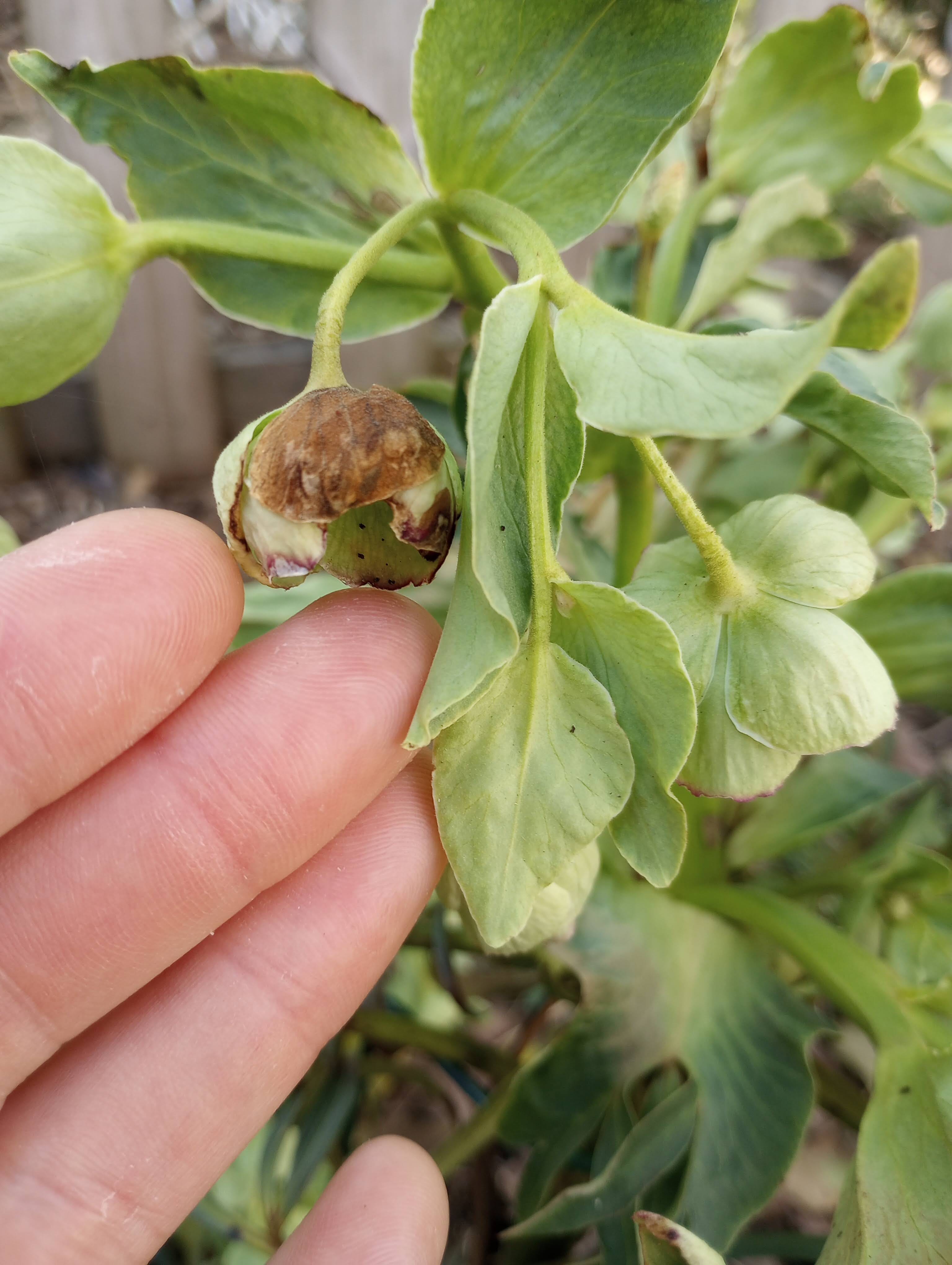
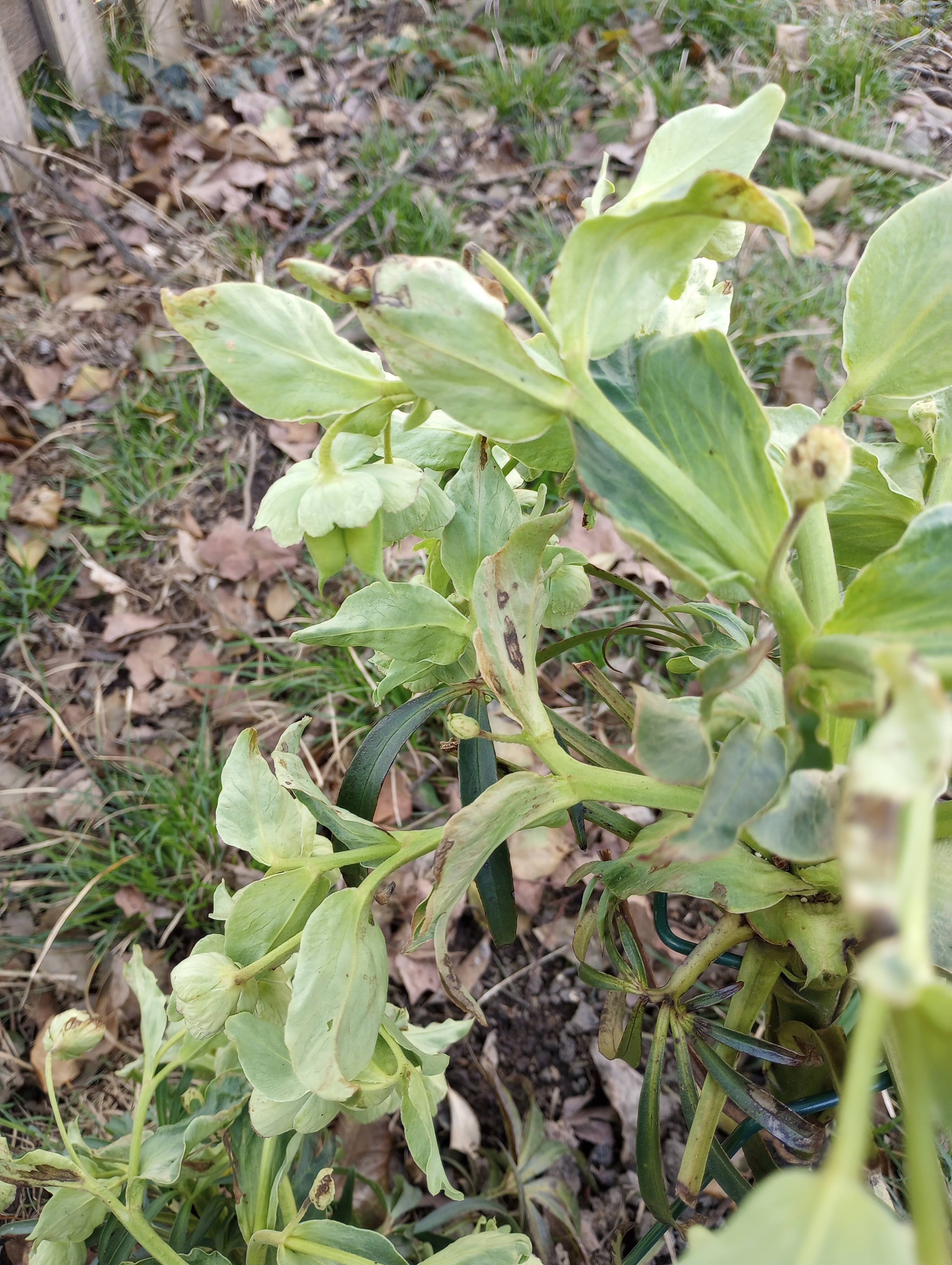
Now, I have monitored the Stinking Hellebore, my baby, carefully, and for at least a week, several days after the planting, it was looking fine and dandy. However, about four days ago, I noticed some browning. One of the flowers was brown and curling up. That was the first sign, and I spotted some browning, splotching on other leaves. That was concerning, and the next day, two days later, a little more advanced. Today I checked, and it looks like the browning hasn’t increased any since then. That’s good. I assume that this is simply “transplant shock” (I’m not sure if that’s a term exactly but I think it is), as the plant has just teleported into a new environment, new soil type, different amounts of sunlight, and the roots have to resettle and adapt to the move. I haven’t overwatered, although the soil might still be a little wet for it. It has rained a bit, and that soil there has stayed moist. It doesn’t get intense sun all day, but sun until about 1 or 2 pm. That could matter, but right now my diagnosis is simply that it’s having some stress from the move.
You may know that I am concerned with the invasive plant problem, and am certainly not wanting to propagate any invasive species, and plant natives, mostly. Well, already I’ve had my first test, the first real test of my principles. Because, I immediately researched my new Stinking Hellebore baby, and discovered some concerning things—native to Eurasia, and in some places (TN not yet one, but I think North Carolina was on the list), hellebores are considered invasive. This means that I now may be propagating and caring for an invasive plant. Yes, me. What can I do? This is how principles are tested. You say, no nepotism. And then your nephew is trying to get a job. What do you do? You get what I’m saying.
Well, as we can see, I did plant it. I had to. Donna Jo gave it to me. That’s my excuse, I guess. Is this one plant likely to be the demise of native plant life in Tennessee? No, no… and I have done so much good work in removing invasives off of my property. So, if we look at the scales of justice, or whatever, surely they are balanced in my favor, regarding my ecological footprint… I can have a Stinking Hellebore, right? It’s a slippery slope, I suppose. It’s easy when they aren’t pretty, but then someone wants to give you a pretty one, one that’s caught your fancy, and oh boy, what do you do now?
Donna Jo had a beautiful vine, ground cover, called periwinkle, that’s flowering right now, and is very attractive. I had heard of that, and thought, at the time I thought it was native, and thought that it could do part of what wintercreeper is commonly doing right now, being an attractive, green ground cover. However, sadly, not-native, and considered invasive. That made me sad.
On a side note, wintercreeper is really an amazing plant. It can literally become a shrub, form itself upwards and become a dense bush, standing alone. You see it in that form all over in the neighborhood. So, wintercreeper can be literally just a mass of ground cover, or it can be snaking up a tree and forming a large canopy on the trunk of a tree, or it can wind itself up and become a dense shrub. I don’t know how they get it to do that, if it is another cultivar or what. But, that’s pretty amazing, to be so modular as a plant.
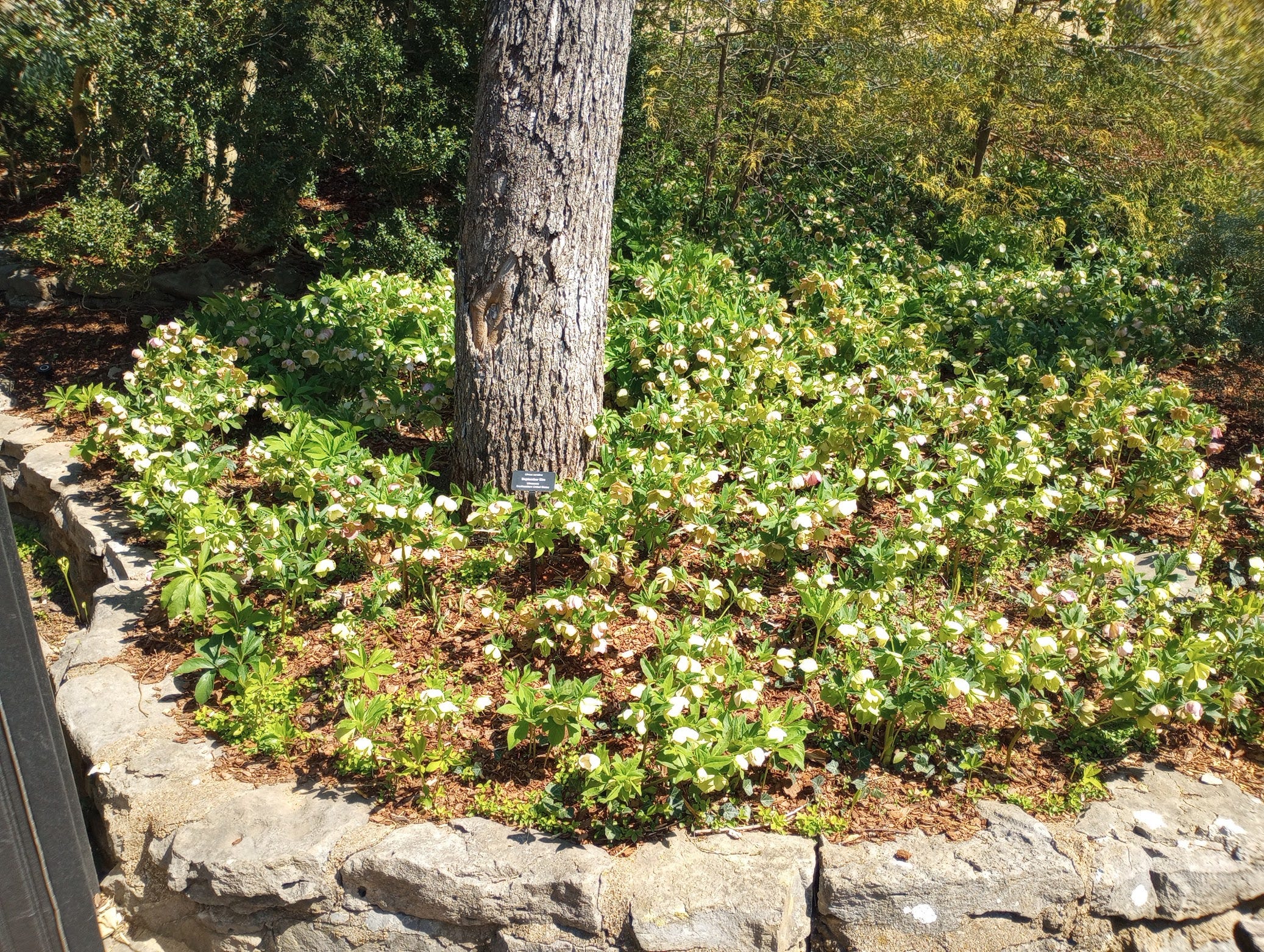
Now that hellebores are on my radar, again, I know I have said this many times, but it really is so true—once you learn about a plant, you start seeing it everywhere. That’s just how it goes. Because, I swear to god I have never seen a hellebore in my life, not once in my 30 years, and now I suddenly see hellebores everywhere I go. All over, but really, that means at Cheekwood, which is a botanical garden after all, and then today, at Vanderbilt, on the campus. At Cheekwood they have tons and tons of hellebores right now. They look healthy and are blooming well.
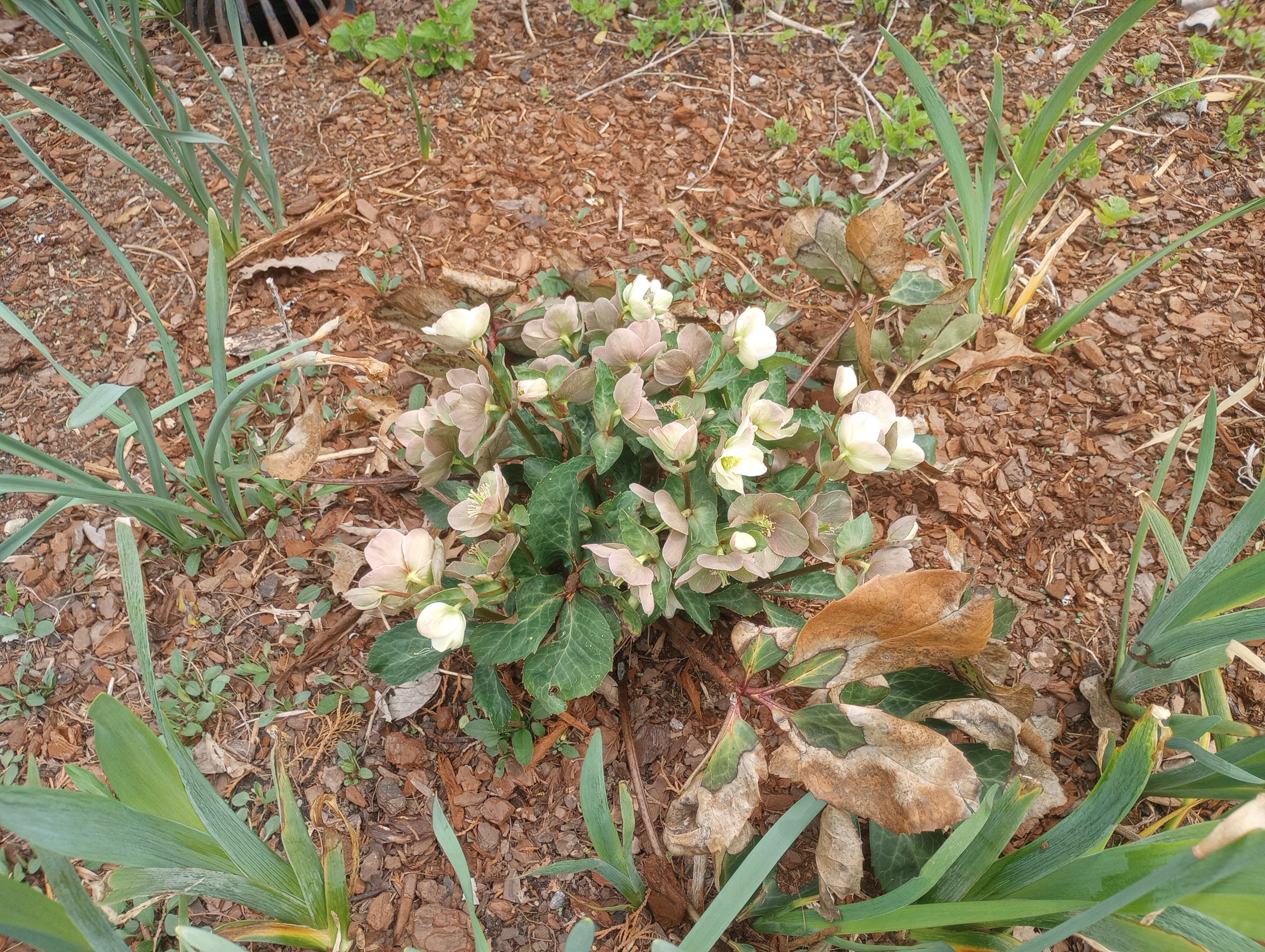
When I went to Vanderbilt today, strolling around the campus, there was a large bed of hellebores, not the Stinking, but the other kind, and they were not looking so good. Armed with my newfound gardening knowledge, I am inspecting all plants, and assessing their conditions, taking notes. These hellebores were stressed, not doing as well as the Cheekwood hellebores. Why? They were wilted, starting to wither. That’s what drought-stress looks like, I thought, and then looking at the soil, it was dry, with visible cracks. This garden bed was between a sidewalk and building too, if that matters, which it probably does, raising the temperature of the bed, and reflecting light. It seemed to me like they needed water.
Who’s the gardener? Excuse me, who’s responsible for these beds??? Give them hellebores some water!!
 HAKUMUSU