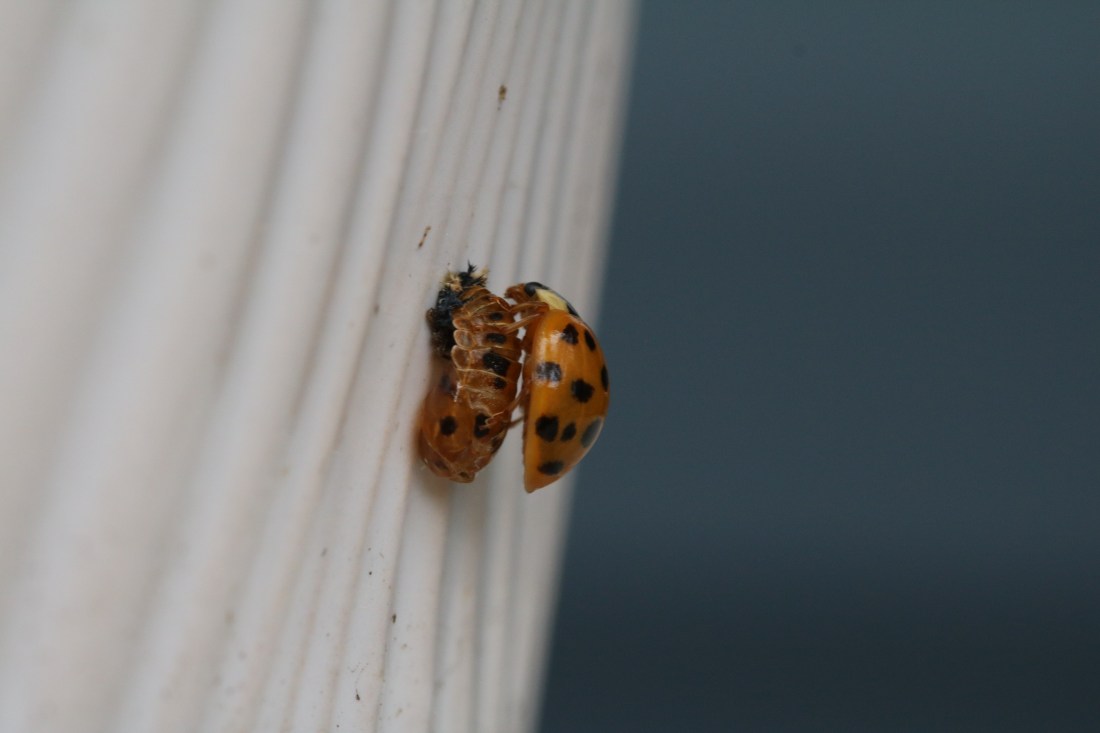
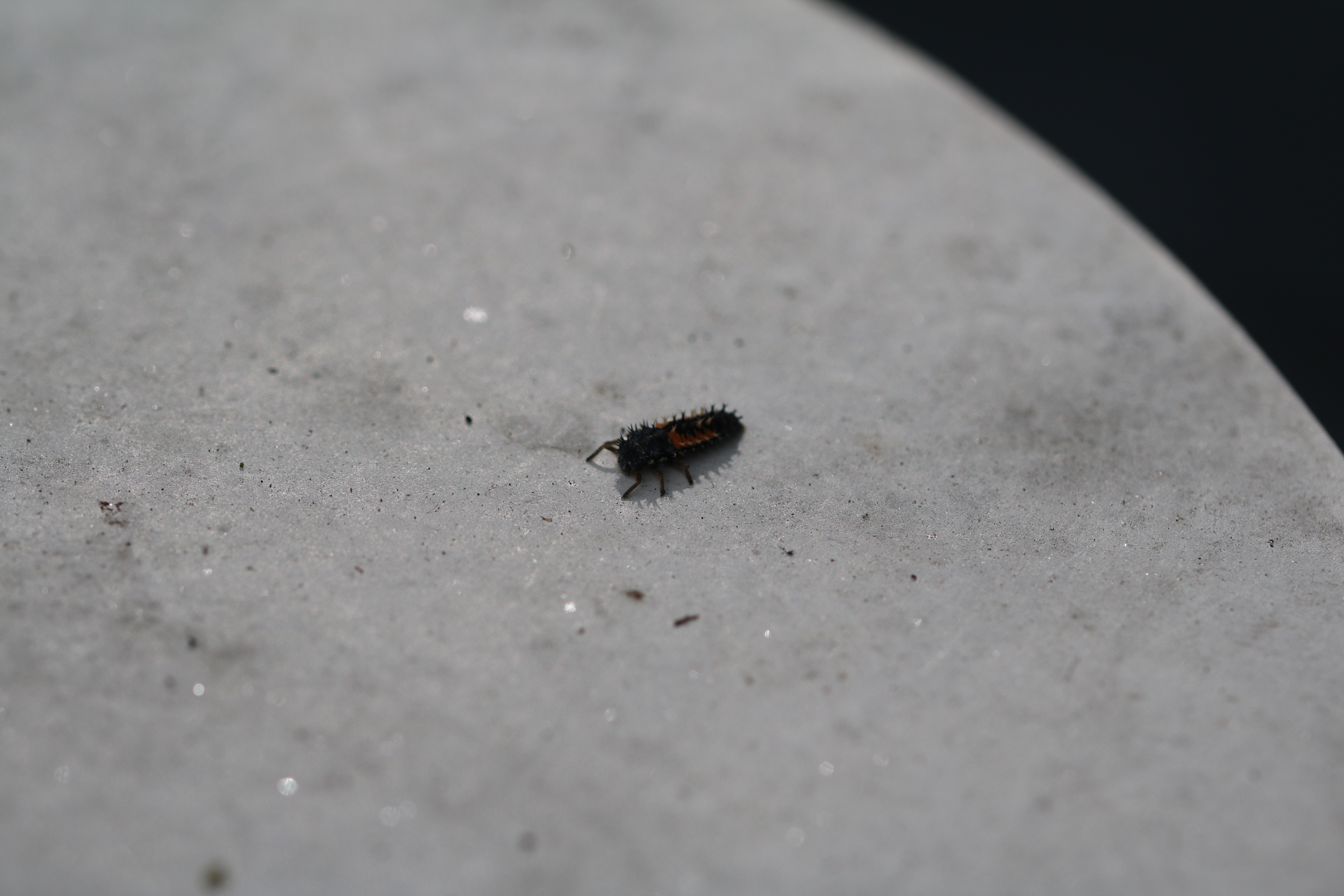
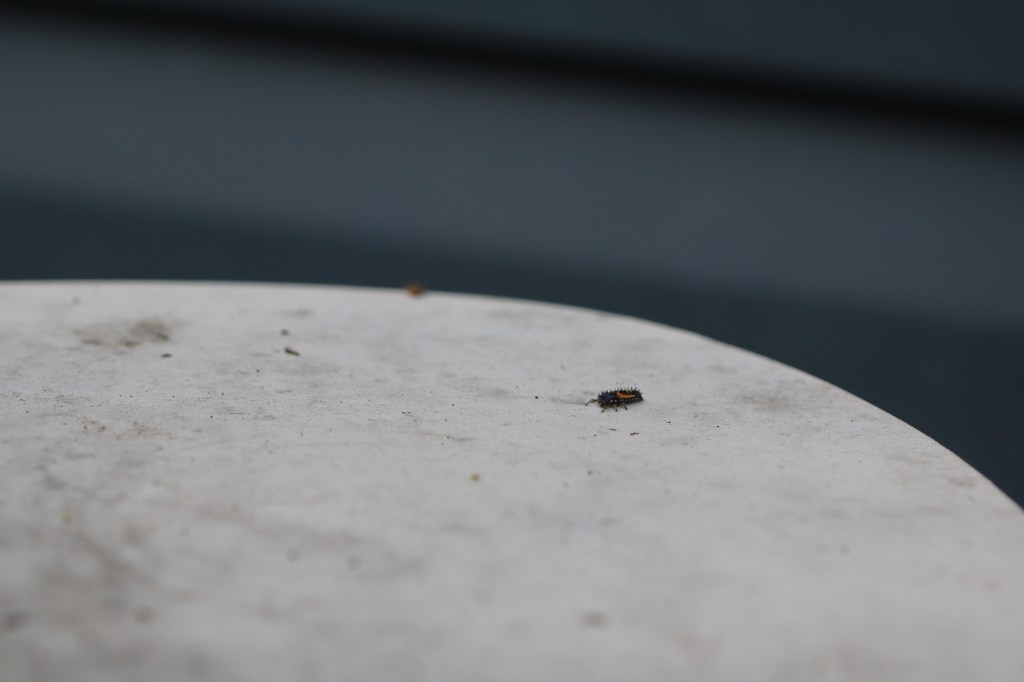
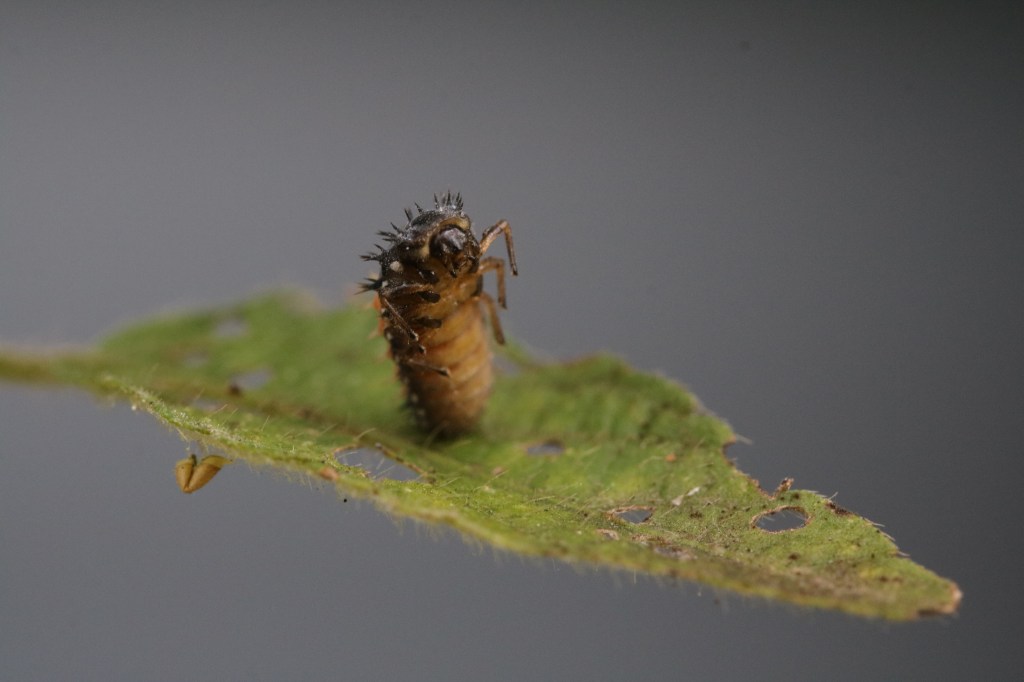
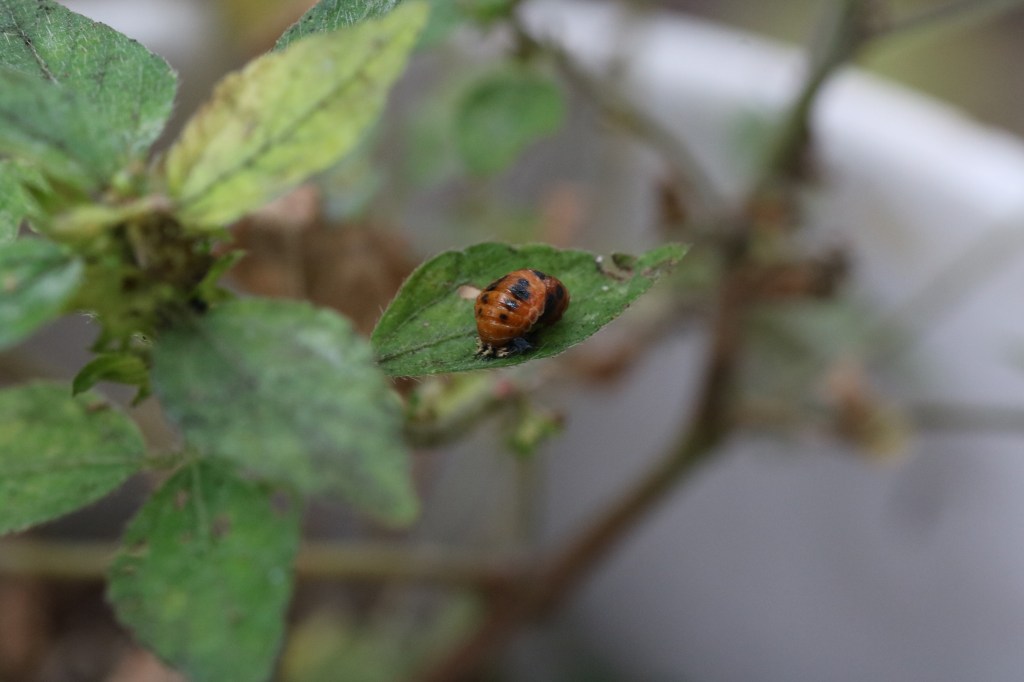
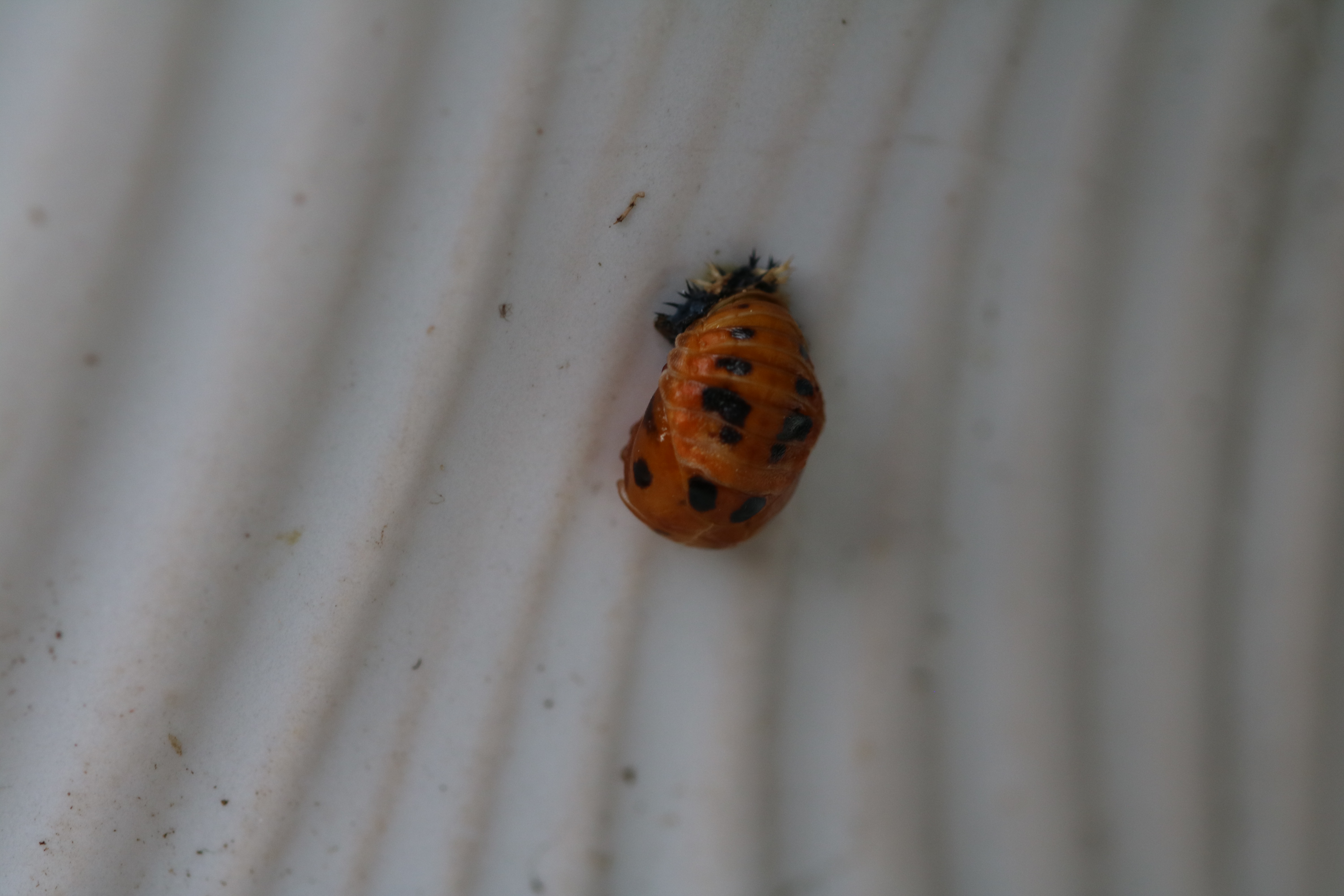
There are a lot of ladybug larvae out and about right now here in early October (Oct. 8th). They’re all over the yard, making their tiny metamorphoses on my front door, my plants, the vines, my car. I was wondering why they would undergo their metamorphosis now, as winter is right around the corner (although we still have 2 months before then, and that is plenty of time to do stuff in the bug world). I read that ladybugs can live for several years and that they stay alive through the winter by hibernating. I had no idea about that.
I told my discerning sister that I had some photos of ladybugs and she said, “Are you sure they aren’t Chinese ladybeetles?” I wasn’t sure. And just now, looking at some photos of the Chinese ladybeetles, or, Asian lady beetle, Harmonia axyridis, they certainly look similar. The internet says that the Asian lady beetle is now in some parts of the US the most common ladybug around, and so these photos probably are of the Asian lady beetle.
There is no difference between a lady beetle and ladybug, they are all in the same family, Coccinellidae, which is a family in the order Coleoptera (the beetles). According to Wikipedia, “Entomologists use the names ladybird beetles or lady beetles to avoid confusion with true bugs.”
(The true bugs are the Hemipterans, another order.) I like saying ladybug, though, personally.
Larval stage #1
Larval stage #2
Larval stage #3
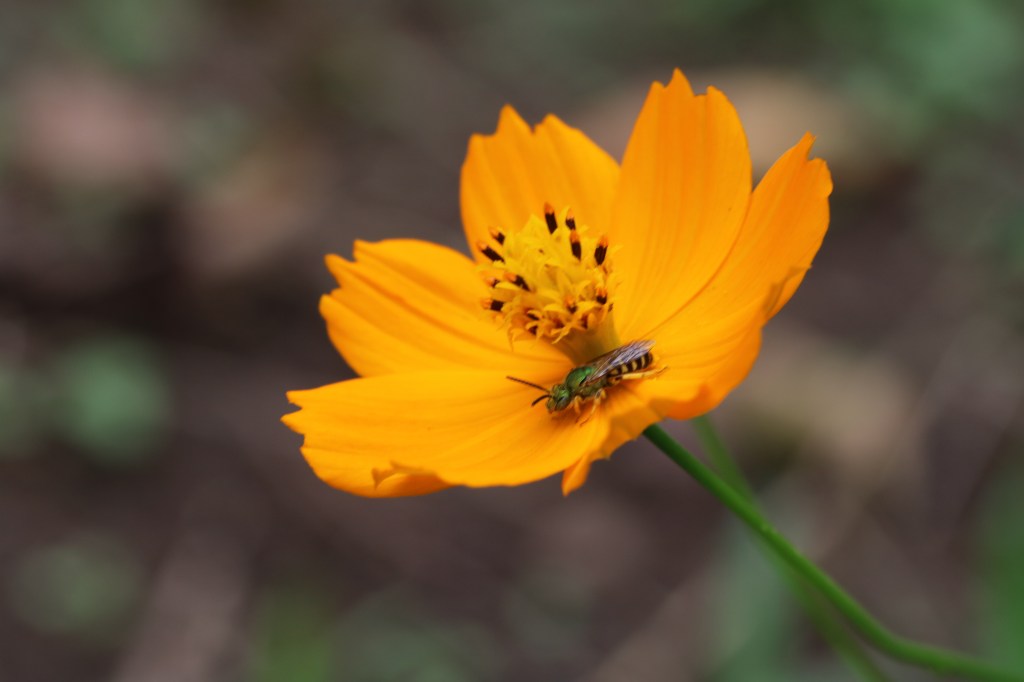
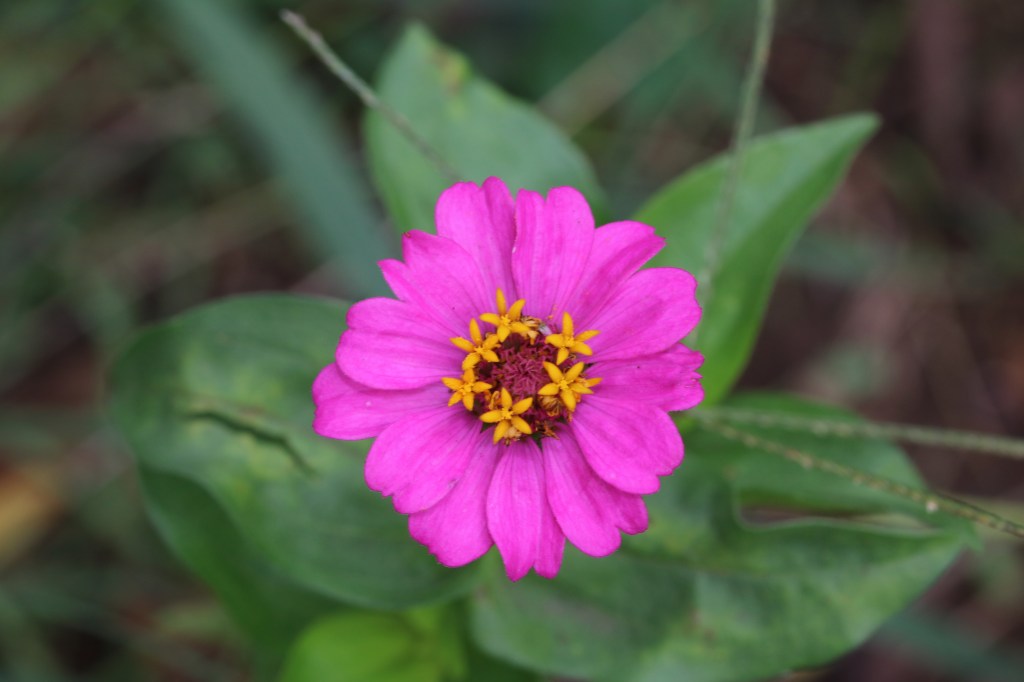
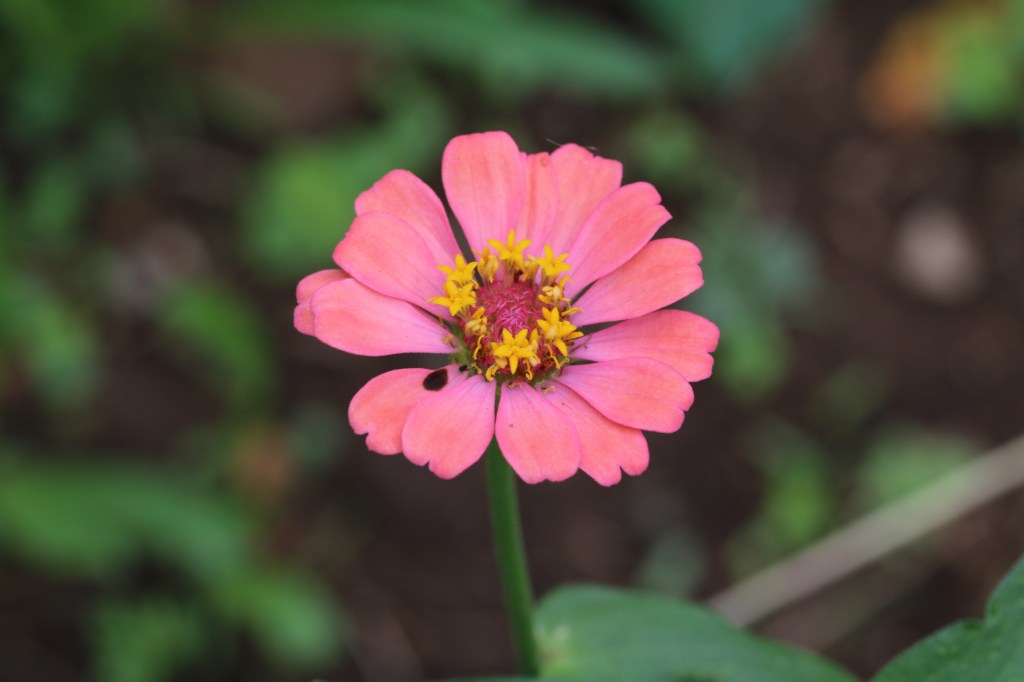
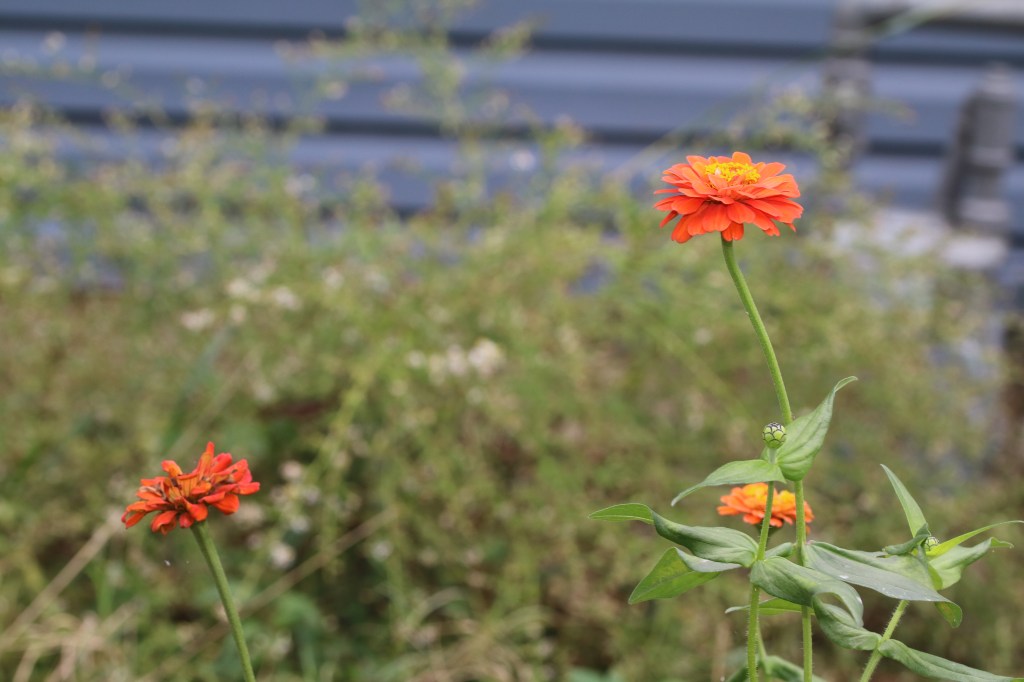
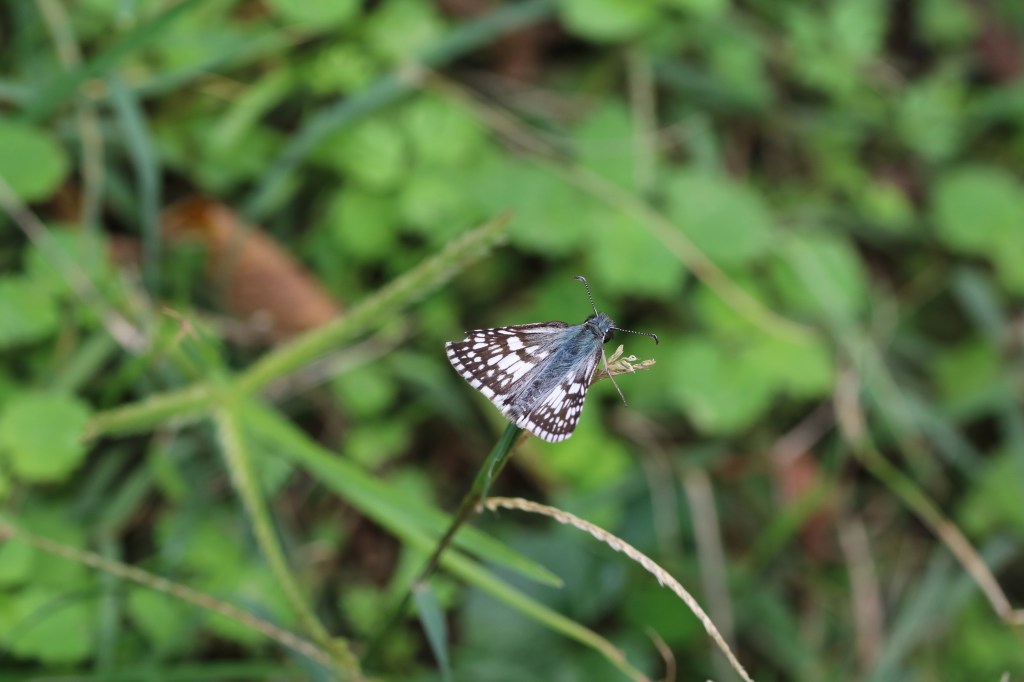
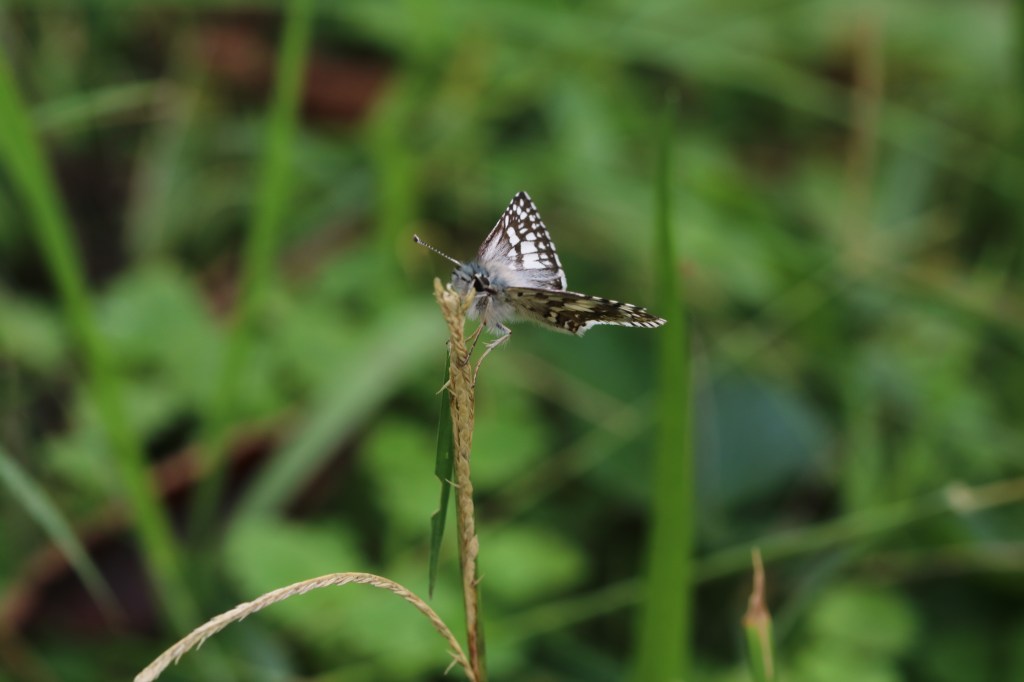
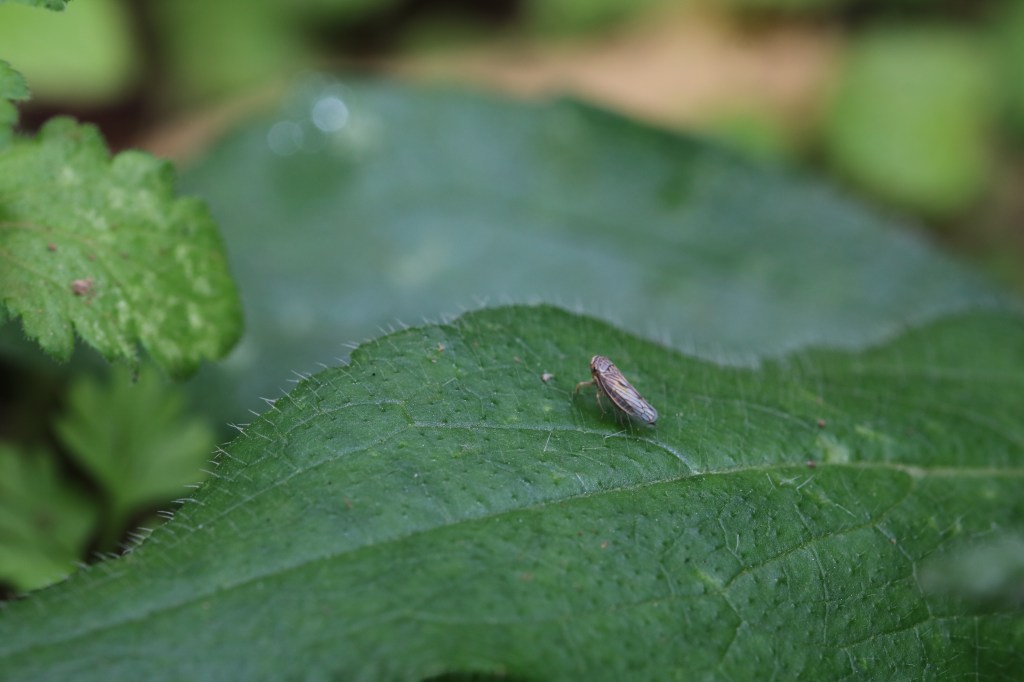
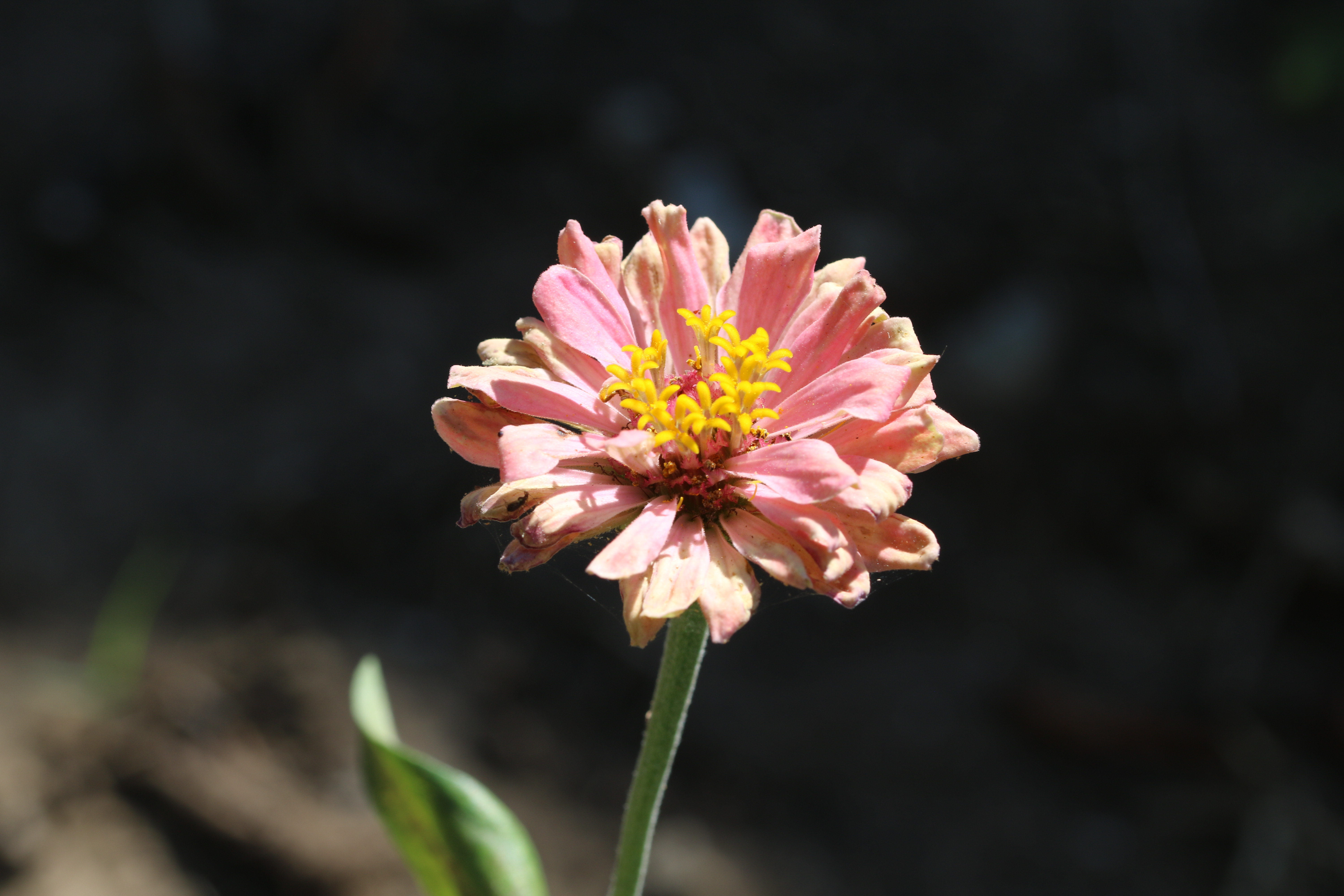
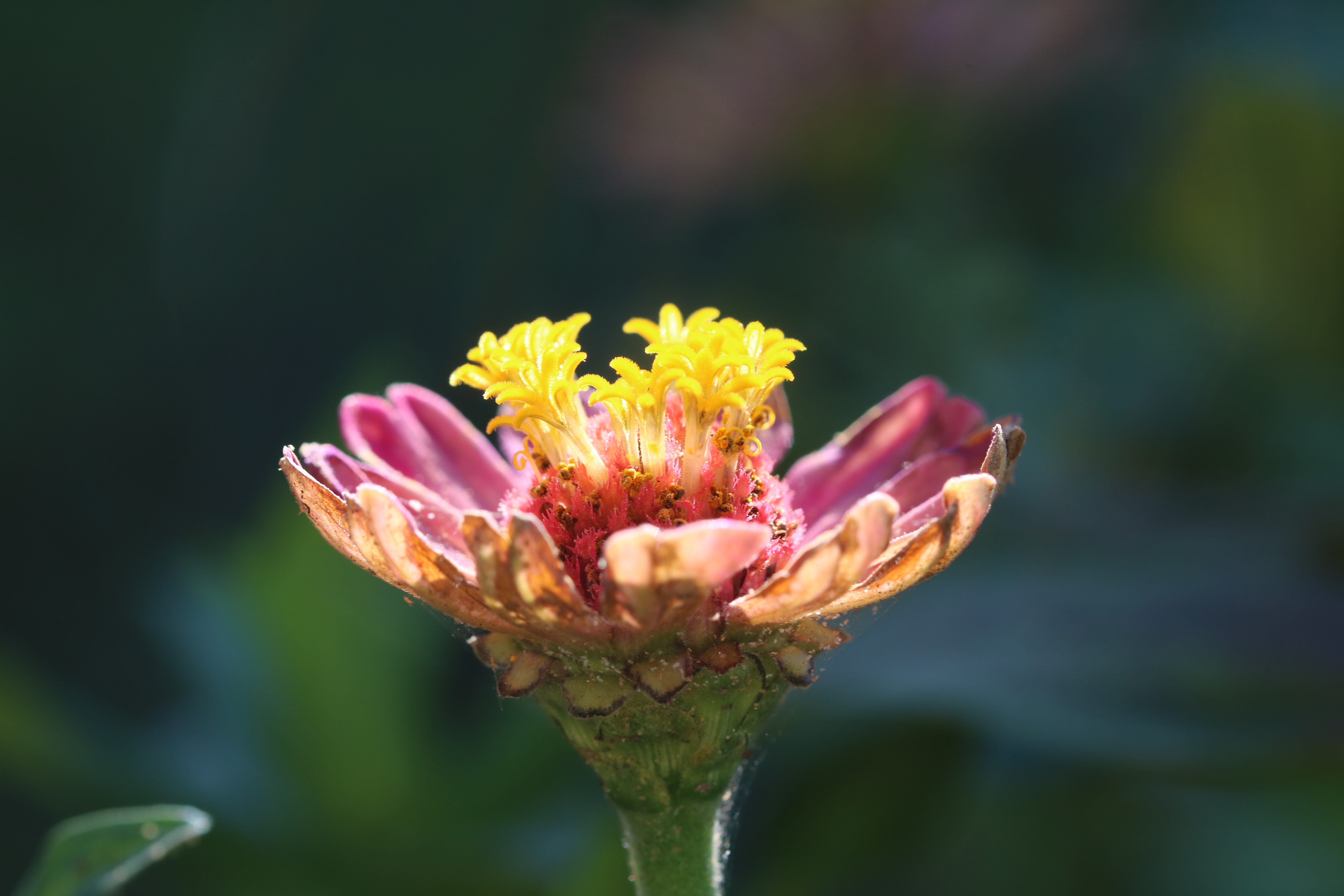
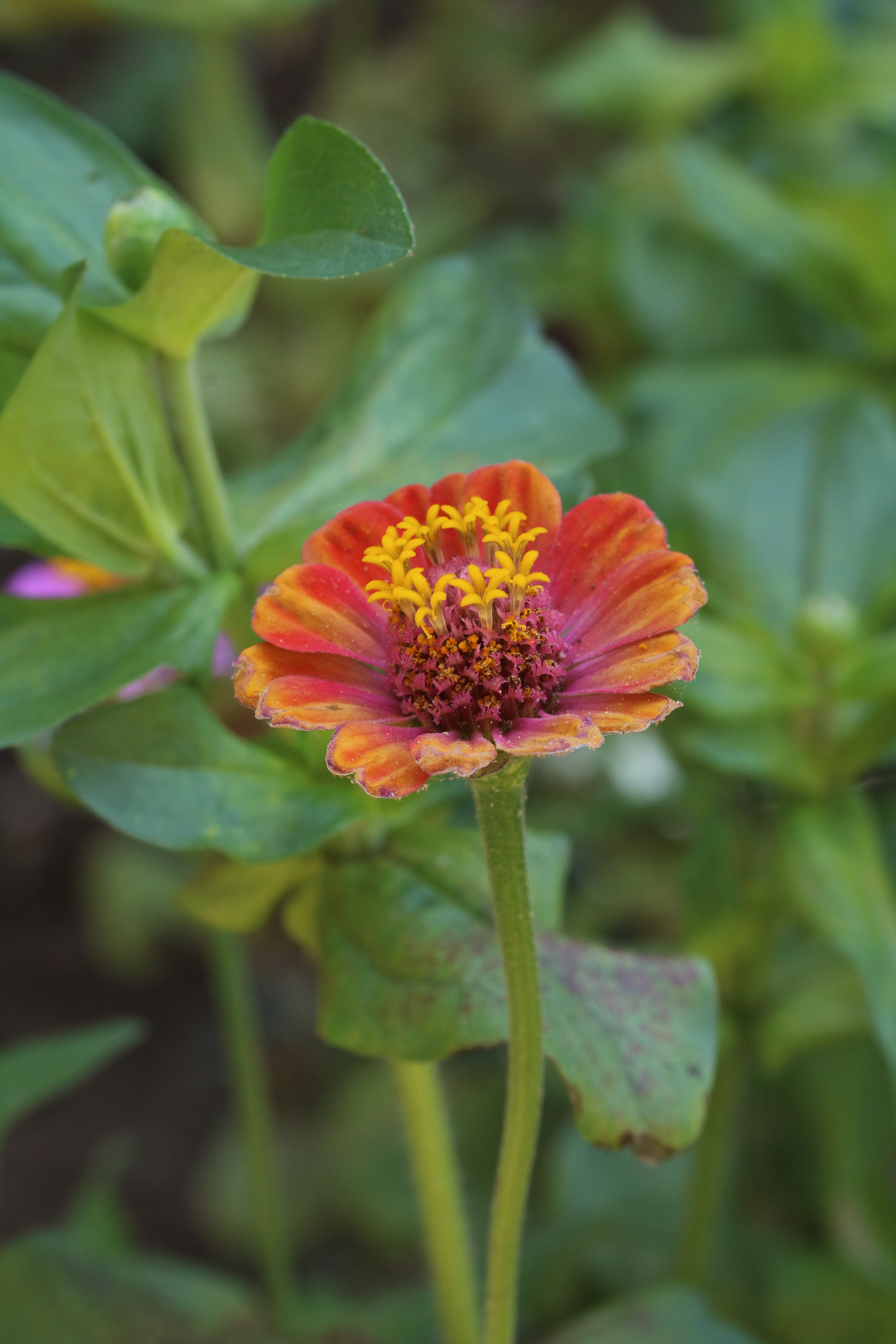
Preparing to undergo metamorphosisPreparing for metamorphosis #2Preparing for metamorphosis #3Pupal stage #1Pupal stage #2Pupal stage #3Final Form #1Final Form #2Final Form #3Cosmos with bee #1Cosmos with bee #2Zinnia #1Zinnia #2Zinnia #3 (orange!!)Common Checkered-SkipperCommon Checkered-Skipper #2Leafhopper (a true bug)
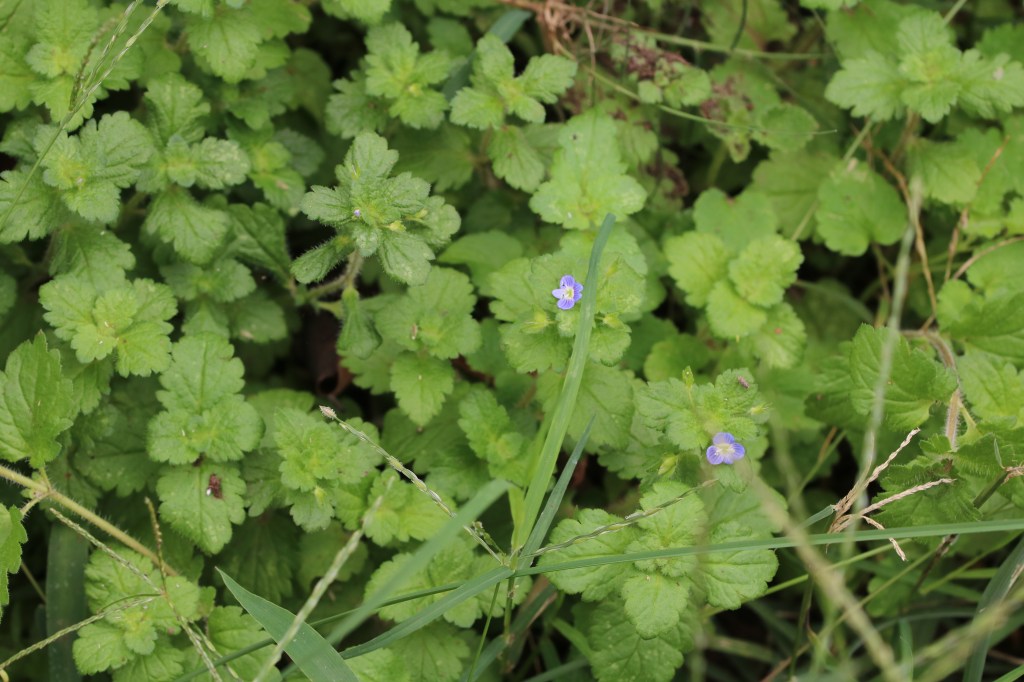
This Persian speedwell has been one of the main plants to dominate the bare dirt of my garden. I’ve just let it go and cover the ground. In the below picture you can also see the Three-seeded mercury, the taller, larger dark green plants. It recently put up some flowers, extremely tiny flowers. They must be some of the tiniest flowers you can find.
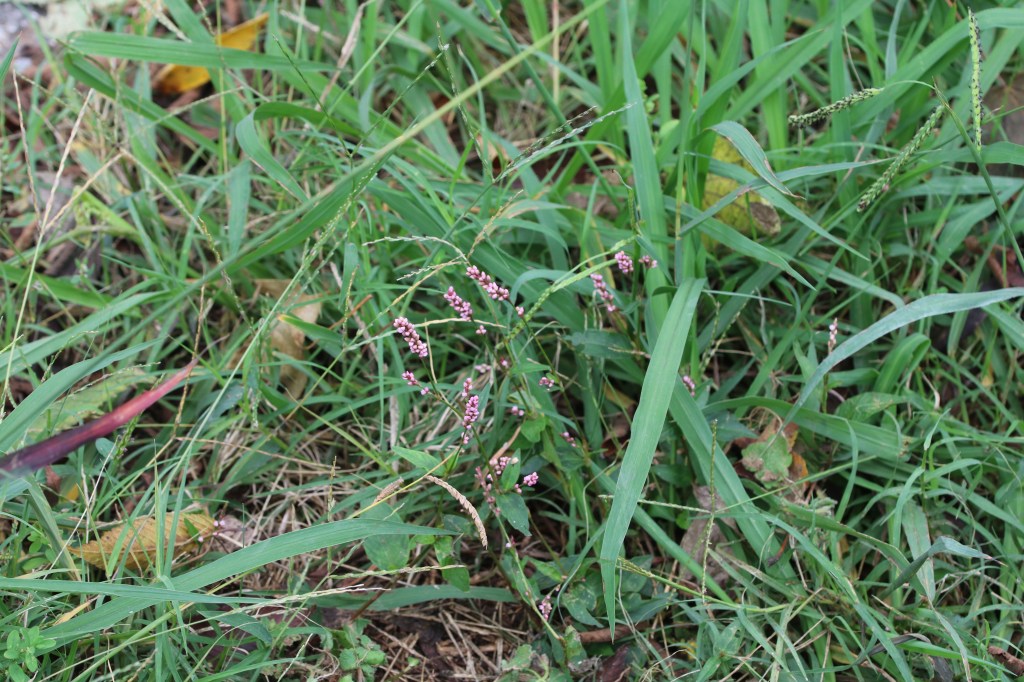
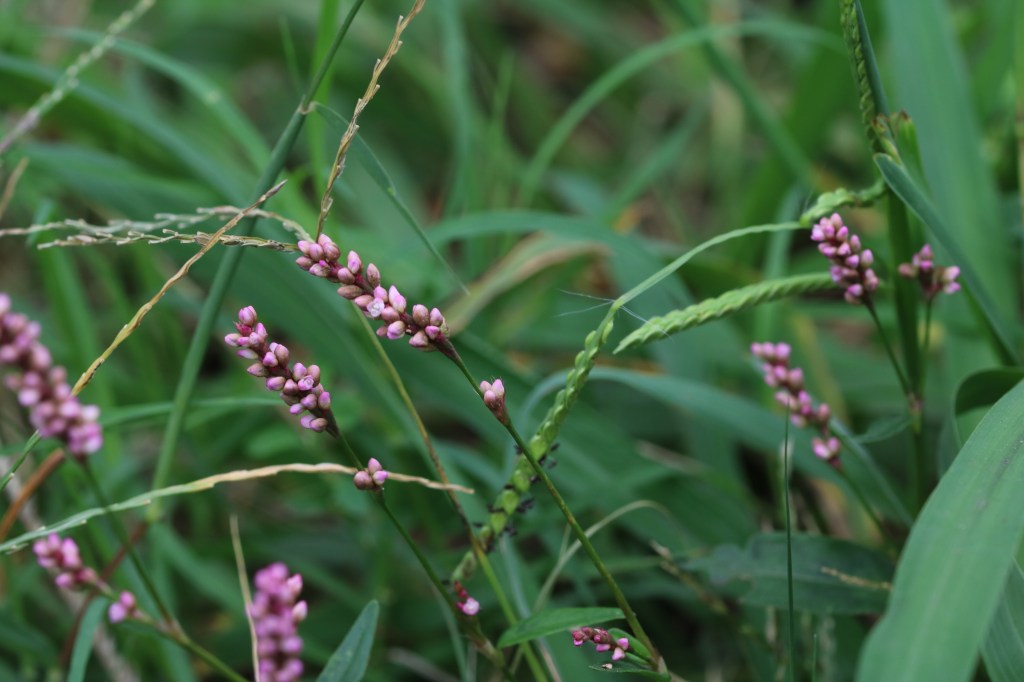
I’ve been seeing this Smartweed pop up, which has some interesting flowers/seeds. Are those pink things tiny little flower buds? Apparently the Smartweeds are edible. We’ll have to try some. (We as in me and whoever else I can get to eat it.)
Mostly Veronica persica, Persian SpeedwellVeronica persica flowerVersonica persica #2Some kind of Smartweed Smartweed
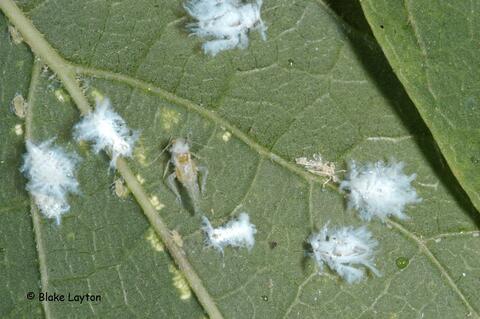
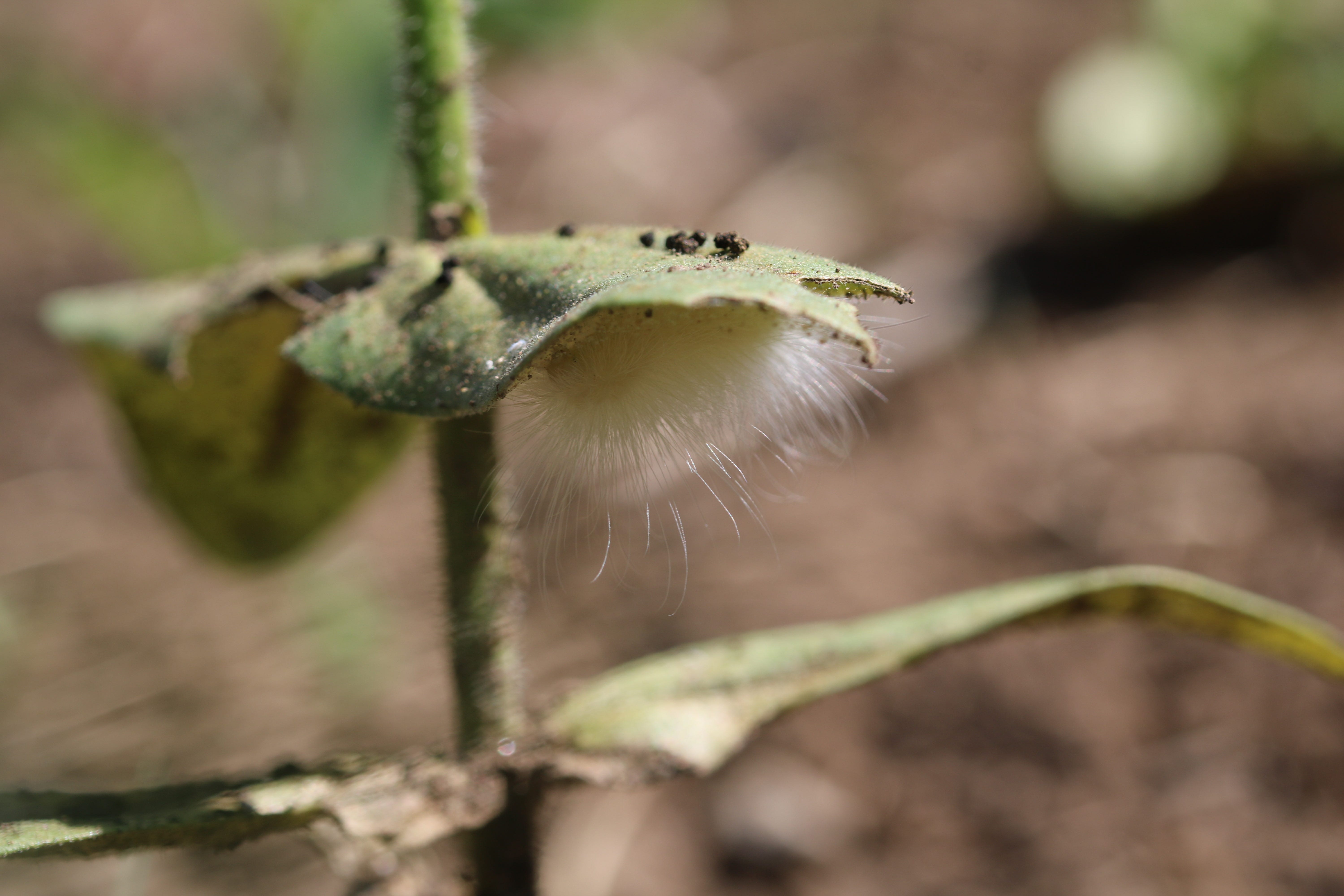
We also have crazy amounts of a fluffy white bug flying around and covering everything with sticky sap. Those are wooly aphids, and probably an invasive kind (from Asia), the Wooly hackberry aphid. According to the internet if you live in the Southeastern US, that’s probably what you’re seeing right now. And I have I think five hackberries in my yard, and a lotttttt of wooly aphids, so it would make sense.
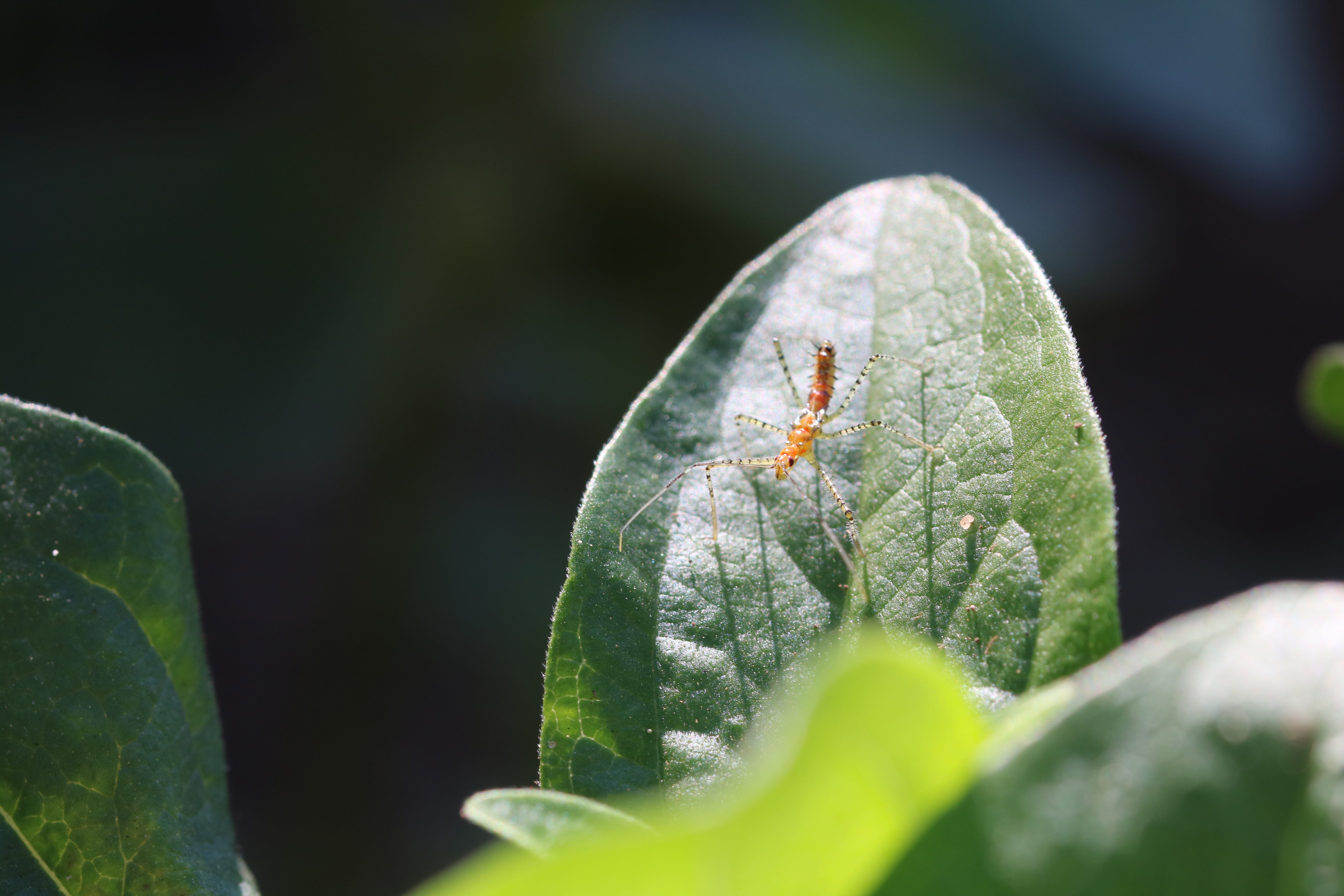
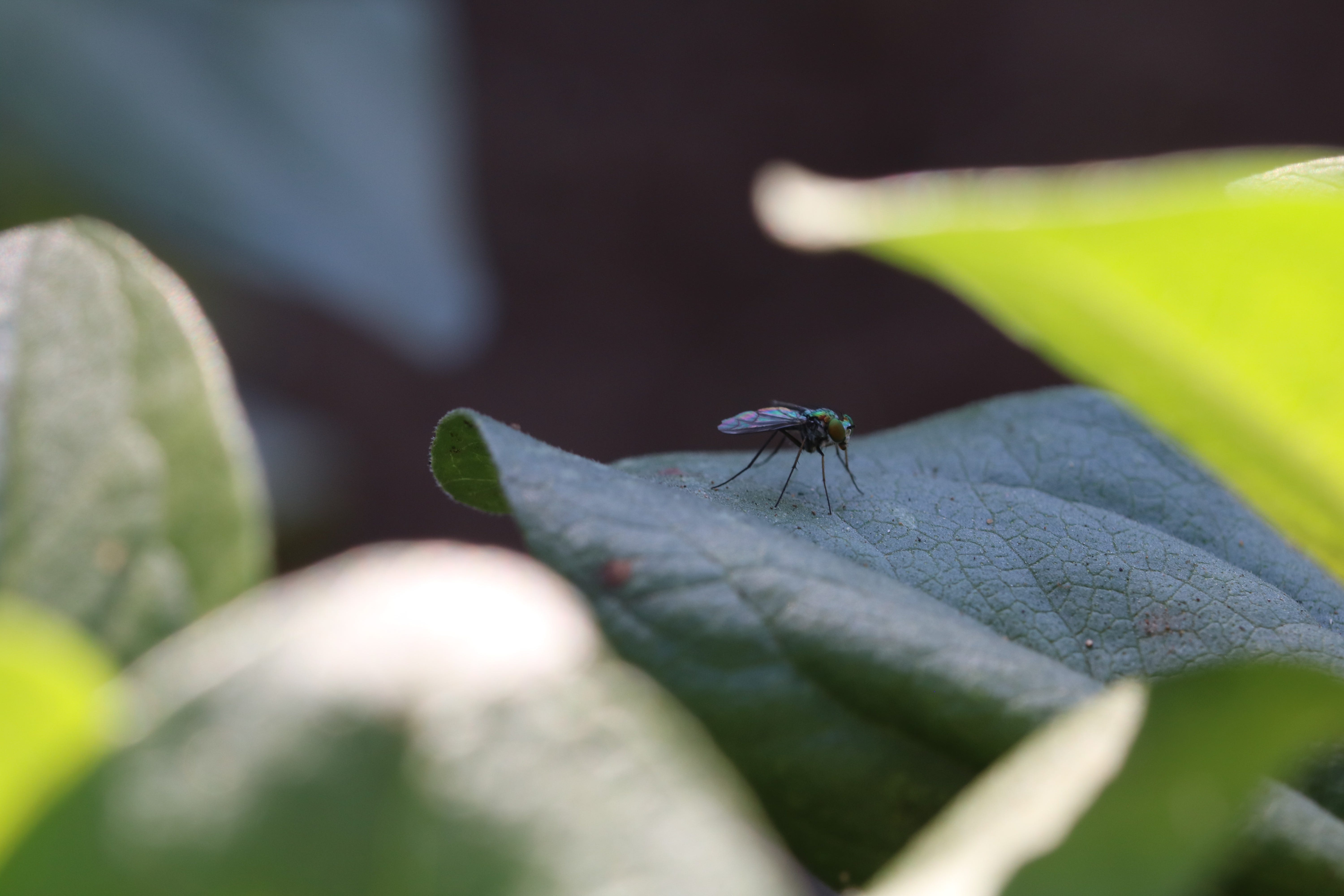
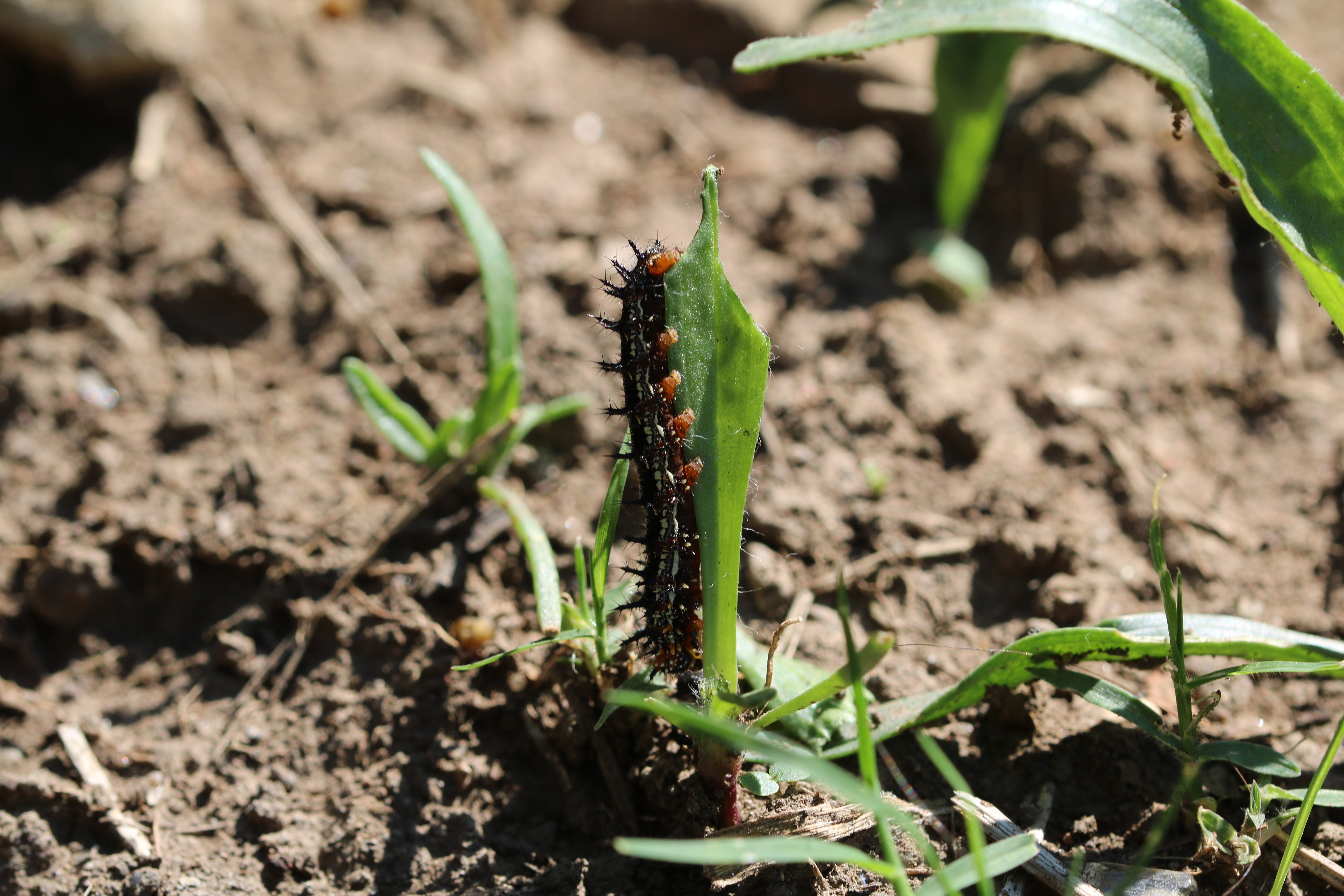
Assassin bug nymphClassic fly right hereCommon buckeye feeding on plantain weedWooly bear caterpillar (Virginian Tiger Moth?) feeding on zinnia
I was happy to see two butterflies this morning on my zinnias. They looked like fritillaries, large and beautiful. And I thought, I made that happen. There is something here now that wasn’t here before, this garden. These flowers.
Now, have I done a net good? Because I did unearth the soil and unhome many thousands of creatures that were living under the grass that I dug up. And I know there were little moths and creatures in there. But, I have done something for the aphids, the lacebugs, and the butterflies, at least. In the end, my flower garden (focusing on natives too, I’ll keep trying) surely will have more of a positive ecological benefit than what was there before.
The zinnias have been easy to grow. A lot of my other seeds are not sprouting at all, and I don’t know if they will. They could be biding their time, they may come up in the spring after overwintering. But the zinnias, they have done well.
I will say that I saw something amazing yesterday. I was walking home from the cafe and I noticed bees, hundreds of bees going crazy over a plant. I’m not sure what it was, it had blue flowers, long stems. I took a photo with my flip phone but that’s not useful for us here. I have to investigate that plant, because that was extremely popular and providing for the bees at an unprecedented level. (Update: it was Russian Sage, Salvia yangii.)
Only the mountain mint has rivaled that level of bee engagement, from what I’ve seen so far. And unfortunately I think my mountain mint is dead. 😢
Zinnia
I was hanging out in the garden yesterday and I had been thinking all day that I should do some macrophotography, but it was so hot and I was feeling lazy. Then, I was out there again, checking things out, and I saw that assassin bug nymph (1st photo) on a leaf, and I just had to get the camera out for that. That was a worthy target. I actually thought at first it was a praying mantis nymph, which I would love to photograph. But this nymph was cool too.
From the photos on the internet it looks a lot like a leafhopper assassin bug nymph. I also thought at first it could be a large aphid, but figured it was an assassin bug after looking at the closeup photos. They do look similar. Aphids and assassin bugs are both in the same order, which is Hemiptera. This order is also referred to as the true bugs.
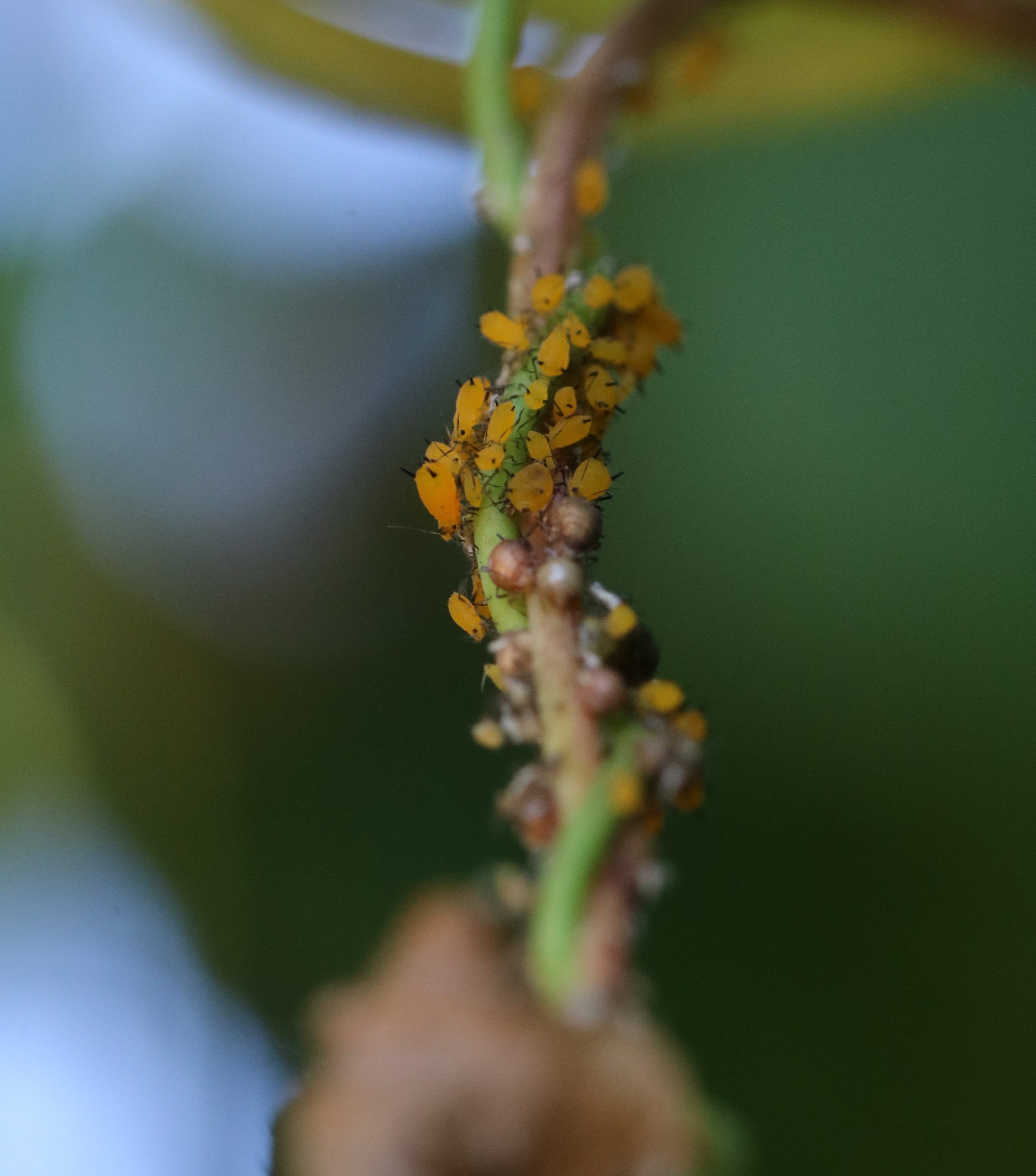
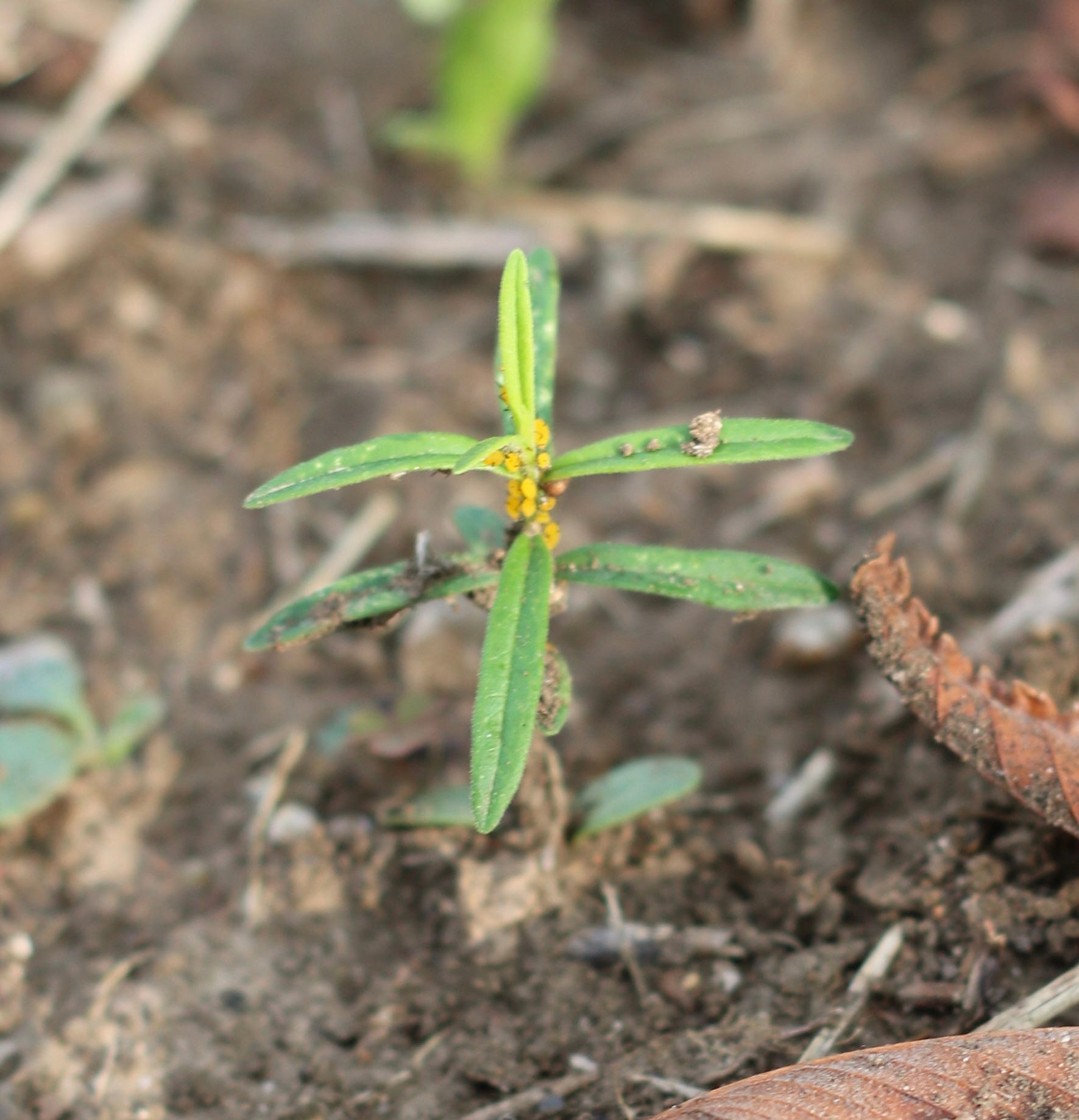
There is one photo here that is not from the garden (below) — that is of the yellow aphids, Oleander aphids. There is a small story here, which is that, if you had read my emergency garden update, you know that I was shocked to see a small milkweed plant pop up in the garden, that I had not planted. That was Honeyvine milkweed, and I thought it was a milkweed because it was covered in these yellow aphids. Well, I was standing out in my driveway talking on the phone, when I noticed a vine across the way on our fence, that looked like Honeyvine milkweed. And this is how these things go. You train your eye, and then you start to see the thing.
Well, I went over to take a look, and I thought, if it was going to be honeyvine milkweed, it should have the yellow aphids on it, right? And low and behold, it did. It was covered in them. Now I wish I would have just taken a photo of the vine as well, for you to get a good look at it, but I am not a good photojournalist. I was simply concerned with the little aphids and not the whole story.
Yellow aphids on honeyvine milkweed
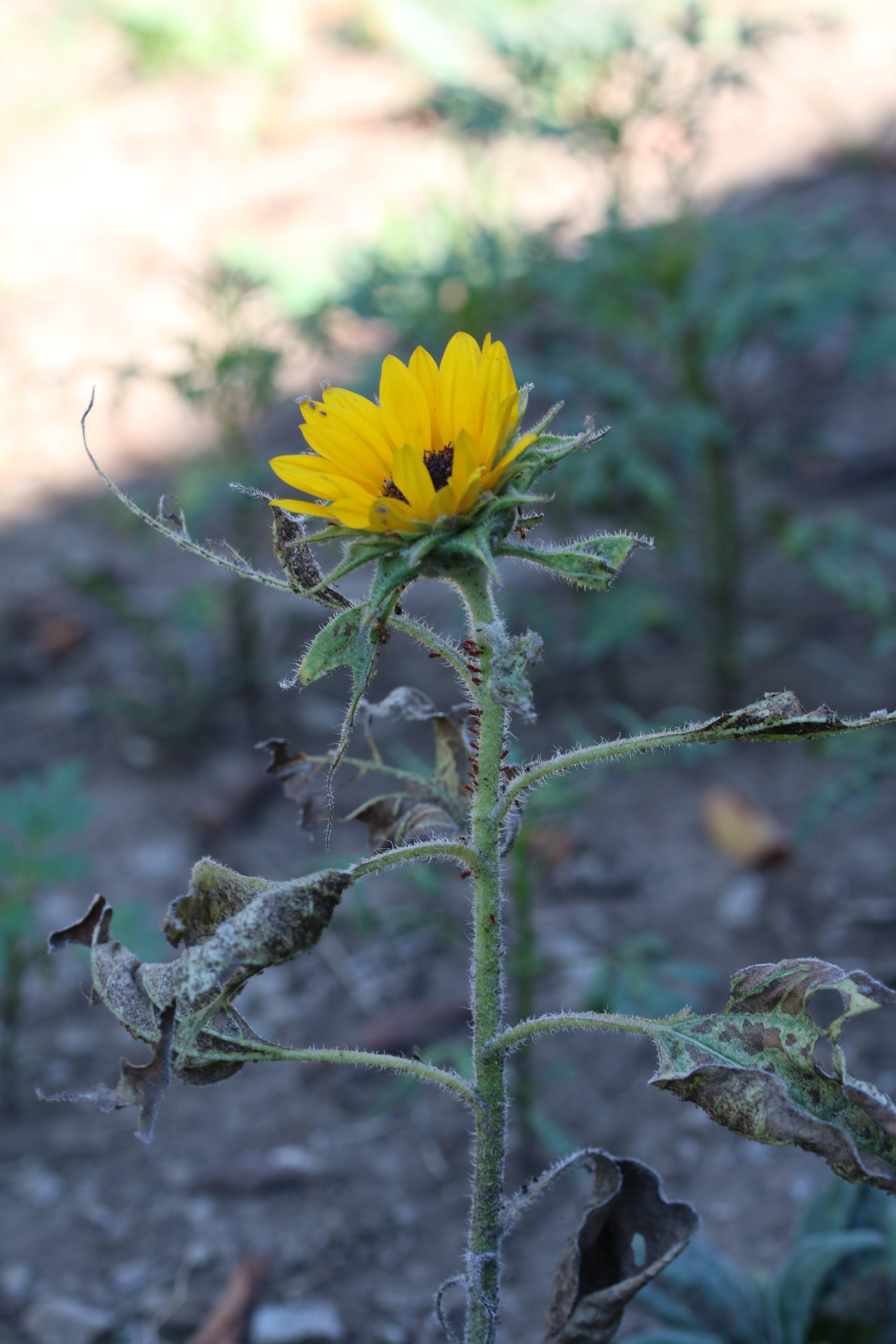
I think that photograph of the sunflower says something about desolation, and finding a way. About survival. That sunflower is clearly not thriving, beaten, bruised, crispy, wilted. It has survived two assaults by something large, having been chomped twice, and it is constantly being drained by aphids and lacewings. It has been thoroughly cooked by the sun for the entirety of its short life, two months. And yet, through all of that, it has been able to flower.
Traumatized, yes, abused, yes, but it flowered. It made it.
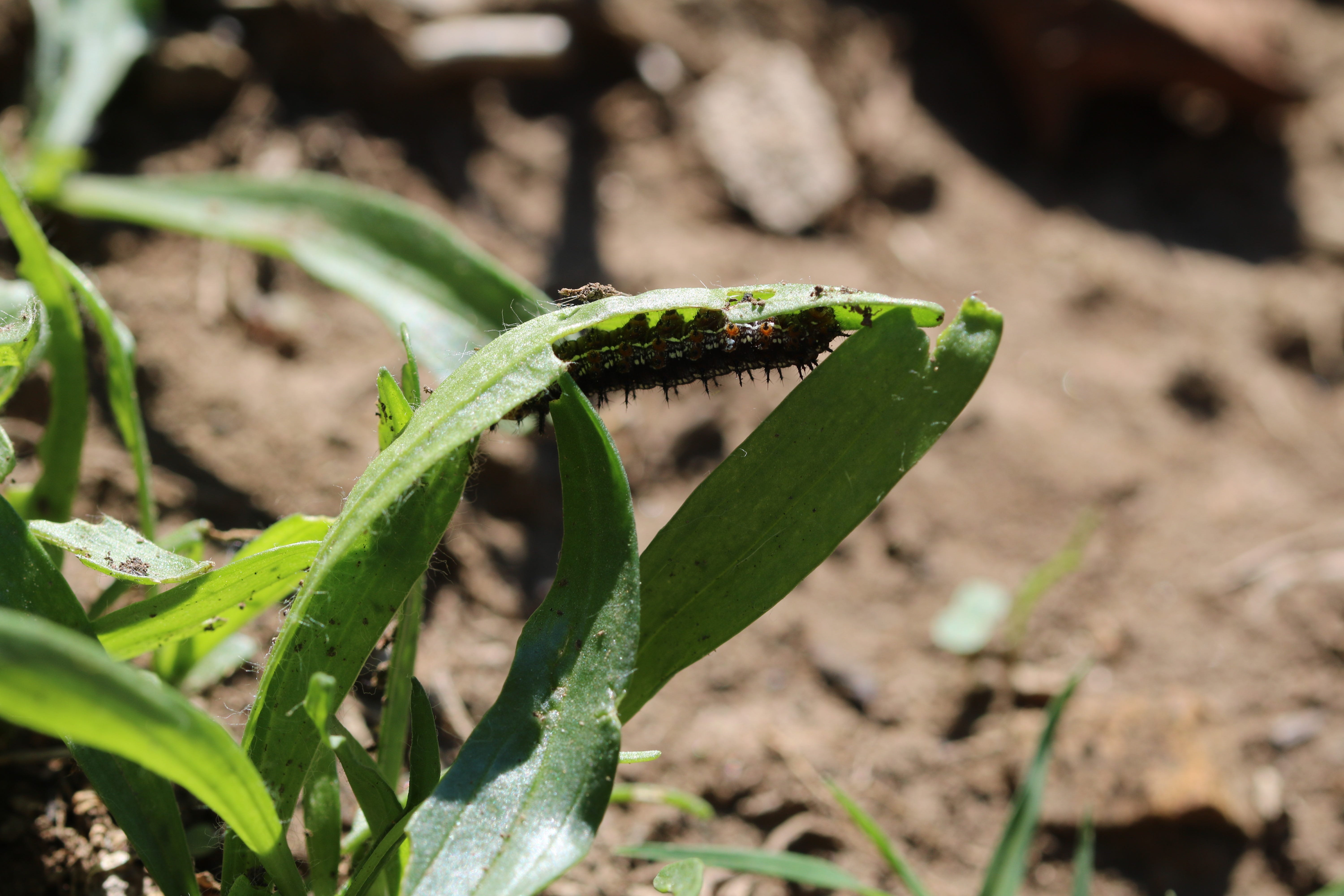
There are now five buckeye caterpillars that are chowing down on a patch of plantain weed in my garden. It’s like I have a caterpillar farm. I was wondering if they would eat the plantain weed faster than it grew, but that has not been the case. There is plenty of plantain weed to go around.
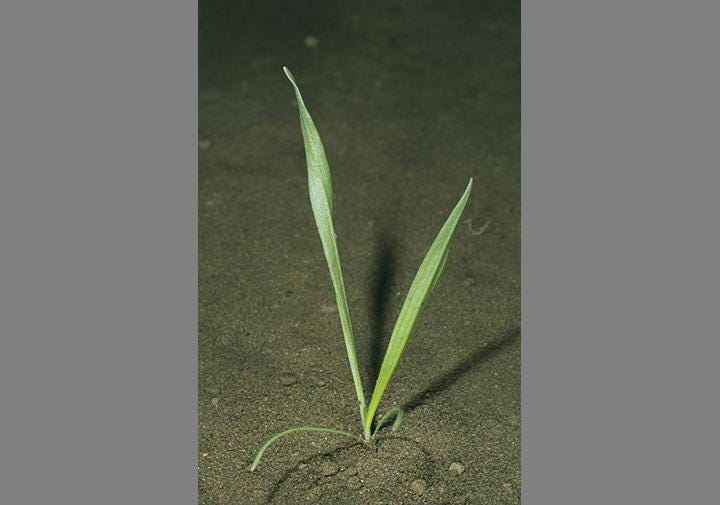
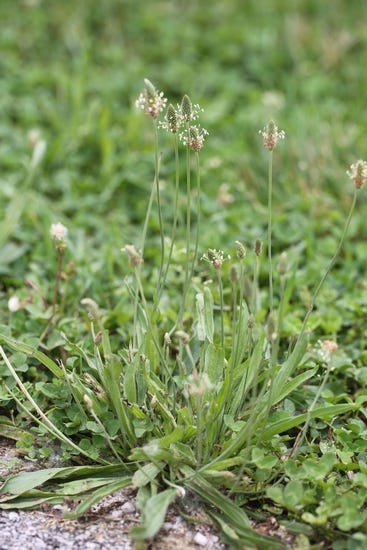
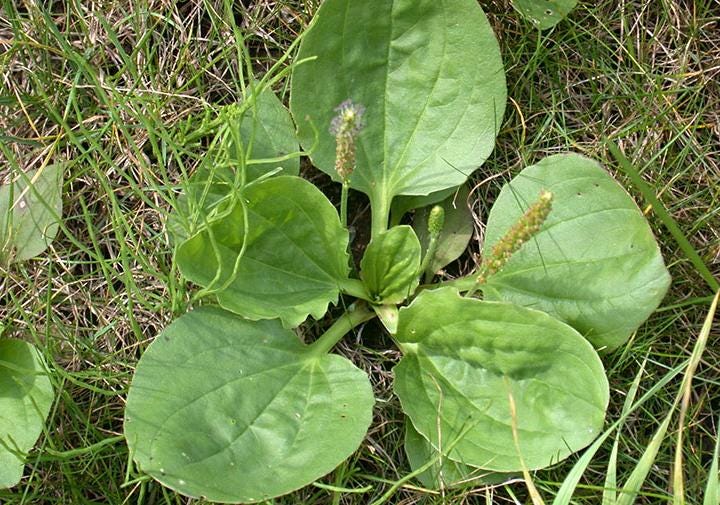
I was wondering what they were munching on, and I thought it could be a grass but it didn’t seem like it. Caterpillars don’t really eat grass, right? I didn’t think so, you don’t see it at least. Well, I looked up what buckeye caterpillars eat, and grass was not listed. So, I did some scouring, and found that these plants were plantain weed, and there are two kinds around here, buckhorn and broadleaf. And now I see them everywhere.
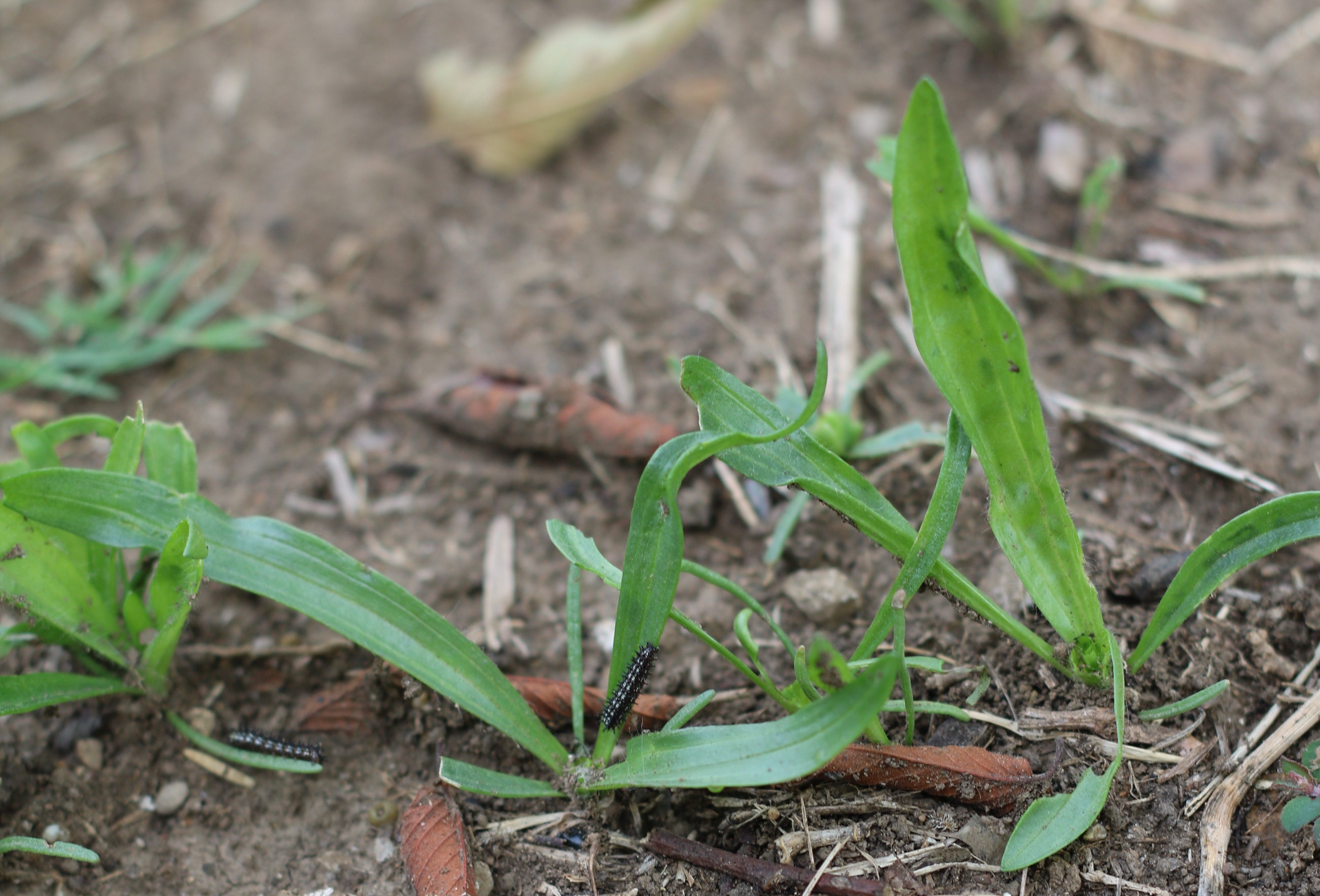
Buckeye caterpillar taking shelter under buckhorn plantain leafPhoto from just four days ago – same caterpillars on plantain weed
This photo above shows clearly the buckeye caterpillars on their beloved plantain weed. This is how big they were just four days ago. They are now about fifteen times as big. I have watched their entire journey, from little tykes to the big beasties they are now. I wonder how big they will get. They’ve gotten so big that they’re starting to hang out on the ground.
They seem to go through phases of activity. They also have good camoflauge, somehow. It takes me several minutes to find all of them. They like to hide under leaves, or at least they did, as now they’re so big I don’t think they care. It probably protects them from the sun, too.
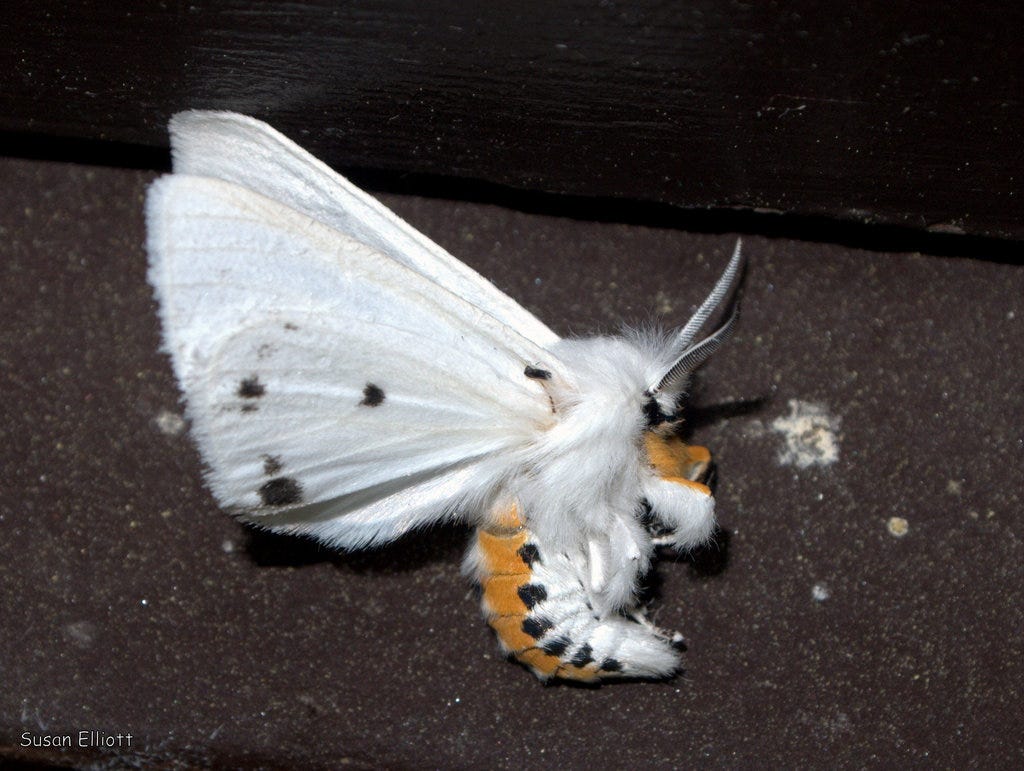
The fuzzy white caterpillar on the zinnea is a wooly bear of some kind. It looks like it is a Virginian Tiger Moth, called spilosoma virginica. It looks similar to what the pictures are on the internet. The below photo is the adult moth form.
Virginian Tiger MothBuckhorn plantain sprout
Mature buckhorn plantain
Broadleaf plantain
I see these plantains everywhere now, in the grass by Ugly Mugs, on the side of the road. Apparently they are edible and good for medical purposes. I want to try eating one.
The title says it all people. There simply must be an emergency update.
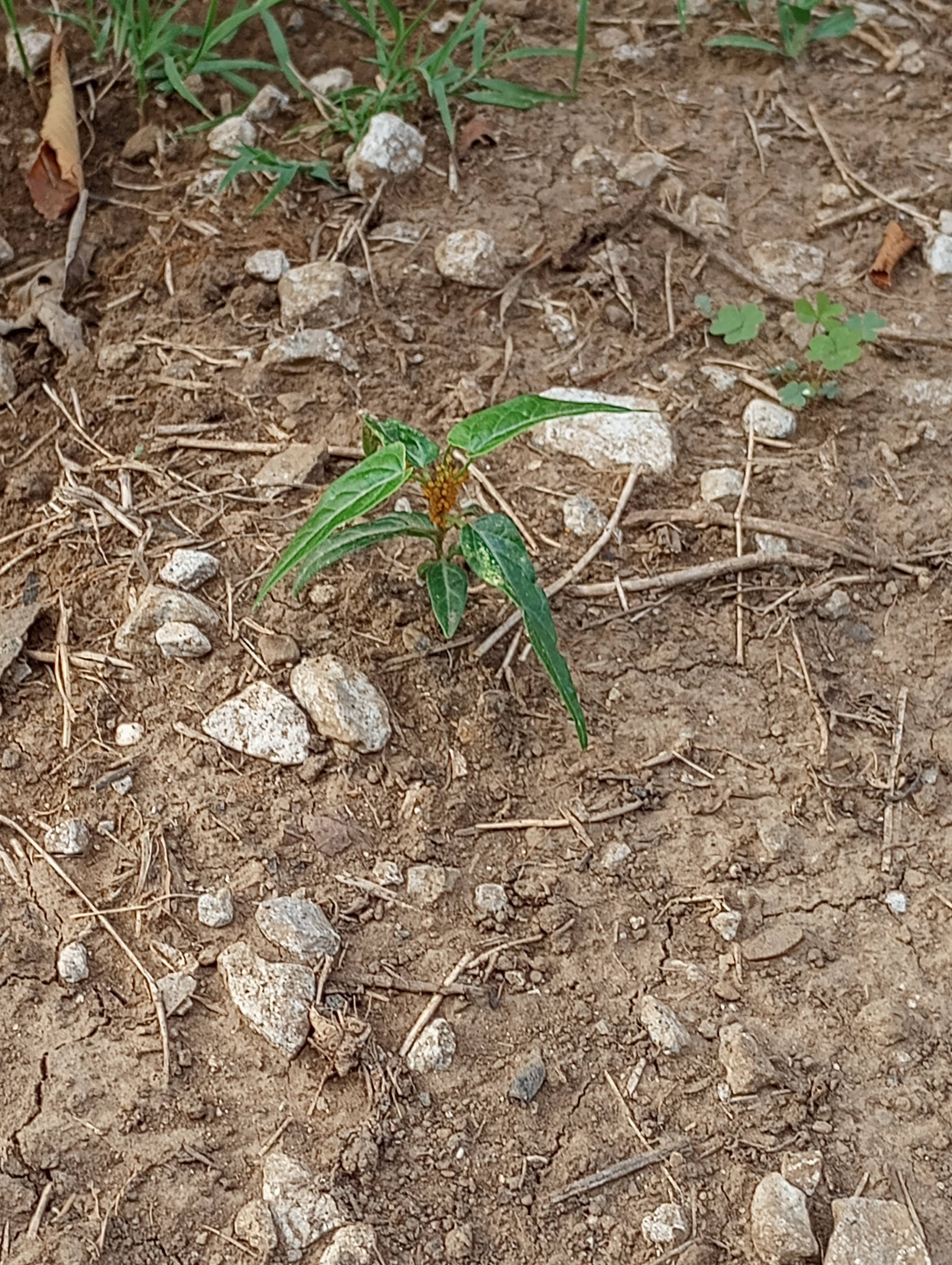
I was in my garden just now, weeding, looking over the state of affairs. Every time I do this, if I sit there for long enough, I make a discovery. Often many discoveries. Well, after about fifteen if not twenty minutes of squatting around and noticing things, I was just about to finish, when I spied something incredible.
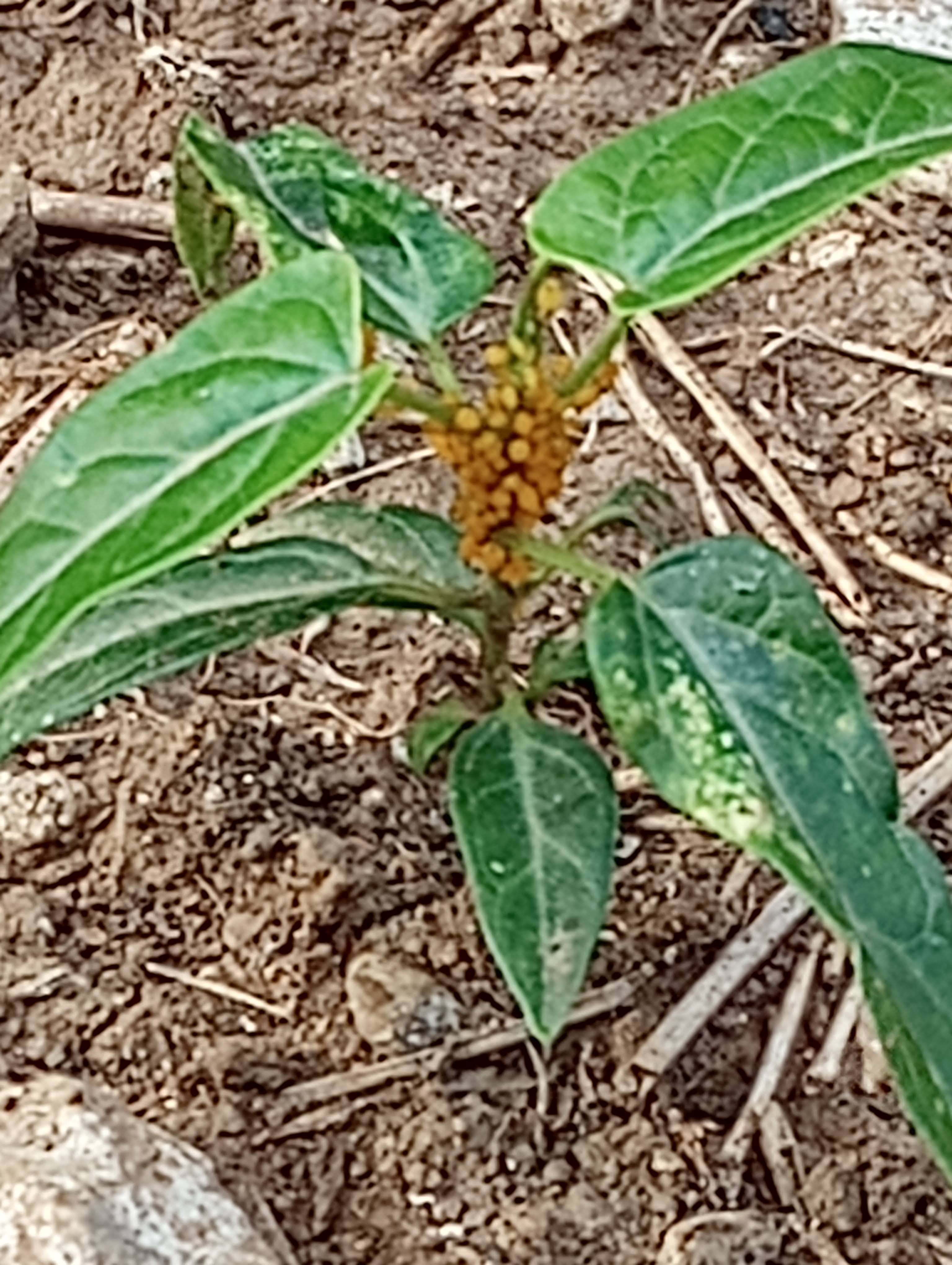
There was a plant, of strange appearance, and it had what appeared to be, those yellow milkweed aphids on it.
Did that mean… It was a milkweed?
To remind you, here is one of my butterfly milkweed sprouts with the iconic yellow aphids on it. All of my butterfly milkweed sprouts have these vibrant yellow aphids, draining them of their vital life force. I should probably take them off because I think they actually are doing damage now.
Butterfly Milkweed with yellow aphids
These aphids… oh my god!!!! Non-native!!!!!!!
Y’all.
Nature is war.
I just went outside and killed them all.
They’re from the Mediterranean. Oleander aphid (Aphis nerii). I assumed they were from ‘round here because they were also called milkweed aphids. Nope. The omnipotent internet has just revealed to me: a foreign invader.
I did what I had to do. To protect my garden. I’m sorry, aphids. I’m sorry.
It’s for the greater good.
Where are your morals now?
Am I to say who lives and who dies?
Yes. I am. For the monarchs!!!!!!
Honeyvine milkweed covered in Oleander aphids
Oleander aphids on honeyvine milkweed
Here are the photos of the mystery plant, the Honeyvine milkweed. And you can see, totally covered in the aphids.
It seems that removing them is a tricky issue because you don’t want to damage monarch eggs. Internet says you could leave them alone if the plant is able to tolerate it. Best method is to remove them by hand if you can (I could). You know these guys aren’t going anywhere. They must be here in America for good. So, just managing the population and keeping your plant healthy is the main thing, it seems.
I am shocked to have a plant pop up in the garden that is A. native and B. something I actually want to have in the garden. Welcome to the family, small Honeyvine milkweed!!!!!!










 HAKUMUSU