
Two days ago at the climbing gym, I was working my shift, doing my duty to god and country, and I decided to pass the time by reading some Legend of Sleepy Hollow by Washington Irving on Project Gutenberg.
(If you do not know about Project Gutenberg — it is an amazing resource. You must know about Project Gutenberg. You can read all the classics, for free, online in your browser or via your Kindle. This is an incredible thing and I have read countless classics via Project Gutenberg, including Sherlock Holmes, Sleepy Hollow, Ben Franklin’s autobiography, many old Greek philosophical texts, Voltaire’s Candide, and Alice’s Adventures in Wonderland.)
I was in the first few paragraphs, when I read something that was very interesting. Here is a snippet of the passage:
“The whole neighborhood abounds with local tales, haunted spots, and twilight superstitions; stars shoot and meteors glare oftener across the valley than in any other part of the country, and the nightmare, with her whole ninefold, seems to make it the favorite scene of her gambols.”
The Legend of Sleepy Hollow is from the late 1810’s, and it’s interesting to read these old books and stories and see how the language has changed, and so rapidly. You see that he uses ‘oftener’, which today would be considered incorrect, and is not used. We would say, ‘more often’. But the real interesting part of this passage was for me, at the end.
“…the nightmare, with her whole ninefold, seems to make it the favorite scene of her gambols.”
What do you mean her? Who is the nightmare? Irvine is clearly depicting the nightmare as some kind of female entity. What does that mean? I didn’t know anything about that. The closest image or association I have with a nightmare creature is the image of a horse from a Magic: The Gathering card, called nightmare. And a ‘mare’ is a female horse, in today’s language, so is a nightmare then some kind of wicked, female horse?
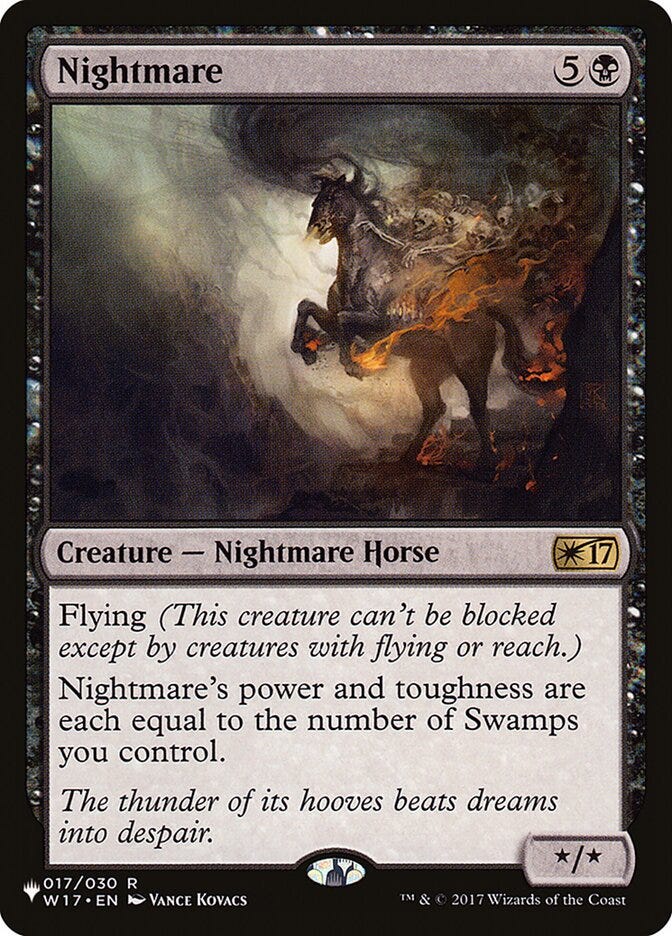
I never knew about this, and so I had to do some Googling. According to Wikipedia (I know you’re not supposed to cite this, okay):
“The word nightmare is derived from the Old English mare, a mythological demon or goblin who torments others with frightening dreams. The term has no connection with the Modern English word for a female horse.[5]”
A mare is a “mythological demon or goblin”! Now, who knew that? And that’s where nightmare comes from. It has nothing to do with the female horse, so says Wikipedia and whoever who the article.
More, from Wikipedia: “Originally, “mare” or “nightmare” referred more specifically to sleep paralysis, in which an experience of terror and paralysis during sleep can be associated with a sense of pressure on the chest and the dreamed presence of entities often pictured as demons, sometimes sitting on the chest. The words also referred to such a “demon,” which was also referred to as a hag and the experience as being “hag-ridden.” The meaning of “nightmare” had generalized from sleep paralysis to any bad dream by 1829.[1]”
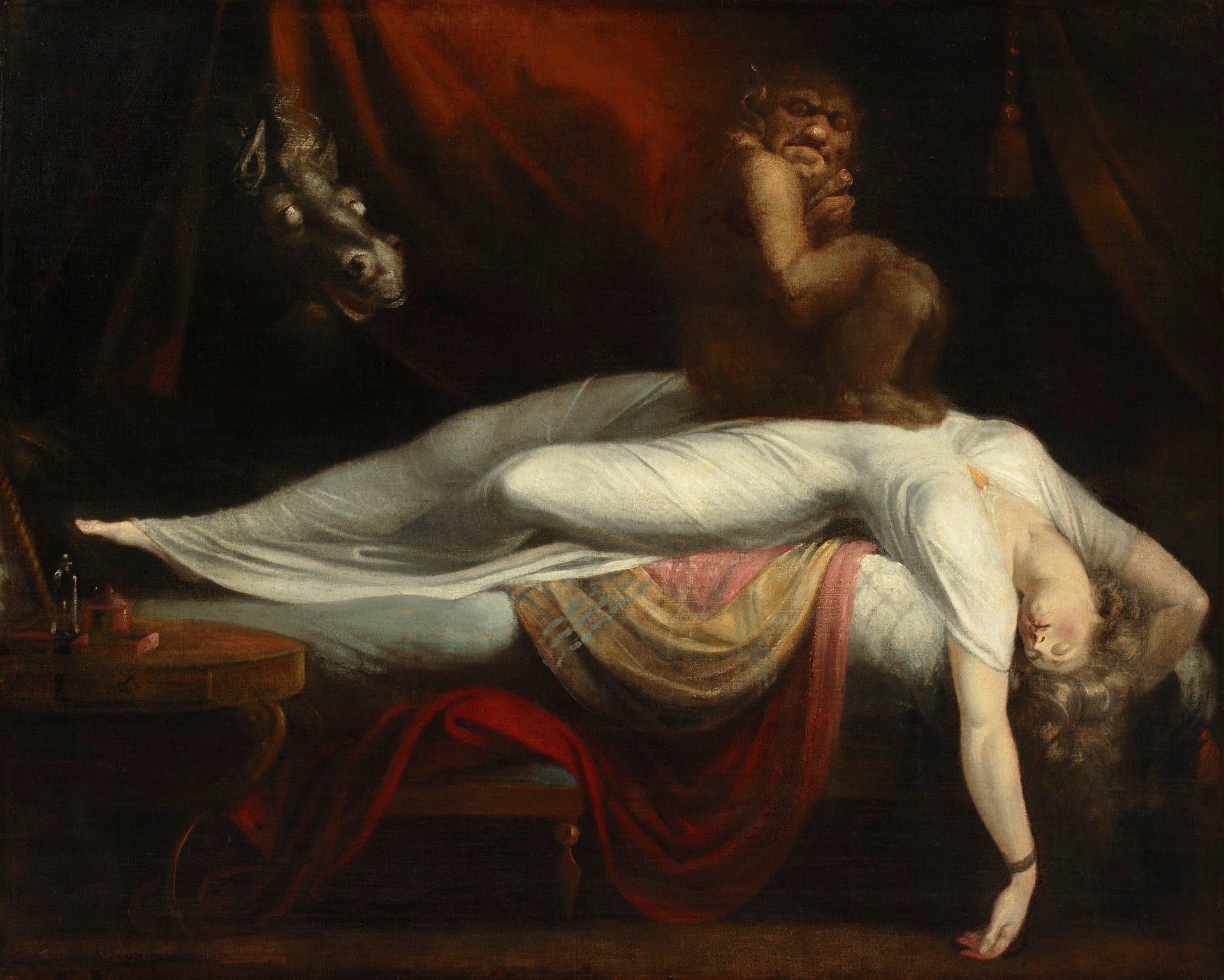
This painting is from 1781. This is what was in their minds, regarding nightmares, at this time. That certainly looks a goblin/demon creature to me. And interesting how there is a creepy horse-ghost in the background. Pretty freaky.
Interesting that the word originally referred to sleep paralysis, before becoming broadly applicable to bad dreams. It makes sense though, because you actually see some evil stuff when you’re having sleep paralysis. I’ve only had it once in my life, when my roommate Adam suggested that I take a melatonin to help me sleep as he did. That night, I ended up having a crazy bout of sleep paralysis, turned sideways, unable to move, and seeing a large, black demon in the corner of the room. After that night, I said Adam, I’m never taking this shit again. That was too freaky.
I think it’s weird that I actually didn’t know about a mare, and never thought about why we say ‘nightmare’ at all. When did the concept of a ‘mare’ get lost? That’s a fun thing to think about. Why haven’t I known about the ‘mare’, sitting on my chest and causing me to have bad dreams? Is that lore gone from our common modern consciousness? Do the older folks know about it?
As I was inn the midst of my ‘nightmare’ investigations, some young lads entered the gym and were checking in at the counter. On the second monitor, my screen was open to the ‘Mare’ Wikipedia page, and one of the guys notices this, seeing that I was deep-diving on Wikipedia, and said, “What are you researching over there?”
I immediately launched into this tale, as I am writing for you, about reading Sleepy Hollow and discovering the interesting line about the nightmare, reading about the origins of the word, finding out about the ‘mare’, (everything I had learned in the last five minutes) and man — these guys were a perfect audience. They were listening with total, rapt attentio, and so I gave them the full scoop. The guy who had originally asked about the Wikipedia page, he said, “So it’s like sleep paralysis.” And I hadn’t even mentioned yet about how the word ‘nightmare’ originally referred only to sleep paralysis, and I said, “Yeah, that’s exactly right!!” and then proceeded to recite more info from the Wikipedia article. It was a wonderful mini-lesson of the etymology of the word ‘nightmare’ that we had over the gym counter check-in right there, and I thought, after they had walked away, and reflecting on how much I had just been geeking out there, “Man, I really am a nerd.” But they thought it was cool.
Now, it gets even juicier than this, people. After learning about the mare, and nightmare and her gambols, I went back to Sleepy Hollow, and read that line again. And then I saw something else that needed to be investigated, which was “her whole ninefold.”
“…and the nightmare, with her whole ninefold, seems to make it the favorite scene of her gambols.”
Okay, so the nightmare is a female hag, demon, devil spirit. Now we know. But what is her ninefold?
We are digging up some very ancient lore here. Apparently this goes all the way back to Shakespear’s King Lear. (From the 1600’s.) A line from the character Edgar:
“This is the foul fiend Flibbertigibbet. He begins
at curfew and walks till the first cock. He
gives the web and the pin, squints the eye, and
makes the harelip, mildews the white wheat, and
hurts the poor creature of earth.
Swithold footed thrice the ’old,
He met the nightmare and her ninefold,
Bid her alight,
And her troth plight,
And aroint thee, witch, aroint thee.”
(The foul fiend Flibbertigibbet? What an incredible name.)
It seems that the nightmare’s ninefold is a bunch of evil creatures, spirits and hooligans that hang out with the nightmare and do evil with her. This picture is by Arthur Rackman, and shows us exactly what the nightmare and her ninefold are all about.
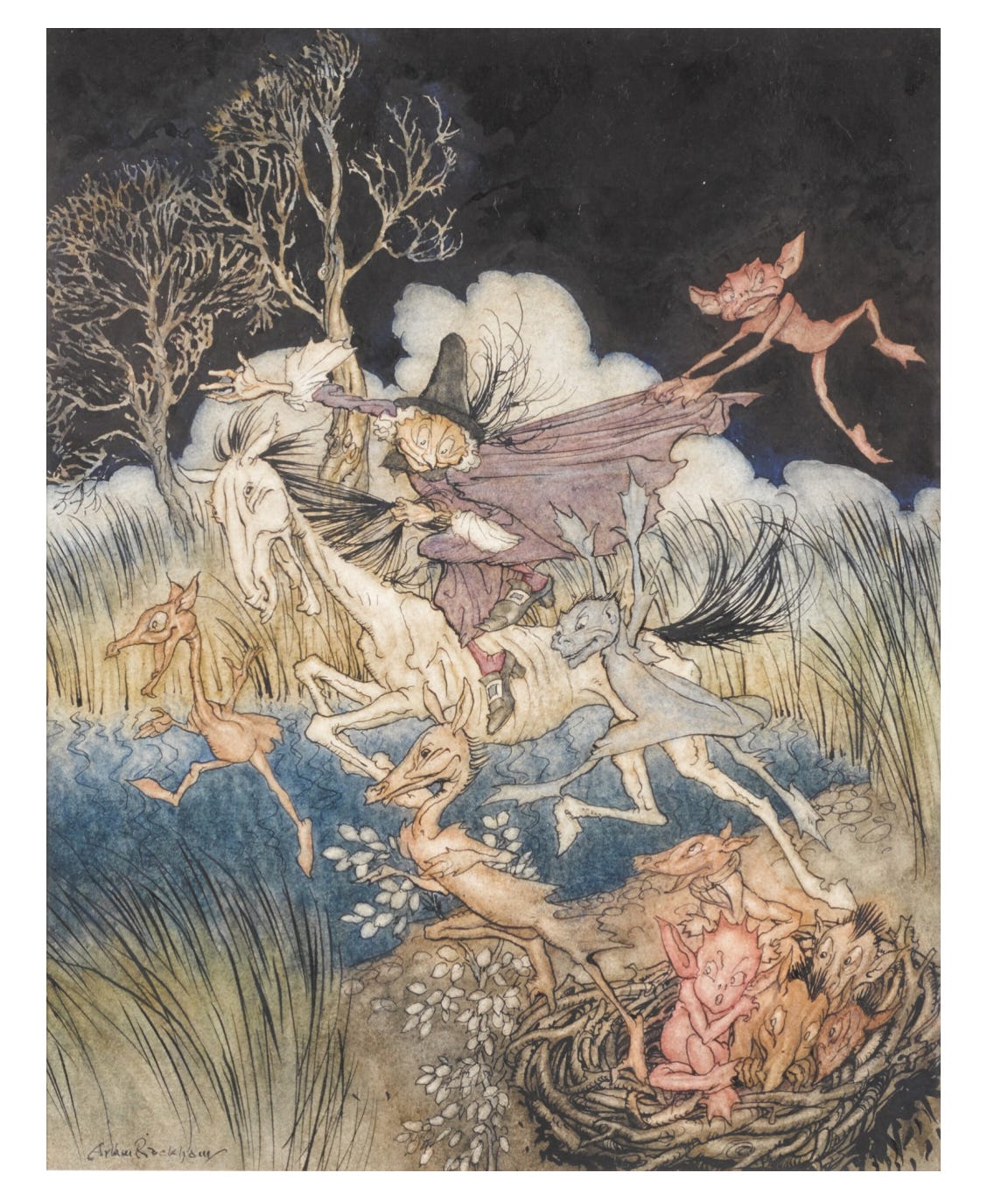
I think horses must have something to do with a nightmare. They made a Magic card called Nightmare that is simply a demon horse, and there’s a spooky horse spirit in the above Henry Fuseli painting from 1781, and the hag is riding a horse here in this Arthur Rackman illustration. The Legend of Sleepy Hollow is about a ghostly horse-rider. Surely all of this horse association is not just coincidence.
I’m glad to know about the ‘nightmare’, now. I feel like it’s something of an evil tooth fairy. I’ll be thinking about this spirit, whenever I heard about nightmares again. The nightmare, and her ninefold.
 HAKUMUSU
really interesting!! I enjoyed learning about this and thanks for finding the art to go with it! I never knew any of it! —M