
Josh and I have a new roommate in the 805B household. SHE very clearly does not have antisocial personality disorder, and is not only just a normal person, but much better. She’s a kickass musician. And today, she cleaned the bathtub, which was funny because before she moved in about ten days ago, Josh and I “cleaned the bathtub”, in preparation for her arrival. So we thought we did. Our new roomie, Hope, showed us today what a clean bathtub really looks like. That bathtub was brand spankin’ new. She described the various colors of sludge that were dripping off of her sponge, as she squeezed out the remnants of what she had sponged up in her scrubbing, she educated me on the various cleaning products she employed, her weapons in the fight against the grime, and I listened, I nodded, I looked, and commented, “Man, I didn’t think it was that dirty!” And she said, “It’s your boy blindness.” Boy blindness! My god, are we blind? But we must have been, to think that our bathtub really was clean.
Last night Hope was crocheting, which meant that she wasn’t going anywhere anytime soon, and her ears were free, which meant that she was a perfect target for me to tell stories too. I had tried, many many times to tell stories to Josh and He Who Must Not Be Named (ex-roommate), and never succeeded. (Update: only several days after this post was written I successfully read Josh not only one, but TWO stories: The Sagacious Monkey And The Boar and The Goblin Of Adachigahara. I was up late, creeping, and Josh came out of his room distressed because he was unable to sleep. He has recently been having trouble sleeping. He was so desperate for reprieve that he consented to storytime, and as he laid on the couch and I read him these stories, I noticed that he was vaping furiously. I commented on this and suggested that maybe it wasn’t helping him sleep. Actually, I said something like, “Vaping??? Before bed??? Sleep problems???” It became a gag in the house actually, especially when He Who Must Not Be Named‘s best friend for life that he met a few weeks ago (but we don’t know the truth, perhaps they have known each for years) was over, and I would go into my room, and grab Grimm’s Fairy Tales or Japanese Fairy Tales, and begin reading, and bestie would start laughing, and He Who Must Not Be Named would be triggered and shout “Put that f****** book away right now and don’t read another word.” Actually he would say something more creative and inventive than that, but sadly I’m not able to imitate him. He had a special and charming way with words. But in case you were thinking I was harrassing the poor girl, I was not, and asked her first if she would like to hear a story of my Fortnite escapades, that had happened earlier in the day, and she said she would like to hear it. I will tell it to you now too because it is a good story, and it should be forever immortalized in binary.
Fortnite is a Battle Royale game. That means it’s like the Hunger Games, where everyone has to kill each other and one person is left standing. There is a variant of the game where you can have a squad, which can be up to 4 people. You and your squad are on a large island, running around and picking up weapons and things, and building ramps and platforms and walls, and trying to kill everybody else and be the last squad standing. They actually call it “elimination” in the game, and when you eliminate somebody, they get teleported away by a little teleporter machine. So, you may be comforted to know that actually when you shotgun someone in the face at point blank, or mow them down with your submachine gun, they aren’t actually dying, just being eliminated.
I joined up with 3 random people, and this was my squad. I am not good at the game but I have good tactics and decent reflexes. I can beat the average gamer but not beat anyone who actually knows how to play the game. My moments of glory are few and far between. But on this day, I had what was shaping up to be my most incredible moment of glory ever. My squad had made it all the way to end, fought and ran and battled our way through, until we were against one other squad. I had with me one partner left at this point, and we were separated, and they got taken out. I was the last man standing for my squad. The map is shrinking now, because of “the storm”, that constantly closes in on the island, and gradually forces everyone into a smaller and smaller space. The players left in the game were now all cramped together – there’s no running, except there is hiding, because you can build walls and stuff to protect yourself, or to build a tower and go high up above everyone, but that’s hard to do if you suck at the game. Anyways, it was just me and three other people left. I was in a decent position on top of the remnants of some fort that someone else had made already. In this fort, there were a few weapons. I picked up a sniper rifle, and immediately after that, spotted at some distance away a player under a tree. I looked down the scope, lined up the shot, sniped them, boom, they went down. Already, me landing the shot was a big deal. When a player “goes down”, they can crawl around pathetically like a little baby on their hands and knees, and can be revived by a teammate for a short time, and if they aren’t shot again. A teammate came to revive this player that I had sniped, and did not protect themselves by building walls around themselves (a bold move), and was further disrespecting me by wildly spinning in a circle as they stood next to their teammate (like this was a game or something), so I looked down the scope, lined up the shot, and sniped them too. Boom, they went down, now two players down, crawling around on the ground like babies, and suddenly, in mere seconds, what was a 1 v 3 was now a 1 v 1. There was just the third player to worry about, and sure enough, just like the second player ran up to their downed teammate, the third one came running up too. They were however, lucky enough to be standing behind the tree, obscured, unable to be sniped, and in a flash I realized what I had to do. This was my moment of glory. I was running on instinct now.
My final victory move required to me to use an item called a shockwave grenade. The shockwave grenade will send out a concussive blast that will not hurt you but will blow everything around you apart, and will send you flying in the opposite direction relative to where the grenade is. Players use this blast to launch themselves over to enemies and surprise them, or to blast away to safety. I was going to now do the super-pro Fortnite shockwave grenade move where you launch yourself over to where the enemy is, and blast them in the face with your shotgun. I have been on the receiving end of such a move many, many times. It hurts. You’re cowering in fear, maybe you’re reloading, trying to revive a downed teammate, praying for escape, when you hear the sound of the shockwave grenade going off, or (another nightmare sound) you hear the sound of the enemy using their plunger gun to pull themselves over to you, signaling your doom. The enemy player then comes soaring down out of the sky and guns you down with a shotgun blast to the face. As I said, I have been “eliminated” in this way many times before.. But now the tables had turned. I was to be the grenade user, to be the hunter, the doombringer, here and now.
I prepared my shockwave grenade. All three of my eliminated comrades were watching me, all three of them witnessing my sniper prowess, I’m sure sitting up in their chairs, throwing their hands up, screaming “Yes! He’s doing it, he’s doing it!!!”, praying for me to bring home the #1 Victory Crown, and now they were about to see my true power. I began to run forward, building momentum, and then I threw the shockwave grenade down, to launch myself across the ditch and over to that final opponent, and when I threw the grenade, I threw it too far out in front of me, not giving myself enough time to jump in front of it, and it detonated and threw me 100 feet backwards, in the opposite direction of my doomed enemies, and directly into “the storm”. I was eliminated immediately. The game was over. A big #2 came up on the screen.
This Fortnite failure, to put it into perspective for you, if you’re still not getting it, was like having an open dunk, a runaway dunk for the game-winning basket, that will give you the 2 points you need to win the game because you’re down one. There’s a second left on the clock, and you run up to dunk the ball and win the game and achieve the greatest glory, your hero moment, and when you jump up to dunk that ball and become a total legend, you hit your head on the rim of the basket and knock yourself out, and lose the game. To the shock and horror of your team, of all of your fans, and to the joy and jubilation of your rivals.
This is exactly what happened in my tragic game of Fortnite.
After the telling of this Fortnite story, I asked Hope to rate the story. Her feedback is important for me to better calibrate my storytelling algorithm for her, giving her the high quality stories that she needs and deserves. Hope, for knowing almost nothing about Fortnite, rated this story an 8/10. I was quite surprised at this high rating. Feeling embolded, fired up with this quite high rating of what I felt was, while a good story, a simple gaming tale, I proceeded to tell her another story, the great story of when my Grandpa came down into the basement to avoid the rest of the family at a family gathering (actually he just wanted to chill with the coolest member of the family) and watched me fight an enormous demon-wolf-girl to the death, an extremely difficult boss that I had been trying to beat for weeks in Bloodborne, and how amused he was by this, and she rated it 9/10, because it had a Grandpa in it, and because even though he might not have really known what it was all about it, he was still proud of me for defeating this demon-wolf-girl. Hope has a good rating system. And the third story I told her then, this was a very important part of calibrating the stories for her, in the story-telling algorithm, was the famous Japanese fairy tale that nobody knows, The Jellyfish and The Monkey, and Hope rated that story a 10/10.
A 10/10! This is a good new roommate we’ve got here.
The other bit of writing I wanted to do in this post was inspired by a story that Hope told me recently. I had this thought when talking with my sis about her friend texting with a guy, and how he sent her some poetry, and she didn’t know how to respond, so she asked all of her friends about it. They analyzed it together. “Why did he send this?” “What does it mean?” “What should I say back?” These kinds of things. And I thought, especially because he had actually sent her poetry, that it was just like what happens with the poetry exchanges in many of the stories in the Anthology of Japanese Literature. These are snippets of stories that are all written in the early days of Japan, around 1000-1300 (the ones that I will reference), and many of them deal with romance and courtship, and escapades. In almost every story about romance, the initial courting is done via exchanging messages of poetry, through a secondary person, like a servant or friend, and friends, members of the court, servants, etc. are consulted in the analyzing of the meaning of the poems and messages, and in the response. It’s a team effort, and it’s just like what we do nowadays, over dating apps and iMessage. I’ll give you some examples.
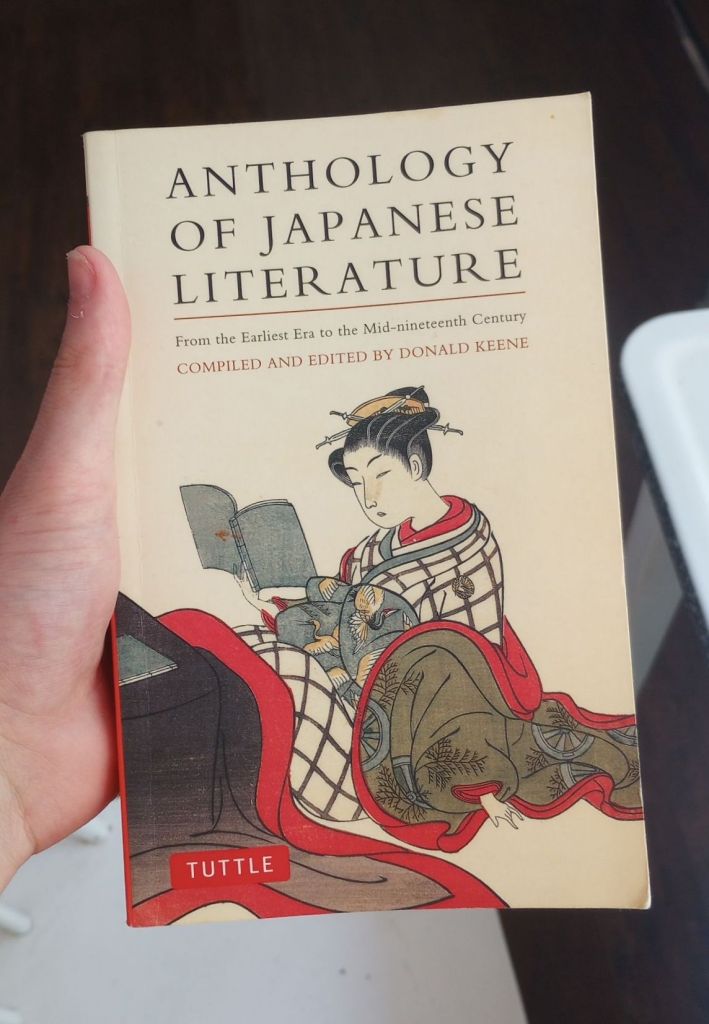
From The Captain of Naruto (late 13th century):
(Context: The emperor sees a pretty lady and wants to get with her.) The Emperor summoned a secretary, instructing him to follow and report the lady’s destination. When the secretary had overtaken her, the lady who understood and meant to mislead him somehow, beckoned him to draw near, and with a smile said, “Tell His Majesty, ‘Of the young bamboo.’ I will wait here, I promise, until I receive his reply.” The secretary, never dreaming that she might deceive him, assumed that she merely wished to arrange a rendezvous and hurried away. The Emperor, on receiving this report, felt certain that she had quoted a line from a poem and inquired what it might be. None of those in attendance, however, were familiar with it, and Lord Tameie was sent for. “It is an old poem,” he said without hesitation.
“Tall though it be, what can one do with the useless lengths of the young bamboo with its one or two joints?”
The Emperor is smitten, and has his secretary track down this woman. He sends her his reply via a letter.
“Was it an empty dream or did I really see the young bamboo, that morning and night I yearn for with a love that is torment? Tonight without fail.”
In response to this letter, the woman replies (she’s not happy because she’s married and doesn’t want to meet the Emperor (hence the sobbing), but her husband (the Captain) thinks she should as they kind of have no choice, because, you know, he’s the Emperor). Sobbing, the lady opened the letter, beneath the words, “Tonight without fail,” wrote in thick black ink the single word “wo”, and refolding the letter sent it by the messenger.
The Emperor does not understand the meaning of this mysterious single wo, and again consults his team of specialists to help shed some light on it.
The Emperor, seeing the letter returned, and no different in appearance than before, was about to conclude reluctantly that it had been without effect, when he noticed that the knot was carelessly tied. He undid it and beheld the word, “wo.” Ponder over it as he would, he could make nothing of it. He summoned several ladies-in-waiting who would be likely to know and asked them about the word. One of them said, “Long ago a certain prime minister wrote the word ‘moon’ and sent it to the daughter of Izumi Shikibu, a lady well versed in such matters. She may have spoken of it to her mother, for she readily understood and wrote beneath ‘moon’ the single word ‘wo.’ That is the allusion, I imagine. ‘Moon’ meant that he would be waiting that night for her to come. And in answer to a summons from above, men should reply ‘yo,’ while women say ‘wo.’ The lady went to him, and he was more in love with her than ever. This lady too will surely come.”
She did go to see the Emperor, and the Emperor loved her, and she wasn’t happy about it, and the Captain (her husband), received great honors and favors afterward. And this story actually comes with a rare explicit moral, which the author writes out at the end.
A prince is to his subjects as water is to fish. However high the prince, he should not be guilty of arrogance or contemptuousness; however low his subjects, they should not be disordered by envy. Emperor Gosaga’s gracious feelings and the Captain’s generous sacrifice in the present story deserve to be remembered as examples of truly noble conduct. It is indeed natural that from the earliest times it has ever been said that between the prince and his subjects there should be no estrangement, but bonds of deep sympathy.
Notice that there is no mention of the wife’s sacrifice, the wife who was kind of blackmailed into getting it on with the Emperor against her will…. Nice.
When Rachel told me about her friend’s story of having the poem sent to her and all of her friends trying to understand what it meant and how to respond, it made me think of these poetry exchanges like in The Captain of Naruto, where the Emperor literally does the exact same thing, summoning his ladies-in-waiting and having them analyze the poem that the Captain’s wife sent, and what it meant. And I just think it’s amazing that 1000 years ago, in a completely different society, and 1000 years into the future, with different technologies, in an entirely new society, we are doing the exact same things. These moments of realization, that humans still be doin’ the same things they’ve always been doin’, is one reason why I love reading old literature so much. Some things never really change. Don Quixote really made me feel that way, because of the humor. Everyone siding with a crazy person (Don Quixote) and deciding to pretend that a sink basin is a famous magical helmet to mess with the owner of the sink basin (who is arguing that his sink basin is not a magical helmet), was funny 500 years ago in Spain, and it’s funny now, 500 years into the future, in Tennessee. That’s just funny stuff.
Only a few days after learning about the sis’s friend story of the guy sending the poetry, Hope shared with me another similar story that actually ended in success. She helped her best friend to land her current boyfriend, because of her tactful message writing on Hinge (a dating app). Hope’s friend had matched with a guy she was interested in, who was a chef, and had written on his profile, “Just a chef looking for his server.” Something like that. Now, the friend wanted to write a message in response to this line, but didn’t know what to say, so she went to Hope for guidance, and Hope came up with a great line. “I may not be a server, but I know how to serve.” Good line, right here. Serving is modern slang, like stunting, or flexing. Looking good. This guy responded with something about making dinner for Hope’s friend, and again Hope had another stellar line. “You bring the dinner, and I’ll bring the dessert.” And the rest was history. They met and are now dating.
Hope told me this story and again I was thinking, this is just like how it was done in the old Japanese days, except it’s with phones, over dating apps. This back and forth, wordplay, banter, via writing, curating the perfect message, asking your team for help, your girls, your homies, analyzing the meaning of the messages.. They be doin’ all that stuff in Japan a thousand years ago, and here we are in the 21st century, and we’re doing it still, over iMessage and Hinge. (Does anyone pass notes in the classroom anymore? That must still be happening.)
Here is another example, of courtship via poetry and writing, in The Lady Who Loved Insects (sometime before the 12th century).
(Context: There’s a weirdo girl who loves insects and natural things and doesn’t like to blacken her teeth because she thinks it’s unnatural. Blackening your teeth with iron filings was a custom in Japan back then, for whatever reason people come up with for doing something like that. I read that it turns out that it was also good for your dental hygiene, so they were really onto something there. This weirdo girl attracts the attention of some guy, and he makes her a fake snake to try and “give her a fright”, and he succeeds somewhat.)
Among those who had heard gossip about the girl and her odd pets was a certain young man of good family who vowed that, fond of strange creatures though she might be, he would undertake to give her a fright.
The girl’s family decides that because this guy went to such great trouble to create a mechanical snake for her, she should write a reply, and so she does. …taking a stout, sensible-looking sheet of paper she wrote the following poem, not in hiragana which she never used, but in katakana: “If indeed we are fated to meet, not here will it be, but in Paradise, thou crafty image of a snake.” And at the side was written: “In the Garden of Blessings you must plant your seed.”
The footnotes say that, about the Garden of Blessings line, The snake must by good behavior get itself reborn in some more dignified incarnation. And she is referring to the creator of the snake.
Now, the Captain of Horse sees the letter she wrote to the snake-maker-boy and wanted to meet this interesting bug girl. He went to the house and saw her gleaming white teeth and was scared, but oddly attracted to her, so he sends her a poem.
…using the juice of a flower stem as ink he wrote the following poem on a piece of thickly folded paper: “Forgive me that at your wicker gate so long I stand. But from the caterpillar’s bushy brows I cannot take my eyes.” He tapped with his fan, and at once one of the little boys ran out to ask what he wanted. “Take this to your mistress,” he said. But it was intercepted by the maid, to whom the little boy explained that the poem came from the fine gentleman who had been standing about near the gate. “Woe upon us all,” cried the maid, “this is the handwriting of Captain So-and-So, that is in the Horse Guard. And to think that he has been watching you mess about with your nauseous worms!” And she went on for some time lamenting over the girl’s deplorable oddity. At last, the insect-lover could bear it no longer and said, “If you looked a little more below the surface of things you would not mind so much what other people thought about you. The world in which we live has no reality, it is a mirage, a dream. Suppose someone is offended by what we do or, for the matter of that, is pleased by it, does his opinion make any difference to us in the end? Before long both he and we shall no longer even appear to exist.”
She writes back to the Captain: “By this you may know the strangeness of my mood. Had you not called me kawamushi (hairy caterpillar), I would not have replied.” And the Captain replies, “In all the world, I fear, exists no man so delicate that to the hairtips of a caterpillar’s brow he could attune his life.”
That’s some good banter right there.
There was one more example I wanted to share. This is from Yugao, a chapter from The Tale of Genji. (Context: Prince Genji is in some outskirt of the capital, in a neighborhood of commoners, visiting his old “wet nurse”, who cared for him whilst he was a young lad (he’s now 17). While looking at pretty flowers he receives some writing, is intrigued, and so is the beginning of a new amor.)
How Genji receives the first writing: There was a wattled fence over which some ivy-like creeper spread its cool green leaves, and among the leaves were white flowers with petals half-unfolded like the lips of people smiling at their own thoughts. “They are called Yugao, ‘evening faces’,” one of his servants told him; “how strange to find so lovely a crowd clustering on this deserted wall!” And indeed it was a most strange and delightful thing to see how on the narrow tenement in a poor quarter of the town they had clambered over rickety eaves and gables and spread wherever there was room for them to grow. He sent one of the servants to pick some. The man entered at the half-opened door, and had begun to pluck the flowers, when a little girl in a long yellow tunic came through a quite genteel sliding door, and holding out toward Genji’s servant a white fan heavily perfumed with incense, said to him, “Would you like something to put them on? I am afraid you have chosen a wretched-looking bunch,” and she handed him the fan.
After his visit with the nurse, Genji looks at the fan and notices the message. (I’m skipping ahead here.)
As they left the house he looked at the fan upon which the white flowers had been laid. He now saw that there was writing on it, a poem carelessly but elegantly scribbled: “The flower that puzzled you was but the yugao, strange beyond knowing in its dress of shining dew.” It was written with a deliberate negligence which seemed to aim at concealing the writer’s status and identity. But for all that the hand showed a breeding and distinction which agreeably surprised him. “Who lives in the house on the left?” he asked. Koremitsu, who did not at all want to act as a go-between, replied that he had only been at his mother’s for five or six days and had been so much occupied by her illness that he had not asked any questions about the neighbors. “I want to know for a quite harmless reason,” said Genji. “There is something about this fan which raises a rather important point. I positively must settle it. You would oblige me by making inquiries from someone who knows the neighborhood.”
Genji wonders if it was written by a woman. He writes back: “Could I but get a closer view, no longer would they puzzle me – the flowers that all too dimly in the gathering dusk I saw.” This he wrote in a disguised hand and gave it to his servant.
That’s all for their exchange of writing – Koremitsu delivers the message and arranges a meetup between them, and a new love is born. But again, it starts with writing.
I feel like this is where I could write some kind of analysis about all of this, or share some profound thoughts. I don’t really have any though. I’m just amused by the similarities. You can infer certain things through iMessage, still, just like Genji could infer from the letter he had been sent. What emojis are used, what acronyms, word choice, gifs, references, spelling, punctuation.
(I have deer photos for you from Shelby Park. That’s for next post.)
 HAKUMUSU